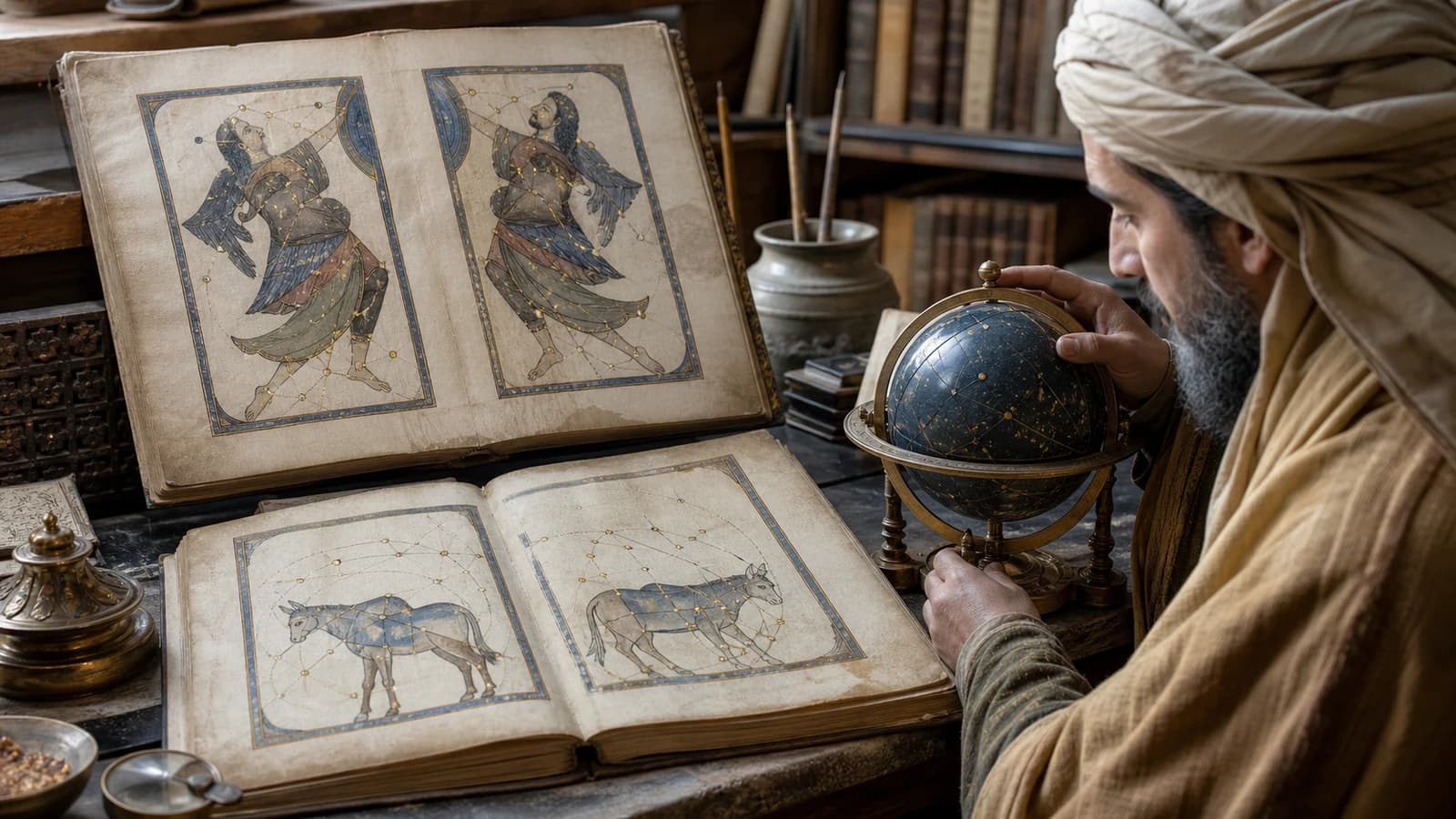
Al-Sufi’s Book of Fixed Stars: Two Views of the Sky
Why al-Sufi’s constellation figures appear in paired mirror views, how observation met Ptolemaic data, and what later manuscript copies preserve.
Abd al-Rahman al-Sufi’s Kitab suwar al-kawakib, or Book of Fixed Stars, is a tenth-century manuscript that critically engages with Ptolemy’s Almagest while integrating Arabic star knowledge. It presents constellations through dual representations: as viewed from outside on a celestial globe and as observed from inside the sky, creating mirror-image views. The work combines precise coordinates, magnitude descriptions, and constellation figures, serving as a foundational catalog for fixed stars in Islamicate astronomy.
Dual Perspectives in Representation
The manuscript’s most distinctive feature is its dual depiction of each constellation. One view shows the star patterns on a globe, oriented for an external observer, while the other shows them as seen by an Earth-bound observer looking up. This mirror effect ensures that users can identify constellations accurately regardless of their reference frame. The artistic rendering preserves the traditional figures while correcting astronomical errors found in earlier Greek texts.
- Examine the globe view to understand spatial relationships.
- Compare it with the sky view for identification accuracy.
- Note the Arabic names alongside Greek equivalents.
- Analyze star dot sizes indicating magnitude differences.
- Cross-reference coordinates with Ptolemy’s catalog.
Integration of Knowledge
Al-Sufi does not merely copy Ptolemy but critiques and expands upon his data. He includes stars omitted by the Greek astronomer, particularly those known to Bedouin astronomers in Arabia. This integration highlights the collaborative nature of Islamicate science, where diverse cultural inputs were synthesized into a coherent whole. The manuscript thus stands as a bridge between Hellenistic and later Arabic astronomical traditions.
Manuscript Transmission
Surviving manuscripts are later copies that reflect their own artistic and textual histories rather than providing transparent snapshots of al-Sufi’s original work. Variations in star positions, constellation figures, and descriptive text appear across different versions. Scholars must therefore treat these documents as nodes in a transmission chain, each contributing to the evolution of astronomical knowledge. The artistic style of each copy offers clues about its date and origin.
The Andromeda Example
The constellation Andromeda in al-Sufi’s work includes a figure of a bound woman and a cluster of stars. While later associations link this region to the Andromeda Galaxy, al-Sufi does not explicitly describe it as such. The text focuses on star positions and magnitudes within the constellation boundaries. Caution is required when interpreting these passages through modern astrophysical lenses, as the manuscript’s primary goal is cataloging visible stars.
The manuscript’s emphasis on coordinates and magnitudes makes it a critical resource for historical astronomy. Al-Sufi’s data allows modern scholars to track stellar proper motion over centuries. The precision of his measurements demonstrates the high standards of Islamicate observational practice.
Visual elements in the manuscript include detailed constellation figures that blend artistic tradition with astronomical function. These images were not merely decorative but served as aids for identification and memory. The combination of text and image creates a robust system for transmitting knowledge across generations.
The Kitab suwar al-kawakib remains essential for understanding the development of star catalogs. It illustrates how ancient Greek knowledge was preserved, critiqued, and enhanced within Islamicate culture. The work’s influence extends beyond astronomy into cartography and astrology, shaping European understanding of the night sky.
Its legacy lies in its rigorous approach to observation and documentation. Al-Sufi’s synthesis of diverse sources creates a unified picture of the heavens that transcends cultural boundaries. The manuscript stands as a monument to the cross-cultural exchange of scientific ideas in the medieval world.
The cover image is an original AI-assisted manuscript reconstruction, not a facsimile of a specific copy of al-Sufi’s Book of Fixed Stars.
Sources
- Library of Congress: Book of the Images of the Fixed Stars — digitized manuscript and catalog description.
- The Met: Folio from the Book of Fixed Stars — paired constellation imagery and object evidence.
- Qatar Museums: Copy of the Book of Fixed Stars — manuscript transmission and collection record.


