What Is a Lawh? Wooden Writing Boards for Qur’an Lessons
See how a reusable lawh carried writing, how one erased passage survived, and what handles and inscriptions reveal on six museum boards.
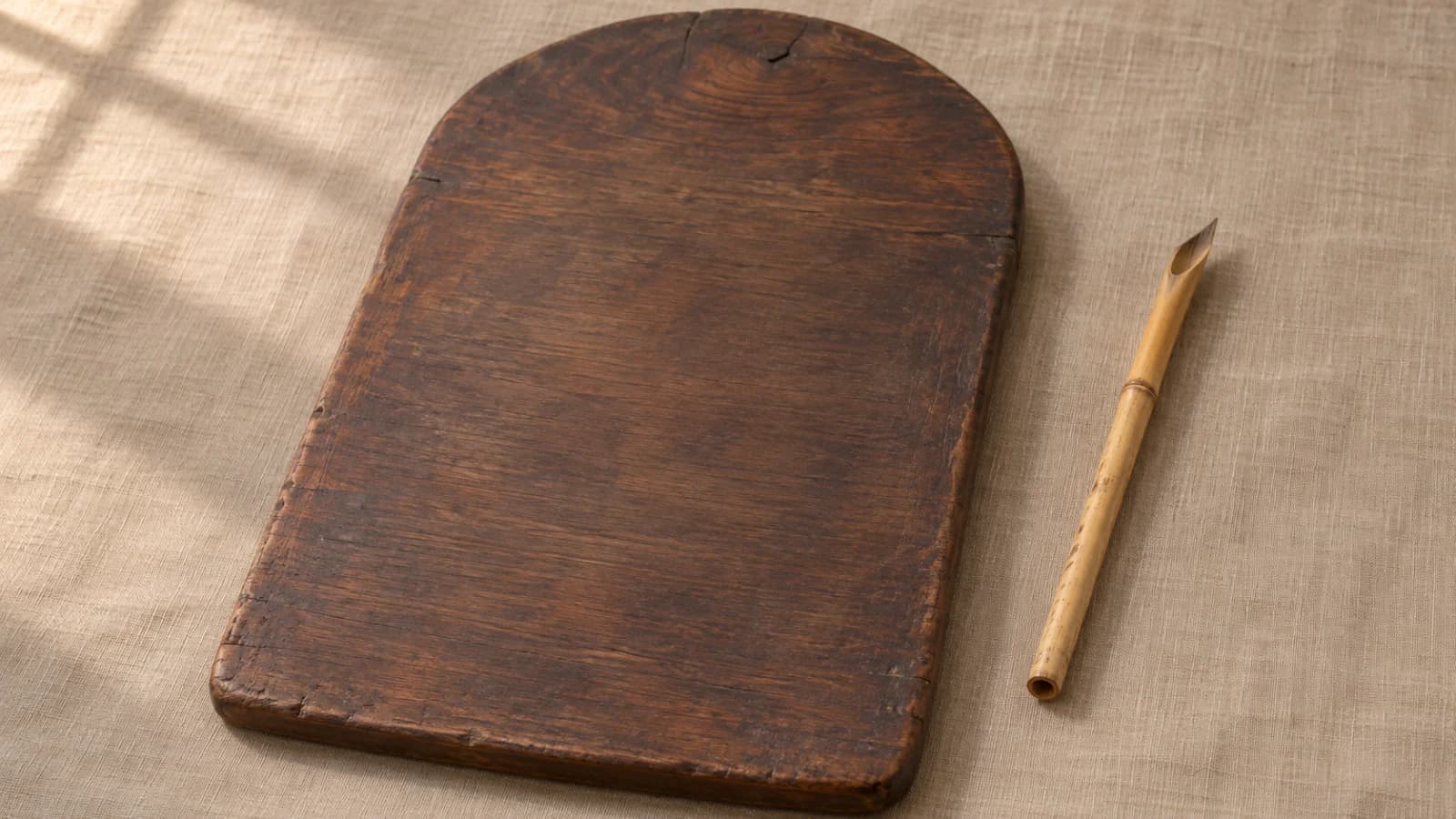
A lawh is a tablet or board. In the context of Qur’an instruction, it can mean a wooden writing surface used for a lesson. A passage could be written in ink, studied and later washed off so the same surface could hold another passage. The British Museum has a nineteenth-century board with writing and traces of an earlier erased passage. The object lets you see how more than one lesson could leave evidence on a single piece of wood.
Some collections use regional names. The Allen Memorial Art Museum calls its Hausa example an allo and relates that word to the Arabic al-lawh. Its leather-covered handle and curved base also show why the form of a board matters as much as the writing on its face. Allen Memorial Art Museum, Allo, 2002.2
How a reusable board fits a lesson
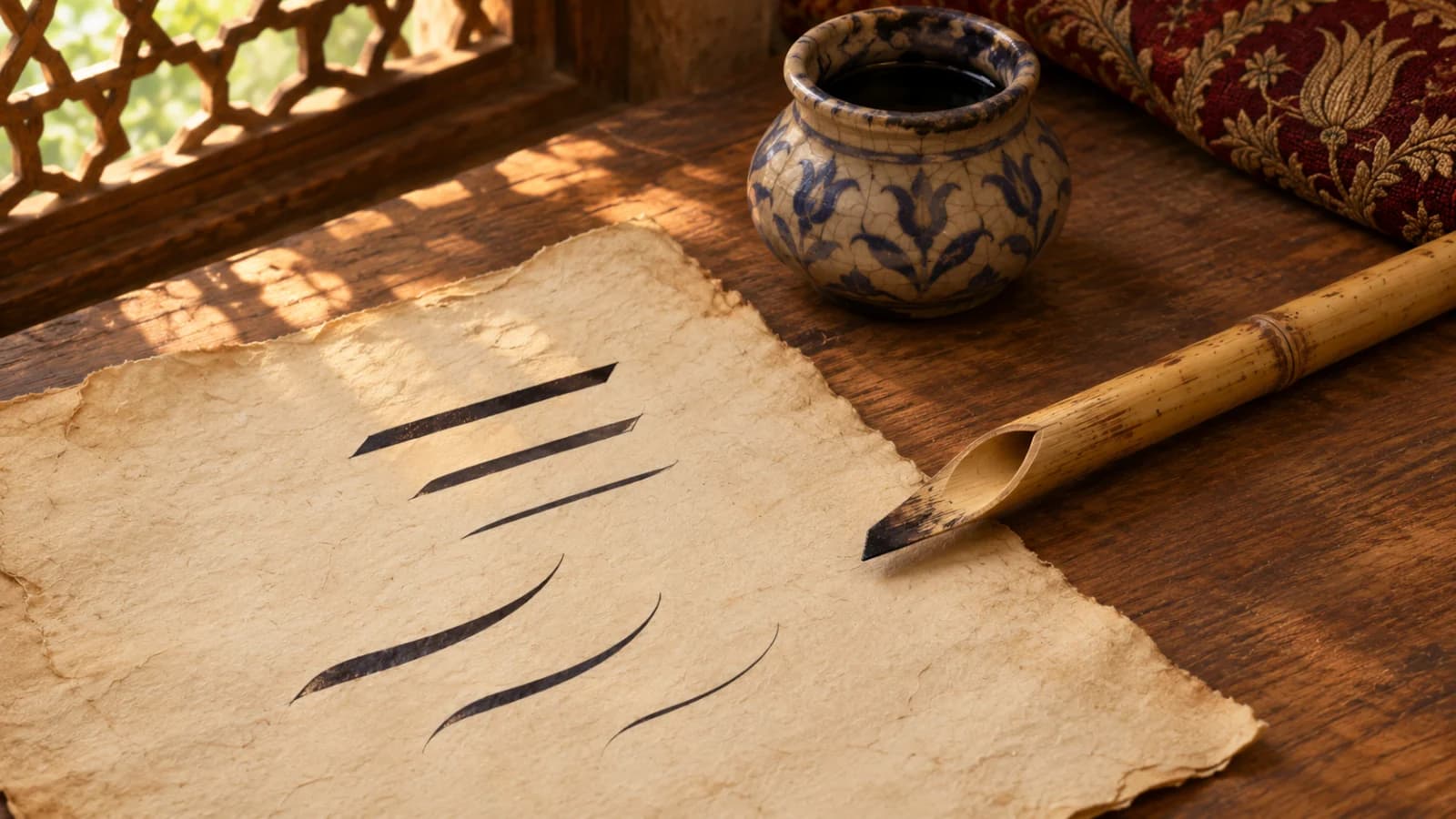
The Metropolitan Museum of Art describes instructors writing passages with reed pens and ink that could later be washed off. It also describes learning Arabic letters and reciting the text as parts of instruction, with the sequence varying between pupils. A board makes a portion of writing available on a surface a learner can revisit. It can support looking at the letters, reading aloud or repeating the passage during a lesson. The catalogue gives this teaching context for the object. It does not identify every person who held or wrote on the board. Met, Qur’anic Board, 2025.579
The tools and the learning tasks are different pieces of evidence. A reed pen or qalam provides a writing edge. The ink leaves marks on the wood, and the board provides the surface. The words might be a passage that belongs to a surah, or chapter of the Qur’an. A lesson can centre on writing, reading or recitation, and the board alone rarely tells you which activity occupied the most time. Our account of memorisation and recitation explains two related activities that may be discussed alongside this kind of learning object.
A photographic record preserves the appearance of the writing at the time the image was taken. That moment may be the most recent state of a reused surface. A faint earlier line can be worth looking for, but shape, grain and lighting can also affect what appears on the photograph. A museum’s transcription or discussion supplies context for identifying what you are seeing.
What the erased passage in a British Museum example shows
The British Museum’s board 2011,6037.1 is a nineteenth-century West African example. It is rectangular with a rounded top, 32 centimetres high and 13 centimetres wide. The museum records Arabic writing on the front and back in a Sudani Maghribi script. Its inscription note identifies Surat Quraysh, chapter 106, on one side. It also identifies traces of Surat al-Ma’un, chapter 107, after wiping. The numbers identify chapters. They need not represent the sequence in which a particular pupil studied them. British Museum, writing tablet 2011,6037.1
The erased trace adds evidence beyond the shape of the board. A plain wooden surface of similar outline might resemble a writing tablet. Here there is a current layer of ink and a curatorial identification of writing that was removed. A description of the object can distinguish the chapter the museum reads clearly, the earlier passage it identifies from traces, and the visible form of the wood. There is no need to reconstruct a passage from a low-resolution picture.
Two boards associated with Mali
The Met’s 2025.579 is wood and ink, dated to around 1900 and attributed to Mali. The recorded height is 43.8 centimetres and the width 21 centimetres. Its inventory number reflects how the museum tracks the object. The date of manufacture given by the record is about 1900. Keeping both fields visible prevents the recent accession from being mistaken for the age of the writing surface. Met, object details for 2025.579
The Smithsonian’s National Museum of African Art records a different wooden writing board, 2002-6-1, under Mali and dates it to the mid-twentieth century. Its catalogue lists wood and ink, with dimensions of 42.8 by 14.5 by 2 centimetres. It is close to the Met board in height and narrower in the published measurements. For a comparison, write the two object numbers next to the two sets of dimensions. The regional labels establish the context the museums assign to the objects. Each record stands on its own for date, form and attribution. Smithsonian, Koranic writing board 2002-6-1
What a handle, hole or curved edge can tell you
The Allen Memorial Art Museum’s Hausa allo, 2002.2, is associated with Nigeria and dated to the 1930s–40s. It is 47.9 by 19.7 by 1.3 centimetres overall, and the materials include wood, ink, nails and leather. The museum interprets the leather-covered handle as a feature for handling as well as decoration. It also explains the curved lower edge as a way to rest the board comfortably against the waist or leg while writing. Both details are part of the curatorial account of this particular board. Allen Memorial Art Museum, Allo, object details and label
Penn Museum’s nineteenth-century board 29-201-704 is recorded with Morocco as its provenience. The wooden piece is 42 centimetres high and 33.5 wide. The record describes a hole near the top centre through which a string could be passed to hang it. It also identifies an Arabic prayer on the surface. This is useful evidence that a writing board associated with Qur’an teaching can preserve a prayer on a particular face. The description of the inscription belongs with the object number and the record that supports it. Penn Museum, writing board 29-201-704
If you compare the two, start by locating the feature named in each record. On the Oberlin board, the leather covers the handle. On the Penn board, the hole is part of a means of suspension. These details help with different questions about how a wooden surface was held or stored. Neither should be inferred for a board whose edge or handle does not appear in the view.
What an uncertain provenance looks like in a catalogue
The Louvre records AFI 1765 as a Qur’anic tablet of carved wood and ink. It measures up to 47.3 centimetres high and 23.5 wide. The catalogue also lists a thickness of 1.1 centimetres and a depth of 2.5 centimetres for the space taken up because the board is deformed. Its provenance field gives both the Maghreb and sub-Saharan Africa with question marks. The record offers two photographs and does not settle a single place. Louvre, Tablette coranique AFI 1765
The wording matters when comparing objects. “Attributed to Mali” is what the Met uses for one board. “Morocco” appears in the Penn provenience field. The Louvre’s two regional possibilities both have qualifications. A museum name, a production attribution, a collecting location and the place where a particular learner used an object are different facts. Keep the language of the source for each claim and leave an unresolved location open.
How a board differs from a manuscript leaf
A writing board and a manuscript can preserve Arabic writing, but their forms point to different ways of using it. The board is a single wooden surface that can be held, turned and prepared again. A mushaf is a written copy of the Qur’an, and its pages or sections can be studied as part of a book. On a loose manuscript leaf, you may look for ruling, a page number or the order of a text. On the wooden board, look for the shape of the edge, writing on both faces and the possibility of repeated use.
Those distinctions also matter when describing a photo. If only one side appears, describe that face. If a museum gives images of the front and back, compare the edges and the way lines occupy each face. A photograph helps you see what remains on the board. Identification of a chapter or reading of partly removed writing is a separate task, best grounded in a documented transcription or curatorial reading.
A short checklist for looking at a wooden writing board
Start with the object number, material and measurements. Then look for a handle, hole or curve described by the museum. Check whether the record identifies writing on one or both sides, and whether it distinguishes a clear line from a trace. Keep a date of production separate from the accession number and copy any question marks in the provenance field. These steps let a short description cover how the board was made, how it may have been used and what survives on it today.
Museum records for comparison
- British Museum, 2011,6037.1 gives measurements, regional attribution, script and the description of erased writing.
- Met, 2025.579 provides object details and a description of reusable boards in teaching.
- Smithsonian, 2002-6-1 supplies material, date and dimensions for another board associated with Mali.
- Allen Memorial Art Museum, 2002.2 explains the name allo and the form of the handle and base.
- Penn Museum, 29-201-704 records the dimensions, suspension hole and Arabic prayer.
- Louvre, AFI 1765 records the thickness and deformation and shows uncertainty about provenance.