What Is a Kanga Cloth? How to Read Pindo, Mji and Jina
Read a Swahili kanga’s border, central field and message. Compare documented East African cloths, factory labels and a sewn dress.
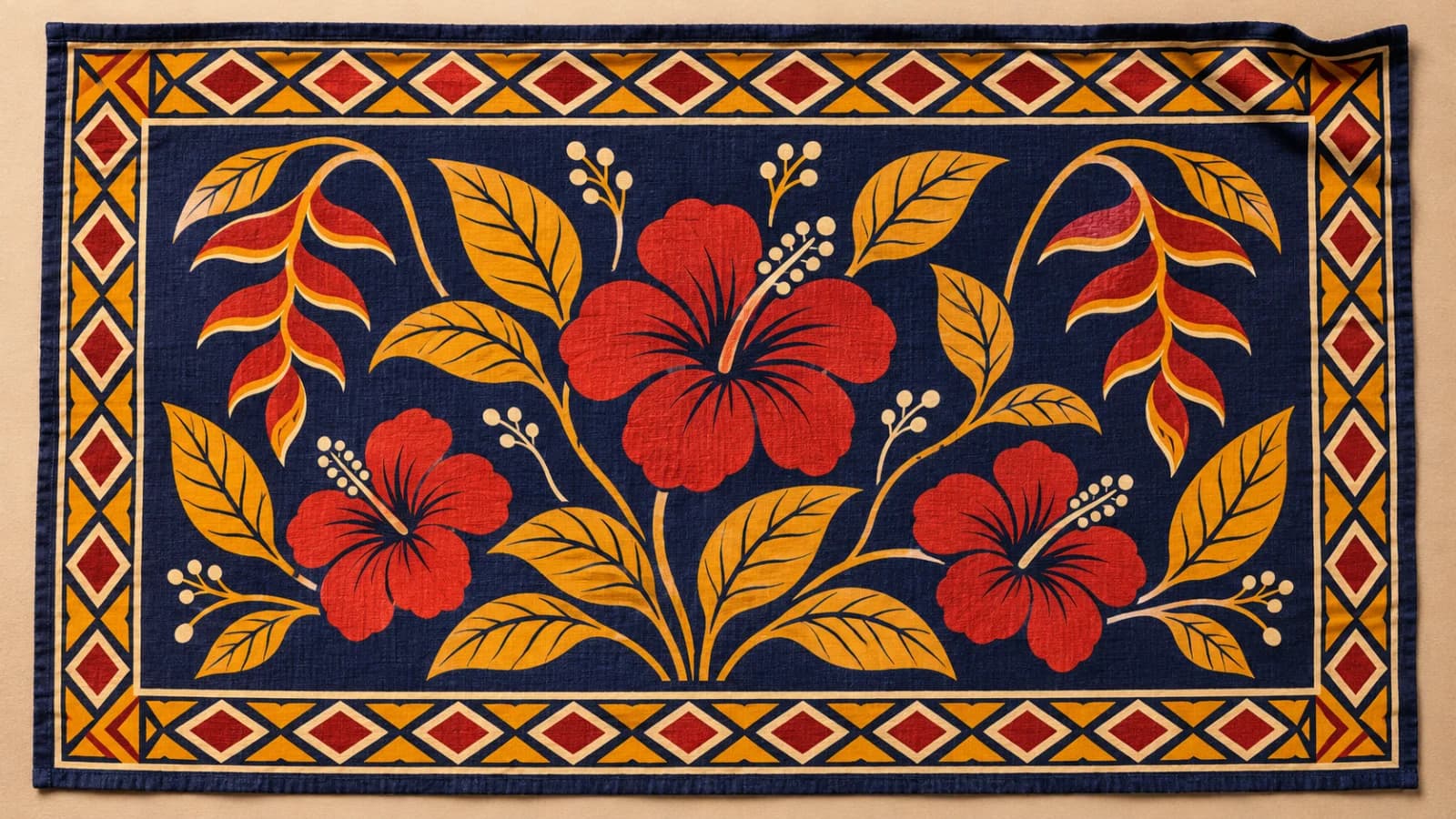
A kanga, also spelled khanga, is a printed cotton cloth associated with East Africa, particularly the Swahili coast and the dress traditions of Kenya and Tanzania. On a cloth laid flat, look for a patterned border, a central field and a line of writing. In Kiswahili, these are commonly called the pindo, the mji and the jina. A kanga may be worn as a wrap, paired with a second cloth or used around the home.
The layout gives you a way to read individual examples. A yellow cloth from 1962 at the Smithsonian carries a reference to the Republic Day of Tanganyika. A red cloth in the same museum has a torch and a Swahili proverb. The objects share a rectangular format and visible writing. Their individual records explain what each one says and where it was made or circulated.
Find the pindo, mji and jina on a flat cloth
The pindo is the frame that runs around the design. Follow it around the corners to establish the limits of one printed rectangle. The mji is the central field, which can contain an emblem, a scene or repeated shapes. The jina is the message, often set towards the lower edge of the field. The University of Wisconsin–Madison guide also gives ujumbe as a term for the writing. These are names for parts of the layout. They can be applied before translating a saying. University of Wisconsin–Madison Libraries, glossary of fabrics
A fold can show a central motif while hiding the border or the writing. A museum photograph may show only one repeat from a much longer length of cloth. Look for a view of the whole piece before describing where the design ends. If both a close view and a full image exist, the full one helps locate the inscription and the close one helps make the letters legible. A viewer can then connect the writing to the pattern it sits within.
For another example of writing incorporated into a textile, see the guide to the Kiswah textiles of the Kaaba. The inscriptions there belong to a different textile tradition and setting. For each kanga, begin by locating the wording inside its own design and then consult the record for what that specific cloth says.
How pairs and repeats affect the way a kanga is seen
Phyllis Ressler’s Smithsonian Folklife account describes kangas as usually sold in pairs. A pair can be worn together, with one cloth wrapped and another draped. A length in a collection can retain the repeated printing. To understand the scale, distinguish the overall measurement of the cloth from the length of one repeat. An object photograph and a dimension field can answer different questions about that same piece. Smithsonian Folklife, Phyllis Ressler’s account of khangas
The National Museum of African Art records both of its 79-25-1 and 79-25-2 pieces at 114.9 by 339.7 centimetres overall. It gives repeat lengths of 166.5 and 166 centimetres respectively. Those figures describe two distinct objects with similar overall formats. If you see one rectangle in a detail image, the repeat gives a way to relate it to the longer textile. If you see the whole length, the overall measurement tells you what was actually catalogued. Smithsonian, object 79-25-1 and Smithsonian, object 79-25-2
Read a message with the image that surrounds it
On Smithsonian object 79-25-1, the central design contains a circle with a heart and a flower crossed by two tusks. It includes a reference to Republic Day and the date 9 December 1962. The Swahili phrase below links unity with the joy of the republic, according to the museum’s translation. Around the centre is a yellow-ground design with a patterned frame. The record relates it to Tanganyika. Here, the date and the emblem help place the wording in a particular public commemoration. National Museum of African Art, Republic Day kanga
On 79-25-2, the museum describes a torch above a Swahili proverb about the person roasting meat experiencing its smell. The cloth has a red ground and a frame with black and white patterns. The museum identifies the saying as a proverb. That identifies the kind of message printed on the cloth, while a particular use would depend on who chose it and when it was seen. A translation can give the literal sense before you consider its social use. National Museum of African Art, torch and proverb kanga
The Textile Research Centre’s collection gives other examples. Its exhibition lists a 2010 cloth from Kenya, TRC 2013.0123, whose wording expresses affection for Africa. A 2015 cloth from Tanzania, TRC 2015.0345, expresses a wish for a happy wedding day. These documented examples show the range from a collective sentiment to an occasion-specific greeting. When writing a caption, give the inventory number beside the interpretation so a reader can find the corresponding cloth. Textile Research Centre, collection examples
Where a cloth was made and where it was sold
On the red kanga 79-25-2, the Smithsonian records a paper label with a company and a location in Wakayama, Japan. It says the cloth was manufactured in Japan for the Kenyan market. Those two places answer different questions. A maker’s mark, if present, can be evidence about production. The museum’s account of the market explains where the cloth was intended to circulate. Smithsonian, manufacture and market in the 79-25-2 record
The yellow 1962 example has trade wording along the selvage, including a name in Dar es Salaam. The museum gives Tanzania in its geography field and explains the Tanganyikan reference in the printed design. Keep the wording at the edge, the place listed in the record and the event named in the design together when comparing them. The textile has more than one kind of geographical clue. Smithsonian, geography and selvage notes for 79-25-1
East African coastal exchange has a much longer history. The accounts of Kilwa Kisiwani and seasonal Indian Ocean navigation give context for reading the coast as a region connected by trade. For a twentieth-century printed cloth, the object record and manufacturer’s label are evidence for its own route.
How the cloth is worn and used
Ressler’s account describes kangas as skirts, shawls and head coverings, as well as textiles used in the home. It also describes how cloths may be given and kept within a family. The Textile Research Centre describes ways one of a pair can be wrapped and the other draped. Fold and position determine how much of the printed field remains visible. A photograph of someone wearing the cloth can document one arrangement. The occasion or intended message is best explained by a caption, an interview or another source connected to that use. Smithsonian Folklife, wearing and giving khangas and Textile Research Centre, ways to wear the cloth
Cloth can be organised around a border and central field using different techniques. The guide to suzani embroidery explains how separately embroidered sections can be joined to form a larger design. On the kanga, follow the printed border around one rectangle and look for the seam or fold that affects how much of the design is visible when the cloth is worn.
What changes when the print becomes a sewn dress
New Mexico State University’s University Museum documents an example inspired by kanga fabric, 2014.01.01. The dress came from ChiChiA London, founded by Tanzanian-born designer Christine Mhando. The museum describes hot pink cotton with overlapping Swahili text in black capitals. It is cut and sewn into a knee-length dress with waist darts, a wide neckline and a front peplum. In this example, the pattern is laid out on a fitted garment. The words interact with the cuts and seams. New Mexico State University, A Kanga-Inspired Dress
Compare a full view of the dress with a cloth spread flat. On the rectangular textile, the frame helps you see the edges of a complete design. On the dress, trace where lines of text meet a seam or continue across a portion of the garment. The comparison makes the changes in format visible without requiring a claim about the original use of the printed material.
How to record a kanga from a photo or museum label
Begin with the object number and the visible part of the textile. Describe the frame, field and location of any writing. Look up the overall dimensions and, when available, the repeat measurement. Identify the place named in the record and whether it refers to manufacture, an intended market or an event. For an inscription, use a published reading or translation and indicate who supplied it. These details make it possible to compare objects whose patterns or colours look similar.
Collection records and guides
- University of Wisconsin–Madison Libraries describes the layout terms and alternate names for the cloth.
- Smithsonian Folklife, Phyllis Ressler discusses layout, paired cloths, messages and uses in Kenya.
- Smithsonian, 79-25-1 records the 1962 commemorative cloth, its wording, dimensions and repeat.
- Smithsonian, 79-25-2 records the torch, proverb and the Japanese manufacture for Kenya.
- Textile Research Centre presents named cloths, their messages and examples of wearing them.
- New Mexico State University University Museum documents a sewn dress with kanga-inspired printed cotton.