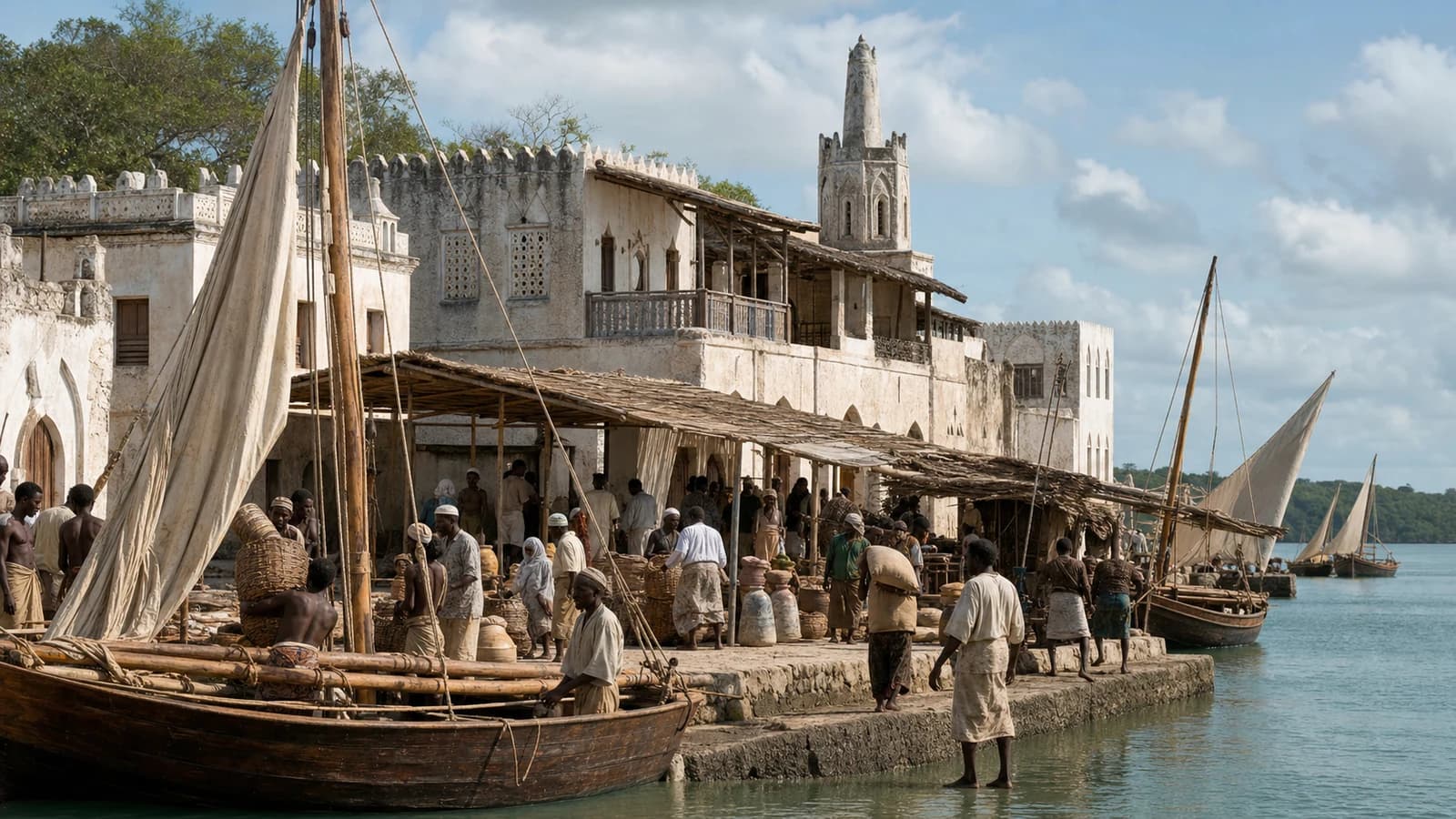
Kilwa Kisiwani: Coral Architecture and Ocean Trade
How coral rag, lime mortar, mosques and palaces made Kilwa's commercial power visible across the medieval western Indian Ocean trading world.
Kilwa Kisiwani, an island situated off the coast of present-day Tanzania, was a major Swahili urban and trading center whose monumental coral stone architecture reflects its deep integration into Indian Ocean trade networks.
Materials and Construction Techniques
The monumental buildings of Kilwa Kisiwani were constructed primarily from coral rag, which refers to quarried fossil or reef limestone rather than living decorative coral. Builders bound these rough stone blocks using a durable lime mortar produced by burning local limestone. To roof these structures, builders laid mangrove poles across the walls to support the overhead structures. For highly visible architectural elements such as doorways, mihrabs, and decorative niches, craftsmen used finely dressed coral stone, which was soft enough to carve when freshly quarried but hardened upon exposure to the air.
This architectural tradition was not a foreign import but a local Swahili development. While the designs accommodated international trade partners, the construction techniques and spatial layouts emerged from the coastal society itself. The domestic remains, consisting of smaller stone houses and mud-and-thatch dwellings, demonstrate that coral stone construction existed alongside other vernacular building methods, reflecting a stratified urban community rather than a uniform settlement of foreign merchants.
The Great Mosque and Husuni Kubwa
The Great Mosque of Kilwa is one of the most significant surviving structures on the island. It features a complex hypostyle plan that was expanded over several centuries to accommodate a growing congregation. The mosque’s domes and vaults, constructed of coral and lime mortar, represent sophisticated engineering solutions designed to span wide spaces. The mosque served as the religious heart of the city, anchoring its identity within the wider Islamic world of the Indian Ocean.
Nearby, the complex of Husuni Kubwa stands on a cliff overlooking the sea. This massive fourteenth-century structure functioned as a palace, a commercial warehouse, and a residential complex. It features a large sunken courtyard, residential apartments, and extensive storage rooms designed to hold trade goods. The scale of Husuni Kubwa indicates the centralized control of trade by Kilwa’s ruling elite, who managed the flow of commodities between the African interior and maritime merchants.
Trade Networks and Archaeological Evidence
Kilwa’s architectural development was funded by its strategic position in Indian Ocean trade networks. The city controlled the trade in gold from the interior plateaus, alongside ivory and other goods. In exchange, Kilwa imported Chinese porcelain, Islamic glazed ceramics, glass beads, and textiles. These imported goods are frequently recovered during archaeological excavations, often found embedded in the plaster of elite homes or discarded in domestic middens.
Archaeological evidence, including locally minted coinage bearing the names of Kilwa’s rulers, confirms the existence of a highly monetized local economy. This numismatic evidence, combined with written travel accounts, provides a detailed picture of a wealthy, literate, and politically organized society. The coins demonstrate that Kilwa’s authority was consolidated locally, even as its merchants engaged in far-reaching maritime transactions.
Conservation and Environmental Challenges
Today, the ruins of Kilwa Kisiwani face severe environmental threats. Coastal erosion, driven by wave action and rising sea levels, actively undermines the foundations of structures situated near the shoreline. Invasive vegetation grows within the mortar joints of the coral rag walls, forcing the stones apart and causing structural collapses. Because the ruins are exposed to a humid, salty maritime climate, the lime mortar and dressed coral surfaces degrade continuously, requiring active conservation interventions.
Modern preservation efforts focus on stabilizing the surviving masonry using traditional lime-based materials rather than modern cement, which can trap moisture and accelerate the decay of the soft coral stone. It is critical to recognize that these ruins do not represent an abandoned, extinct civilization without descendants. The local community living on the island today maintains deep historical and cultural connections to the site, and contemporary conservation strategies increasingly involve these descendant populations in managing and interpreting their own heritage.
Evidence-Reading Checklist
- Verify whether the coral elements are quarried fossil limestone or living reef coral.
- Examine the presence of local coinage to assess the autonomy of the local economy.
- Identify the structural role of mangrove poles in supporting the roofing of these buildings.
- Distinguish between elite coral rag structures and vernacular mud-and-thatch domestic remains.
In conclusion, the coral architecture of Kilwa Kisiwani serves as physical evidence of a sophisticated Swahili urban society that successfully navigated global trade networks while maintaining its distinct local identity and architectural traditions.
The cover image is an original AI-assisted historical reconstruction of medieval Kilwa, not a photograph or exact restoration of Husuni Kubwa or the Great Mosque.
Sources
- UNESCO World Heritage Centre: Kilwa Kisiwani and Songo Mnara — archaeology, trade and heritage significance.
- UNESCO Reactive Monitoring Mission: Kilwa — site fabric, threats and conservation.
- The Met: Trade and the Swahili Coast — regional Indian Ocean exchange and material culture.
Related reading
- How dhow construction connected ocean ports
- How caravanserais supported long-distance trade


