Monsoon Navigation: The Seasonal Clock of Indian Ocean Trade
How reversing winds shaped sailing seasons, port stays and trade across the Indian Ocean—and why the monsoon was a variable system, not a simple timetable.
Indian Ocean mariners planned long voyages around winds that change with the seasons. Broadly, the southwest monsoon brings winds from the ocean toward South Asia in northern summer, while the northeast monsoon reverses the pattern in winter. Local seas, however, do not all change on the same date or in the same way.
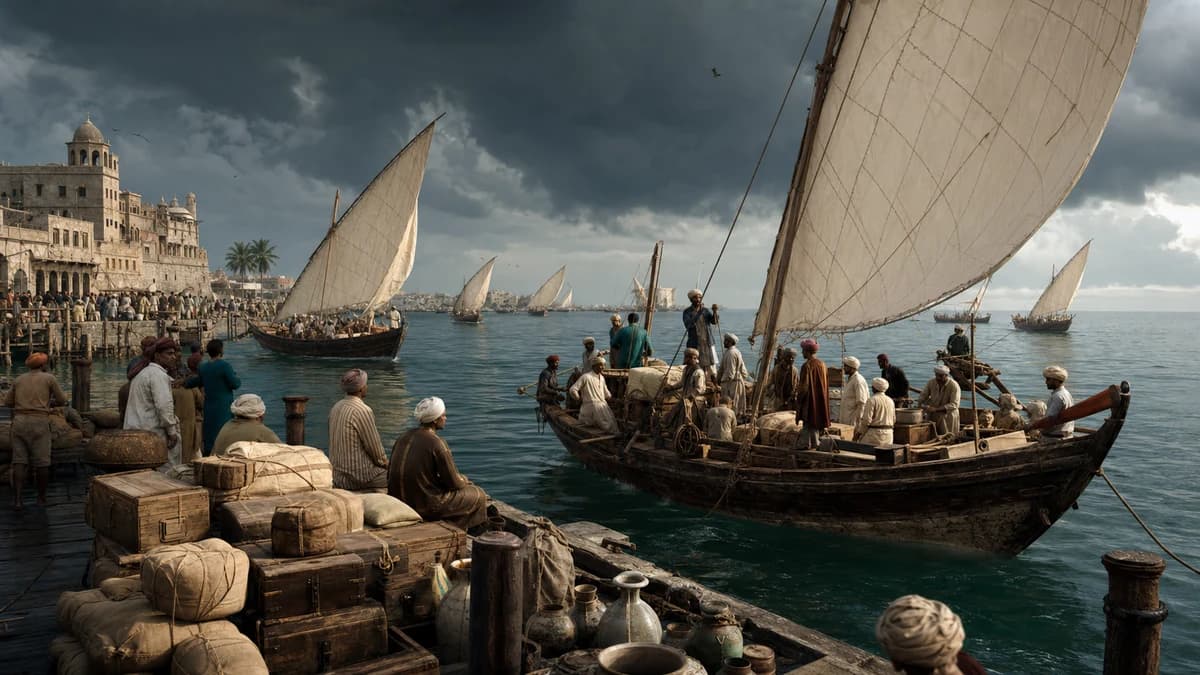
The cover image is an original AI-assisted maritime reconstruction, not a photograph of a documented voyage or storm.
Seasonal wind created windows, not guarantees
A ship waiting in Muscat, Aden, Gujarat or the Swahili coast had to consider departure date, route, vessel, cargo and the onset of local conditions. Too early could mean weak or contrary wind; too late could bring dangerous weather or strand a crew until the next season.
The monsoon is a large atmospheric circulation influenced by land–sea heating, pressure and geography. Coastal breezes, cyclones and currents complicate its regional expression. Historical sailing directions therefore deserve more trust than a single modern arrow drawn across a whole ocean.
Wind shaped commercial time
Merchants and crews often remained in port for months before a favorable return voyage. These stays supported lodging, credit, storage, brokerage, repair and multilingual communities. The circulation of people and ideas was not an accidental by-product of trade; it was built into seasonal waiting.
Historic Jeddah illustrates a port shaped by Red Sea trade and pilgrimage. Muscat connected Gulf and Indian Ocean routes. Neither port can stand for the whole system, but each shows how maritime schedules affected urban life.
Knowledge was cumulative and shared
Pilots combined stars, compass directions, depths, currents, landmarks and remembered wind patterns. Arab, Persian, Indian, African, Southeast Asian and later European sailors all contributed to navigational knowledge. The ancient Greek Periplus documents early awareness of seasonal crossings but did not “discover” winds already experienced by local seafarers.
Climate variability also matters. A route successful in one year might demand adjustment in another. Historical monsoon knowledge was probabilistic expertise, not a mechanical calendar.
How to reconstruct a voyage
- Specify month, direction, port and sea rather than saying only “the monsoon.”
- Use contemporary sailing instructions alongside climate data.
- Include waiting time and the possibility of multi-stage voyages.
- Separate prevailing wind from daily weather and ocean current.
The monsoon linked the ocean because it imposed rhythm. Its reversals made distance navigable while ensuring that trade remained dependent on time, uncertainty and local judgment.
Sources
- Qatar Digital Library: Muscat and the Monsoon — seasonal sailing and port life.
- UNESCO: Historic Jeddah Nomination Documentation — Red Sea trade, pilgrimage and urban history.
- Istanbul University Press: Celestial Navigation in the Indian Ocean — navigational practice alongside seasonal winds.


