What Is a Zarf? Ottoman Coffee Cup Holders and Museum Examples
A zarf holds a small handleless coffee cup. Compare Ottoman-era brass, silver and enamel examples, and see how the cup and holder fit together.
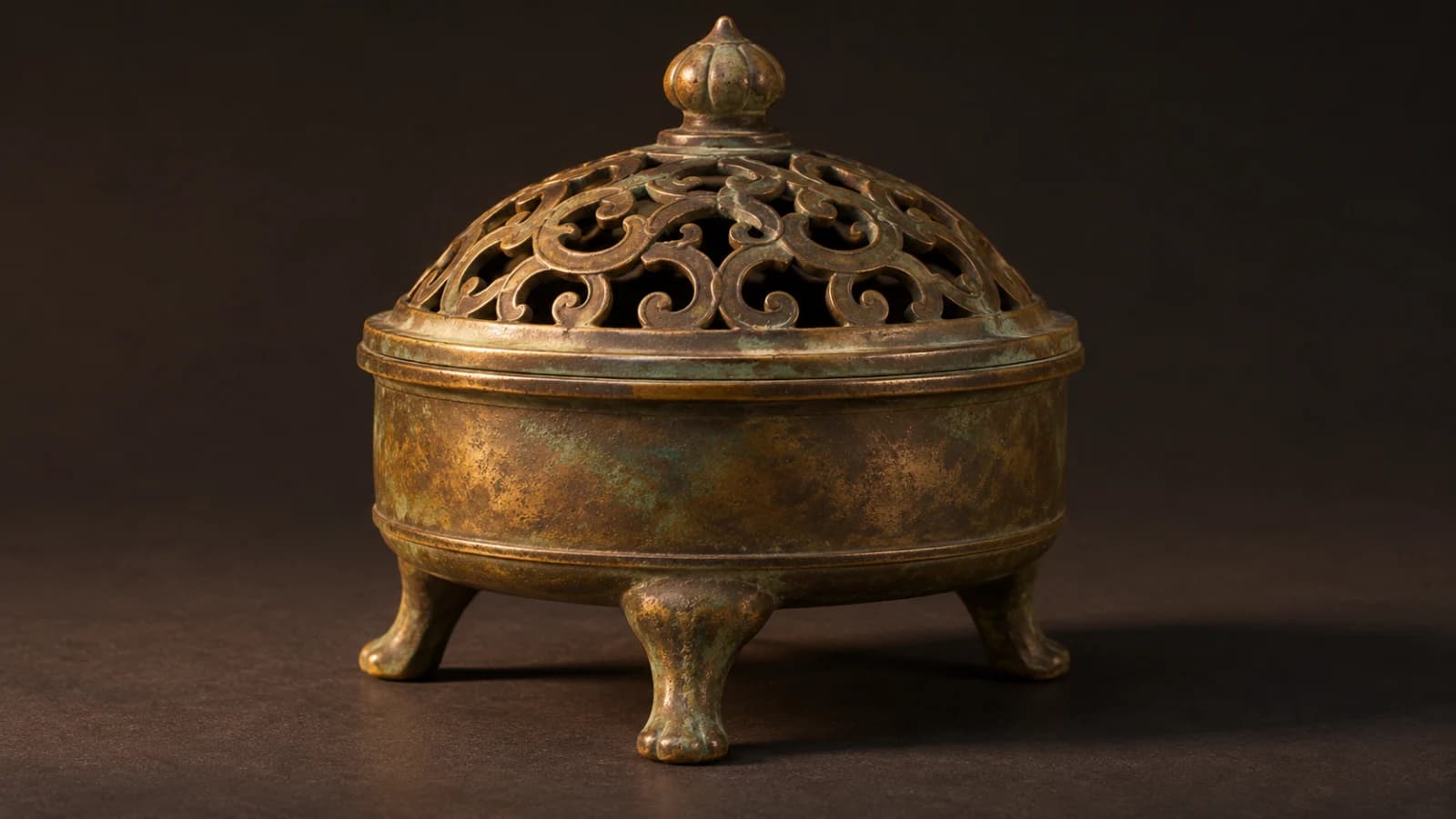
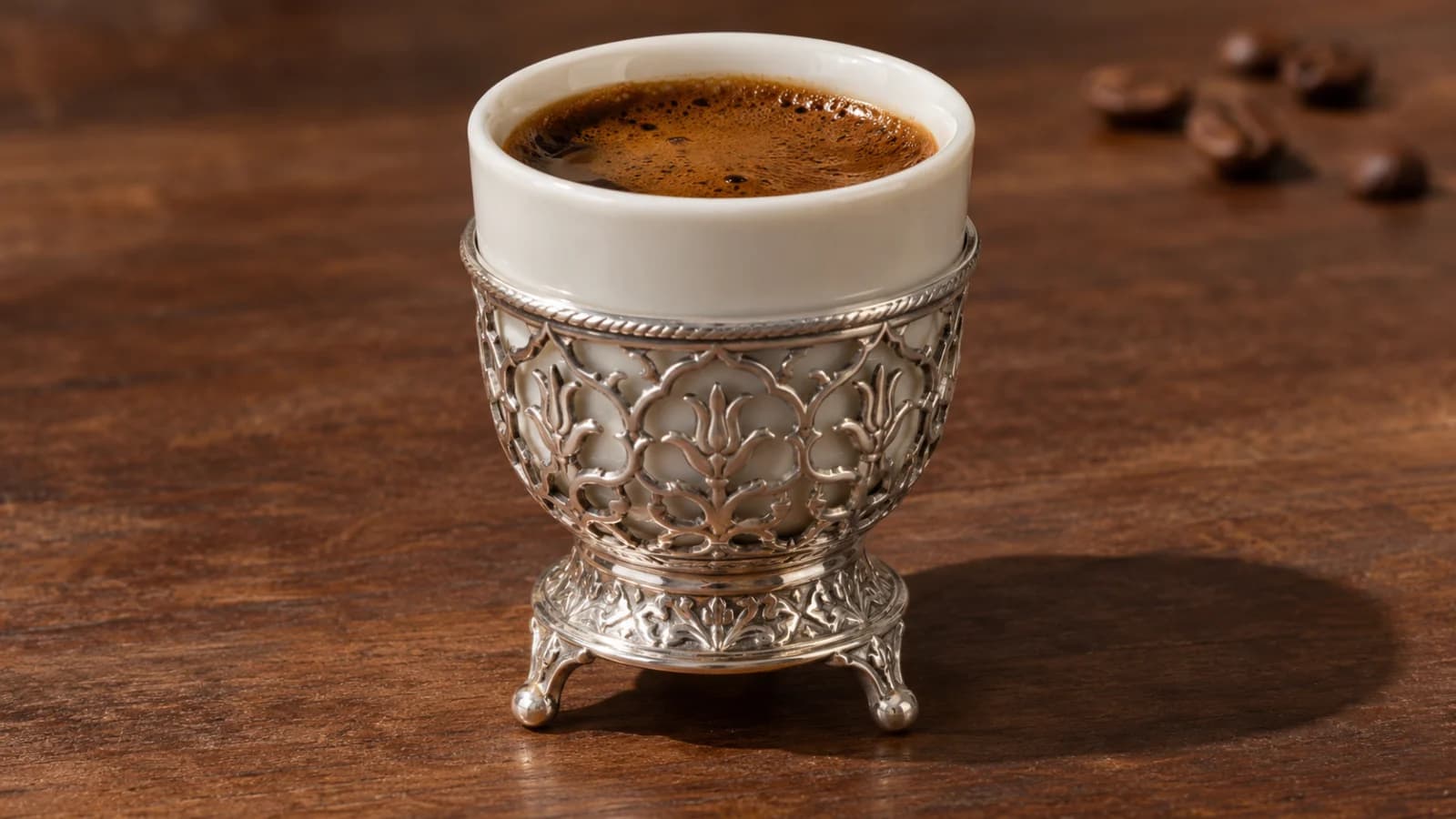
A zarf is an outer holder for a small handleless coffee cup. In Ottoman-era coffee service, a ceramic or glass cup, often called a fincan, sat inside a separate holder that the drinker could grasp. The holder could be as plain as a brass cup-shaped support or as elaborate as a gold frame decorated with enamel and gemstones.
Two rims in a museum photograph can belong to two separate objects. The inner vessel holds the coffee. The outer one supports that vessel and provides a surface for the fingers. Some catalogues show both together, while others record a holder that has survived by itself.
How a cup fits inside the holder
In profile, many zarfs have a hollow body that is wider at the top and narrows toward a foot. The sides receive the lower portion of the cup. Ayman M. Edris examined seven brass holders from the Al-Ashmunein storehouse in Mallawi, Egypt. His drawings show a cup resting in the lower portion of the holder, with some of its side touching the inner wall. He explains that the amount of cup visible above the metal depends on the dimensions of both parts. Ayman M. Edris, study of brass coffee cup holders, Shedet 4
At The Metropolitan Museum of Art, a nineteenth-century cup and holder attributed to Turkey have separate identifiers. The glazed, painted porcelain cup, 89.2.2162a, is 3.5 cm high and 5.6 cm in diameter. The pierced, engraved and inlaid silver holder, 89.2.2162b, is 4.1 cm high and 5.4 cm in diameter. The cup’s recorded diameter is greater than the holder’s. These are overall measurements, with no measurement of the cup at the point where it sits inside the holder. To understand the fit, compare the cup’s narrower lower part with the opening and inner walls. Those are the surfaces that have to meet. Two cups of the same listed diameter can have different profiles near the base. The Met, Cup and Holder, 89.2.2162a, b
Why a holder was useful for hot coffee
The British Museum’s exhibition guide Life in a cup describes the use of two nested porcelain cups to protect the fingers and traces the rise of small metal holders in the eighteenth century. A person could grasp the outer piece instead of gripping the thin wall of the cup that directly held the drink. The upright foot could also support the assembled cup when it was set down. The objects show the shape of the surfaces available to the fingers. They provide no measurements of how cool those surfaces stayed after the coffee was poured. British Museum, Life in a cup, brewing and serving
In the brass examples Edris studied, the bottom of the foot is wider than its upper part. He relates that shape to the stability of the holder. His study also describes how part of the cup protrudes above the holder’s rim. Those details matter to the way the pair is handled. For the places where people gathered to drink, see the article on Ottoman coffeehouses and public life. Edris, construction and use of the Al-Ashmunein holders
How brass and silver holders were shaped
The Egyptian examples in the Al-Ashmunein study have a foot, a body and a short connecting section. On one example, a photograph of the underside shows a shallow recessed centre inside the foot. The researcher also illustrates bands of raised dots on the edge of the base. In a side view, a viewer can compare the nearly conical body with the shorter foot below it. The decorated surfaces still follow the shape needed to seat a cup and set it down. Edris, drawings and photographs of the brass holders
On The Met’s silver holder, the catalogue distinguishes piercing, engraving and inlay. A pierced opening goes through the wall. Engraving makes marks on the surface. Inlay sets another material into a recess. Several of those treatments can appear on the same object. Looking at the holder from the inside can show how openings and decoration sit on a wall that still has to cradle the cup. The guide to markets and workshops in the Islamic city gives context for how crafted objects and the skills needed to make them circulated. The Met, record for the silver holder
Ceramic cups and holders had separate journeys
In its exhibition guide, the British Museum lists a brass zarf attributed to Egypt, Af.373, alongside a Chinese-made cup acquired in Egypt, Af.3495. The guide dates both to 1800–1860. It also describes a purple Meissen cup, made in Germany in 1800–1900 for the Ottoman market. These records concern production and acquisition in different places. They show that the service could include ceramics from a distance. The items illustrate a serving practice. Both are listed as donations from Henry Christy, and the guide describes them under separate object numbers. An entry linking one holder with its own cup would be a separate piece of evidence. British Museum, exhibit guide, cup and holder records
There were also cups associated with workshops within the Ottoman world. The Louvre records an eighteenth-century coffee-cup fragment, MAO 936/824, from Kütahya. It is a silica-rich ceramic with decoration painted under a transparent glaze. The record describes a fragment, so its maximum surviving width cannot supply a full set of measurements for a holder. It identifies a ceramic component with its own documented place. The route of the drink has a different record. The article on the port of Mocha and the coffee trade follows the beans that filled such cups. Louvre, coffee-cup fragment from Kütahya, MAO 936/824
The British Museum guide also describes small glazed cups known as haysi. Hays, a pottery centre in Yemen, was making them in quantity by the mid-sixteenth century. The name was also used for cups made in other pottery centres. The exhibit lists a later handled cup from Hays, As1967,03.40, dated to the 1950s or 1960s. It records a specific production place alongside a name that had a wider use. In a description of a holder, check whether the geographical name refers to the cup, the holder or a category of objects. British Museum, Life in a cup, Haysi coffee cups
Enamelled holders made in Geneva
The Khalili Collections catalogue a group of three mid-nineteenth-century zarfs from Geneva, SW 180. The materials entry includes gilded and painted opaline glass, enamelled gold and seed pearls. Its commentary describes metal frames to which goldsmiths could add enamel panels, openwork or gems. It also places such work in an export trade. A label can therefore use the name of an Ottoman serving object and name a Swiss manufacturing centre on the same line. Khalili Collections, Three Zarfs, SW 180
A separate Geneva zarf in Museum Collection is 5.7 cm high and catalogued as made for the Turkish market in the first third of the nineteenth century. The gold body has open areas and oval panels with musical instruments set against coloured enamel. A fabric-lined red leather case closes around the holder. The case belongs to the storage arrangement. The coffee cup would sit in the gold holder itself. Museum Collection, Geneva zarf with a fitted case, MC1178
A royal example with a documented collection history
The Louvre’s nineteenth-century zarf OA 8032 is a gold holder on a low foot. It stands 5 cm high and measures 5.2 cm in diameter. The catalogue describes alternating twisted rows set with emeralds and rose-cut diamonds, with diamond floral ornaments above. Its body and foot are still recognizable as the parts of a cup holder. Its materials show how much ornament could be applied to that small shape. Louvre, emerald-and-diamond zarf, OA 8032
The same record traces it from the collection of Sultan Abdülhamid II to a Paris sale of his jewels in 1911, then to collector Georges Heine and a 1929 bequest. Those are dates in the object’s ownership history. The manufacturing date in the record remains the nineteenth century. The provenance gives a named former owner and a documented sale. The catalogue leaves the individual maker unspecified. Louvre, ownership record for OA 8032
What to look for in a coffee-service display
Start at the lip and look for the line where ceramic or glass meets metal. Then check the view from the side. A visible cup above a short openwork body and foot points to a nested arrangement. If the holder is empty, the interior photo can show where the lower part of a cup would sit. Read the catalogue number for each component before taking measurements from the picture. The height of an assembled group and the height of an individual part answer different questions.
An illustration can show where the holder sits among other parts of a coffee service, such as an ewer and tray. Edris reproduces a nineteenth-century illustration in which a cup appears inside a holder and the two pieces also appear separately. Seeing both arrangements helps identify the outer piece. The article on Ottoman illustrated chronicles and ceremony gives examples of reading position and grouping in historical imagery. An accession record adds the material and provenance of a particular object. Edris, figure 1, historical illustration of coffee service
It also helps to distinguish an account of a living practice from a record of a historical piece. UNESCO’s intergovernmental committee inscribed Turkish coffee culture and tradition on the Representative List of the Intangible Cultural Heritage of Humanity in 2013. The decision describes serving coffee in small cups with water and gathering over the drink. The inscription concerns the practice. An object record such as the Louvre’s or The Met’s provides the evidence for a particular holder’s materials, date and documented ownership. UNESCO, Decision 8.COM 8.28
Museum records and research on the zarf
- The Met, Cup and Holder gives separate dimensions and materials for the porcelain cup and silver holder.
- Ayman M. Edris, brass coffee cup holders compares the construction of seven examples held in Egypt.
- British Museum, Life in a cup documents cups, holders and the way they were displayed in the brewing and serving section.
- Khalili Collections, Three Zarfs describes the materials and export context of a Geneva group.
- Museum Collection, zarf with musical instruments records the enamel decoration, manufacturing location and case.
- Louvre, zarf OA 8032 provides measurements, materials and ownership history.