Ottoman Coffeehouses and the Making of Public Life
How sixteenth-century coffeehouses created new settings for talk, games, performance and news—and why rulers alternately regulated, taxed and closed them.
The Ottoman coffeehouse emerged in mid-sixteenth-century Istanbul as a novel commercial and social space centered on the consumption of coffee and the facilitation of public sociability.
The Emergence and Social Diversity of Coffeehouses
While the exact dates of the first coffeehouses vary across Ottoman historical sources, there is consensus that by the mid-sixteenth century, these establishments had spread rapidly throughout Istanbul. Unlike traditional spaces of association, such as the household, the workplace, or the mosque, the coffeehouse was a commercial venue open to anyone who could pay for a cup of coffee. This accessibility created a new dynamic of public interaction.
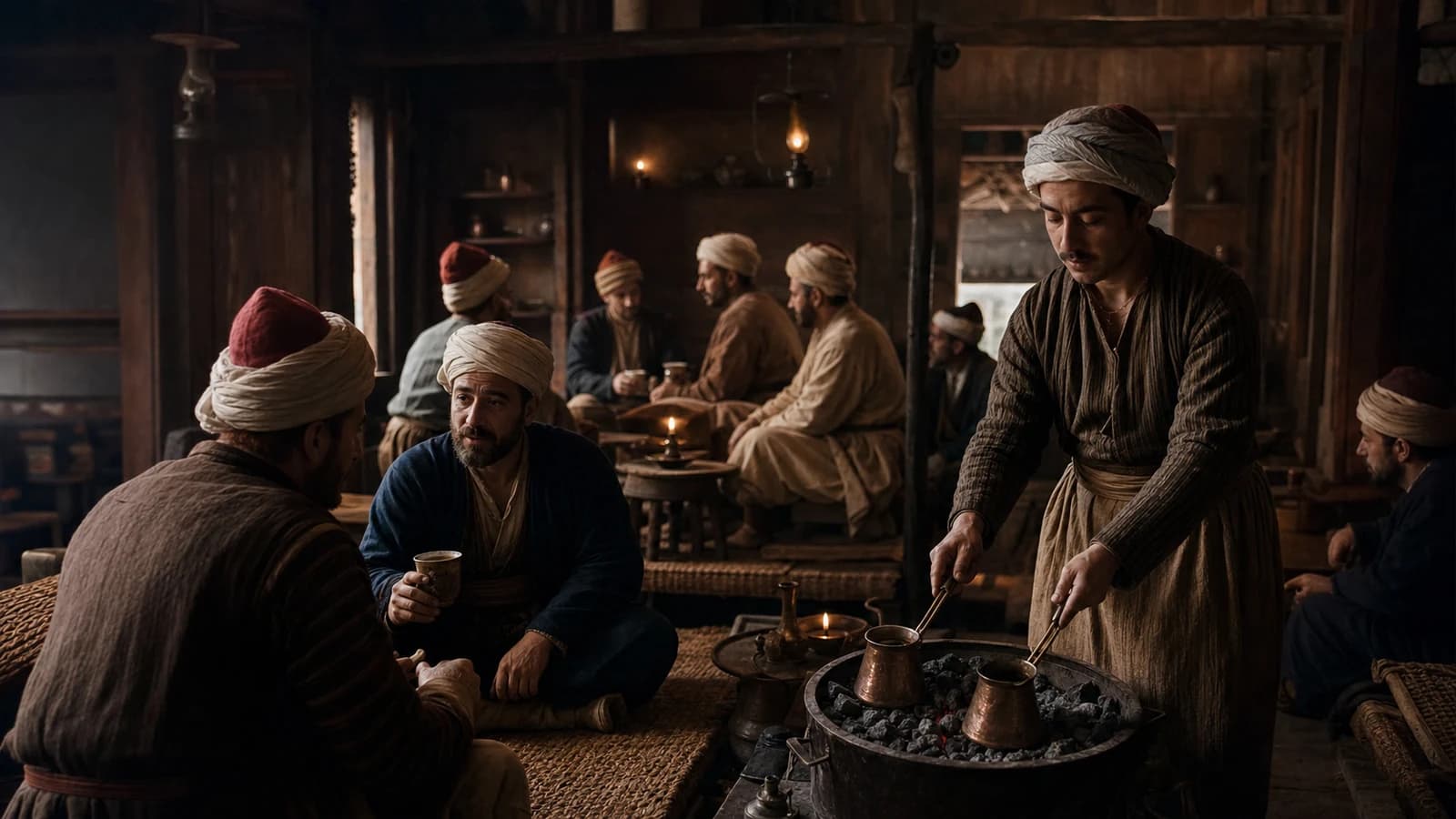
The clientele of these spaces differed significantly by neighborhood, time of day, and historical period. While coffeehouses were predominantly male-dominated, they were not socially identical or equally open to all classes. Some catered to janissaries, others to merchants, scholars, or sailors. Within these spaces, patrons engaged in conversation, played board games like backgammon, listened to professional storytellers, recited poetry, performed music, and exchanged local and international news.
State Surveillance and Political Anxiety
The rapid growth of coffeehouses alarmed Ottoman authorities, who viewed these unsupervised gatherings with suspicion. In the eyes of the state, the coffeehouse represented a potential breeding ground for sedition, rumor-mongering, and political dissent. Unlike the mosque, where behavior was governed by religious norms, or the workplace, which was structured by guild hierarchies, the coffeehouse lacked formal institutional oversight.
This anxiety led to periodic moral, religious, and political objections from state officials and religious scholars. Authorities occasionally issued decrees ordering the closure of coffeehouses, banned the consumption of coffee, or imposed heavy taxes on the establishments. However, these measures were rarely permanent or empire-wide; they were often temporary responses to political crises or localized unrest, and coffeehouses consistently reopened due to their popularity and tax revenue potential.
Evaluating Diverse Historical Perspectives
Historians must navigate different viewpoints when studying Ottoman coffeehouses, as surviving evidence is highly varied. Ottoman chronicles often reflect the anxieties of the ruling elite, portraying coffeehouses as sites of laziness and political subversion. In contrast, European travel accounts sometimes exoticize these spaces, while miniature paintings and poetry offer idealized representations of leisure and artistic performance.
It is important to avoid describing these spaces as modern democracies or as direct, organized causes of political revolution. The coffeehouse was a complex social arena where diverse groups negotiated their place in Ottoman urban society. Rather than serving as engines of radical political change, they were spaces where existing social hierarchies were both performed and occasionally challenged through satire and debate.
A Checklist for Coffeehouse Evidence
- Identify the social background of the author of the source, noting whether they represent the state, the religious establishment, or foreign travelers.
- Compare the locations of coffeehouses mentioned in tax registers with neighborhood demographics to understand their social composition.
- Analyze the language of imperial decrees to determine if a ban was motivated by religious orthodoxy or political security.
- Examine material culture, such as surviving ceramic coffee cups and pipes, to assess the daily habits of patrons.
In conclusion, the Ottoman coffeehouse transformed the urban landscape of Istanbul by creating a new sphere of public life. By analyzing these spaces through a combination of imperial decrees, material culture, and literary sources, historians can understand the complex relationship between state authority and popular sociability.
The cover image is an original AI-assisted reconstruction of an Ottoman coffeehouse, not a photograph or depiction of a named establishment.
Sources
- British Museum: Coffee Culture in the Islamic World — coffeehouse emergence, bans and social role.
- British Museum: Life in a Cup Exhibition Guide — trade, objects and Ottoman context.
- AramcoWorld: The First Social Network — urban meeting places and historical accounts.
Related reading
- How Mocha became a global coffee name
- How Ottoman shadow theatre worked


