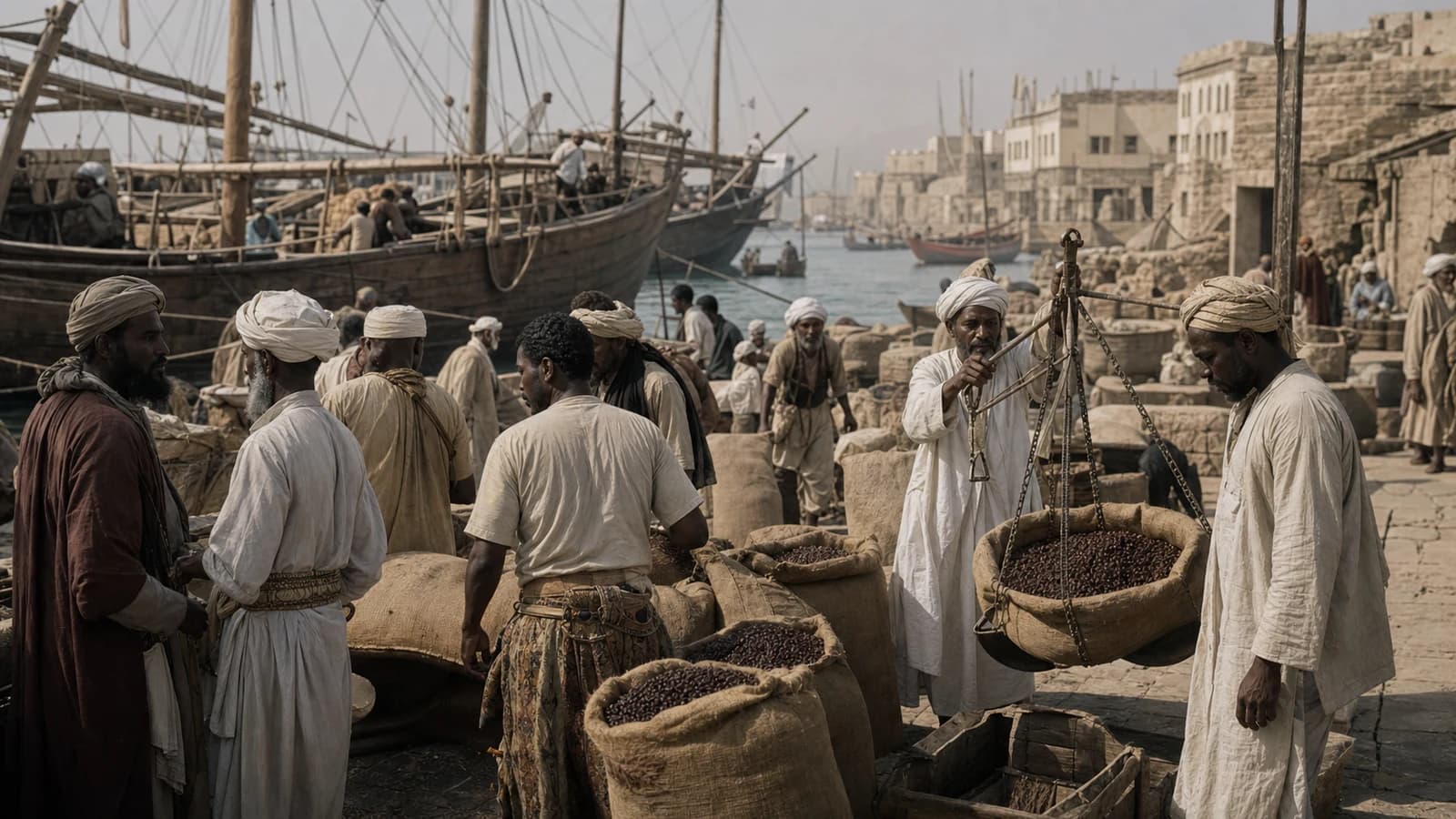
How Yemen's Port of Mocha Named a Global Coffee Trade
How al-Makha linked Yemen's highland coffee to Red Sea and Indian Ocean markets, why its advantage faded, and how a port name came to mean coffee and chocolate.
Mocha coffee takes its name from al-Makha (also written Mokha or Mocha), a port on Yemen's Red Sea coast. From the sixteenth through the eighteenth centuries, Yemeni coffee moved through this harbour into trading networks that connected the Arabian Peninsula, the Ottoman Mediterranean, India and Europe. The port's name became so closely associated with the product that “Mocha” survived long after Yemen lost its early commercial advantage.
The familiar story is often reduced to a single sentence: coffee came from Mocha. That is too simple. The coffee plant's African history, the development of coffee drinking in Yemen, cultivation in Yemen's highlands, overland transport to the coast, Indian Ocean shipping, Ottoman demand and European company trade are different stages. Al-Makha did not grow the beans shipped under its name, and it was never only a coffee warehouse. Its importance came from organizing exchange between inland producers and several maritime markets.
Mocha, Mokha and al-Makha: one place, several spellings
Al-Makha is a common transliteration of the Arabic place-name المخا. European travellers and merchants rendered it in forms including Mocha, Mokha and Moca. Historical documents may therefore appear to discuss different places when they refer to the same Yemeni port. Modern maps often use Mokha or Al Mokha, while coffee labels favour Mocha.
Spelling matters in research. A search limited to “mocha” produces recipes and chocolate drinks; adding “al-Makha Yemen port,” “Mokha trade” or a historical company name retrieves catalogues and shipping records. The geographic entry point is our Islamic world map, while the Islamic history timeline helps place Ottoman expansion and later commercial change.
What happened in Yemen before the port boom
Coffee's biological and cultural beginnings should not be collapsed into one origin legend. Coffea arabica is associated with the highlands of northeastern Africa, especially Ethiopia, but Yemen became crucial to the cultivation, preparation and organized trade of coffee as a beverage. By the fifteenth century, coffee drinking was associated with Sufi communities in Yemen, where it could support wakefulness during night devotion. From there the drink circulated through travel, pilgrimage and commerce.
This does not mean one Sufi “invented” coffee at a documented moment. Sources written after a custom becomes established often tell stories that explain its prestige. Historians distinguish such narratives from evidence for cultivation, consumption, legal debate and trade. The British Museum's material on coffee culture emphasizes Yemen and Sufi religious orders in the beverage's early spread without reducing the process to a single discoverer.
Yemen's highland terraces supplied the crop. Beans then had to move down difficult routes toward Red Sea outlets. Port history begins with this inland geography: farmers, labourers, pack animals, market towns, tax collectors and brokers made export possible before a European ship appeared at the quay.
Why al-Makha became a major port
Al-Makha rose to prominence after the Ottoman conquest of Yemen in 1538, when it became an administrative and commercial hub. Ottoman control tied the port to a state spanning Egypt, the Hijaz and much of the eastern Mediterranean. Pilgrimage traffic and existing Red Sea routes created consumers and carriers familiar with movement between Yemen, Jeddah, Suez and Cairo.
Political control changed. The Qasimi imamate displaced Ottoman rule in much of Yemen during the seventeenth century, yet the port continued to flourish. Its rulers could tax valuable exports, negotiate with foreign merchants and manage access to inland supply. The coffee trade was therefore not simply a European enterprise imposed on an empty coast; Yemeni authorities and merchants set conditions inside a much older regional economy.
| Part of the network | Main role | What a port-only story misses |
|---|---|---|
| Yemeni highlands | Cultivation, harvesting and initial preparation | Ecology, farm labour and inland prices |
| Caravan and market routes | Movement from producing districts to the coast | Transport costs, tolls and intermediaries |
| Al-Makha | Storage, taxation, brokerage and seaborne export | The port handled goods other than coffee |
| Red Sea and Ottoman markets | Large established demand and onward distribution | Europe was not the only destination |
| Indian Ocean merchants | Finance, shipping, imports and regional connections | Gujarati and other Asian actors were central |
| European companies | Company factories, contracts and long-distance purchases | They entered an existing system and depended on local brokers |
A port of coffee—and much more than coffee
The name Mocha became a coffee label, but historians warn against imagining warehouses filled with one commodity and little else. Research on al-Makha documents textiles, spices, metals, porcelain, aromatics and stimulants in its market. Ships did not need to arrive empty simply to load beans; merchants balanced imports, exports, currency and credit across several ports.
This diversity helped al-Makha function as an entrepôt. Indian textiles could circulate through Red Sea markets, and Yemeni coffee could pay for imports. Gujarati merchants, including Bohra networks, acted as brokers and commercial partners. Ottoman, Arab, Armenian, Indian and European participants did not occupy equal positions, but the marketplace cannot be described accurately through European company diaries alone.
The distinction matters because a commodity label hides the city that produced it. Calling al-Makha “the coffee port” is useful shorthand; calling it a port that existed only because Europeans wanted coffee erases local government, regional consumers and non-coffee trade.
How coffee travelled from Yemen to the Ottoman world
By the early sixteenth century, coffee was established in major cities of the Ottoman realm. Cairo, Damascus and Istanbul developed coffeehouse cultures in which people talked, played games, listened to performances and exchanged news. Authorities sometimes tried to restrict coffeehouses, but regulation and moral controversy are evidence of popularity, not proof that the drink disappeared.
Jeddah was a vital node because it served the Hijaz and pilgrimage routes. Cargo could move north through the Red Sea and onward toward Egypt and Mediterranean markets. Pilgrims also carried habits, stories and demand across political borders. Coffee's expansion was thus commercial and social at once.
For more on the institutions surrounding trade, read our explanation of caravanserais and long-distance travel. Al-Makha was a seaport rather than a caravanserai, but its success likewise depended on storage, law, taxation, lodging, brokerage and information.
European companies entered an existing market
Dutch, English and French companies established commercial presences and sought regular supplies. Their records are rich because company agents wrote letters, kept accounts and complained about prices, duties and rivals. Those archives have strongly shaped modern histories of Mocha.
They must be read with care. A company factor who describes obstruction may be documenting a failed bargaining strategy rather than a dysfunctional market. Local authorities had fiscal goals; brokers served multiple clients; merchants from India and the Red Sea had their own capital and shipping knowledge. European companies could be influential without controlling every transaction.
By the early seventeenth century, al-Makha was a principal entrepôt for coffee moving toward Red Sea and Mediterranean consumers. European demand later expanded, but chronology matters: the Ottoman and Islamic-world market was not a preliminary footnote to “real” coffee history in London, Amsterdam or Paris.
Was Yemeni coffee protected by a monopoly?
Yemen enjoyed an early commercial concentration, and rulers and merchants had reasons to protect revenue. Popular retellings often claim that every exported bean was boiled or sterilized so nobody could grow coffee elsewhere. That statement is too absolute for the evidence usually supplied with it. Controls, secrecy and restrictions may have existed, but viable seeds and plants did leave the region.
Another popular story credits a single pilgrim, Baba Budan, with smuggling exactly seven beans to India and thereby breaking the monopoly. The story is culturally influential, especially in accounts of Indian coffee, but its precise details are difficult to verify from contemporary documentation. It should be presented as a later tradition, not the sole mechanism by which cultivation moved.
The historical result is clear even when the heroic tale is uncertain. Coffee cultivation spread to India, Java and other suitable regions. Dutch colonial production in Java, followed by expanding cultivation in the Caribbean and Latin America, gave buyers alternatives to Yemeni supply. Once “coffee” could be sourced at scale elsewhere, al-Makha's name no longer guaranteed control of the commodity.
Why the port declined
There was no single morning when Mocha ceased to matter. Its relative decline resulted from several connected changes: competing plantations offered larger or cheaper supplies; trade routes and company strategies shifted; Yemeni political conditions affected security and taxation; and other ports gained advantage. Environmental and harbour conditions also mattered over time.
The opening of new production zones changed bargaining power most decisively. A port that had benefited from access to a scarce regional crop faced a world market supplied by empires using coerced labour and plantation systems. This global expansion made coffee more widely available while imposing enormous human costs outside Yemen.
Later conflict and economic marginalization affected al-Makha, but modern hardship should not be projected backward as if the port had always been peripheral. At its height it was a place where rulers, brokers, sailors, pilgrims and company agents negotiated one of the early modern world's most desired commodities.
What “mocha” means on a modern coffee menu
Today the word can refer to three different things, and context decides which one is intended.
- Geographic-historical Mocha: coffee associated with Yemen and the port name al-Makha. Specialty sellers may use “Yemen Mokha” for beans grown in Yemen, but the farm region and traceability should still be stated.
- A flavour description: coffee can naturally show cocoa-like notes. This does not mean chocolate was added. Roasting, variety, processing and brewing influence the cup.
- A caffè mocha: the modern café drink normally combines espresso, milk and chocolate. Its chocolate ingredient distinguishes it from a plain Yemeni coffee.
The overlap is not accidental: the historic coffee name became associated with a flavour, and later with a chocolate-and-coffee drink. But a menu label cannot tell you that a bean came from Yemen. For origin claims, look for producer, region, harvest, processing method and importer information.
How to evaluate a “Yemen Mocha” product claim
- Ask for the producing region and community. “Mocha” alone may be a blend name rather than geographic origin.
- Look for lot and harvest information. Traceability is more useful than romantic packaging.
- Separate variety from trade name. A coffee marketed as Mocha is not automatically a single botanical variety.
- Check the processing description. Natural or dry processing is common in Yemen, but a method should not be assumed from nationality alone.
- Treat tasting notes as descriptions, not ingredients. “Chocolate” may describe perception unless the label lists added flavouring.
- Be cautious with monopoly legends. A good seller can explain provenance without claiming every bean descends from a single smuggling episode.
How historians reconstruct Mocha's trade
No single archive contains the whole market. Ottoman administrative sources record government concerns; Yemeni chronicles describe political power; Islamic legal and literary texts reveal debate and consumption; European company records preserve prices and disputes; archaeology and material culture show cups, mills and port remains. Each source has a viewpoint.
Researchers compare dates, units and place-names before merging figures. A “bale” or local weight may not equal the same amount in another account. A shipment purchased at Mocha could contain coffee grown far inland. An agent's claim that trade stopped may mean his company failed to buy, not that every merchant stopped trading.
Objects add another layer. Cups and coffeehouse scenes show how the drink was served and imagined, while botanical evidence and plantation records track cultivation. The British Museum's exhibition materials are particularly useful for connecting beverage culture to objects rather than presenting trade as numbers alone.
Common questions about Mocha coffee history
Did coffee originate in Yemen or Ethiopia?
The plant's African history and the beverage's Yemeni history answer different questions. Coffea arabica is associated with Ethiopian highlands, while Yemen was central to early cultivation, coffee drinking and organized export. Saying “coffee came from one country” without defining plant, beverage or trade creates a false choice.
Did all early coffee exports pass through Mocha?
No. Al-Makha became a leading port, but Red Sea and regional trade involved other ports and land routes. “Mocha” became the most durable label, not proof that every bean followed one route.
Is mocha coffee naturally chocolate-flavoured?
Some coffees have cocoa-like tasting notes, including coffees from Yemen, but those notes are sensory descriptions. A caffè mocha contains added chocolate. Historical Mocha refers first to the port name and trade association.
Can a bag labelled Mocha be assumed to contain Yemeni coffee?
No. It may name a blend, roast style, flavour or café drink. Genuine origin information should identify Yemen and ideally a region, producer or lot.
Why is Mocha important beyond coffee enthusiasts?
The port reveals how an everyday drink emerged from Muslim devotional practice, Yemeni agriculture, Ottoman consumption, Indian Ocean commerce and European company competition. It is a case study in how local knowledge becomes a global commodity—and how a place-name can survive after trade power shifts elsewhere.
The next stage of the story appears in our account of Ottoman coffeehouses and public life in Istanbul. It shows how a traded crop acquired new social settings after leaving Yemen, and why the history of consumption cannot be read from shipping totals alone.
Sources
- British Museum, Life in a Cup — supports the account of coffee drinking in Yemen, Sufi devotional use, pilgrimage routes and its early-sixteenth-century arrival in Istanbul.
- Royal Botanic Gardens, Kew, Coffea arabica — distinguishes the wild African range of the plant from cultivation and beverage history in Yemen.
- University of Washington Press, The Merchant Houses of Mocha — supports the mid-sixteenth-century rise of the port, the 1635 Qasimi transition, its Indian Ocean networks, urban form and mid-nineteenth-century decline.
- Law and History Review, Anglo-Yemeni Treaty of 1821 — documents al-Makha's administrative and commercial setting and warns against reading European company claims as the whole market.
- Itinerario, Storehouse of Stimulants — supplies evidence that al-Makha's market handled multiple commodities and cannot be reduced to coffee alone.
- Qatar Digital Library, Handbook of Arabia, 1917 — provides a dated historical observation of the port after its commercial decline rather than evidence about its seventeenth-century peak.
- Qatar Digital Library, Bombardment of Mocha in 1820 — documents British residency, coffee shipment and customs disputes during a specific late phase of Mocha's history.
- Library of Congress, Early Eighteenth-Century East Indies Trade — uses a 1722 voyage and map to show two-way cargoes, anchorage at Mocha Roads and coffee exports within an Indian Ocean network.
- AramcoWorld, Coffeehouses of the Middle East — supports the distinction between Ethiopian plant history, Yemeni devotional use and Ottoman coffeehouse culture.
- AramcoWorld, Yemen's Well-Traveled Bean — documents Yemeni cultivation, qishr, modern coffee practice and the survival of chocolate-like tasting notes without added chocolate.
The header image was created with AI assistance as an editorial illustration. It should not be used as evidence for the historical appearance of al-Makha or its harbour.


