Barid: The Postal and Intelligence Network of the Caliphates
How relay routes moved official messages and reports across early Islamic states, what stations required, and why the barid was not a public post office.
The barid operated as an official communications and intelligence institution within early Islamic caliphates and their successor states. It adapted existing imperial infrastructures, modifying its structure under Umayyad and Abbasid rule to meet shifting political needs. The system facilitated the movement of dispatches and reports through relay stations, mounted messengers, established routes, and dedicated officials.
Relay Stations and Routing
Relay stations supported the movement of messengers, but their spacing and density varied with route, period and political control. Surviving descriptions do not justify drawing one uniform grid across every province. Routes linked selected provincial centers with political authorities, and the network changed as dynasties, frontiers and administrative priorities changed.
Travel speeds for dispatches depended on route conditions, seasonal weather, urgency, and surviving reports. Uniform speed estimates are unsupported; historical reality involved messengers adjusting pace to terrain and resources. This variability means information traveled at different rates rather than adhering to a fixed standard. The administrative trust required to maintain these routes remains a general feature of the system.
Intelligence and Reporting
The intelligence function included reports on officials and local conditions, but the evidence varies significantly by period. Provincial data could travel toward the center, allowing the caliphate to monitor distant territories. However, the volume and nature of this intelligence were not constant across all eras or regions. The network served as a channel for directives and a feedback loop for governance.
Written orders interacted with messengers in complex ways. Dispatches contained instructions requiring execution, while reports provided context for decision-making. The reliability of these reports depended on established protocols and the integrity of officials. Distinguishing between surviving evidence, written prescriptions, later copies, and modern reconstruction is essential for accurate interpretation.
Administrative Trust
Roads, available mounts, supplies and reliable personnel made official communication possible. Evidence for how each station obtained or managed those resources differs by place and period. The system therefore depended not only on a written order but on a chain of people trusted to carry, receive and report information without treating every route as administratively identical.
State Service versus Public Utility
The barid must be distinguished from a modern universal public postal system. It was an exclusive institution for officials and intelligence, not a public utility for civilian correspondence. This distinction prevents projecting modern frameworks onto historical contexts. Understanding its limited scope clarifies its role in maintaining imperial cohesion without overstating its breadth.
- Identify the dynasty, route and date before mapping a station
- Separate official ideals from documented journeys and reports
- Check whether a source describes dispatch, transport or intelligence
- Avoid treating the barid as a public post office or one permanent map
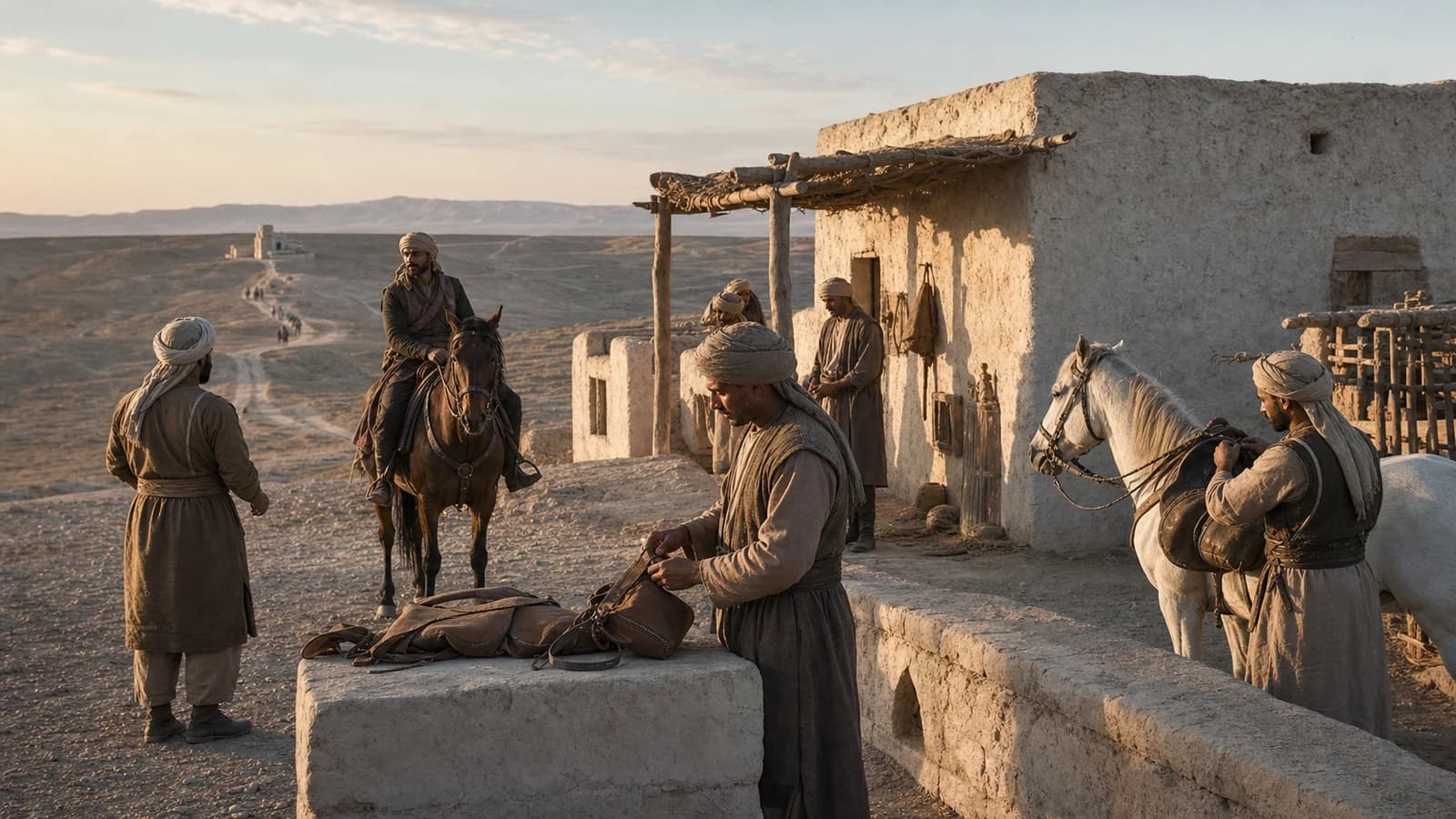
The cover image is an original AI-assisted relay-station reconstruction, not a photograph or exact view of a documented barid route.
Sources
- Cambridge University Press: al-Barid, the Early Islamic Postal System — scholarly history of the institution.
- Encyclopaedia Iranica: Barid — institutional definition and regional development.
- Oxford Academic: Postal Systems in the Premodern Islamic World — scholarly review and historiographical context.


