Arabic Papyri: Receipts and Letters from Early Islamic Rule
How papyrus documents expose taxes, orders and ordinary correspondence, why bilingual records matter, and how tiny fragments revise broad political history.
Arabic papyri from the early Islamic period offer tangible evidence of administrative structures and daily life in Egypt and neighboring regions through surviving receipts, letters, orders, leases, and tax demands. These documents preserve dated transactions and everyday language that narrative chronicles often omit, providing a ground-level view of governance.
Administrative Context and Language Shift
The linguistic landscape during the early Islamic period was characterized by gradual change rather than abrupt replacement. Greek, Coptic, and Arabic could coexist during administrative transition, reflecting a prolonged period where multiple languages served bureaucratic functions simultaneously. This multilingual reality allows scholars to trace the evolution of official documentation over time.
Surviving receipts and tax demands anchor historical timelines with precision, illustrating how resources were managed at the local level. While these fragments preserve specific transactions, they represent individual moments in a complex system. Historians must distinguish between the written prescriptions found in texts and the practical realities of implementation across different provinces.
Material Features and Provenance
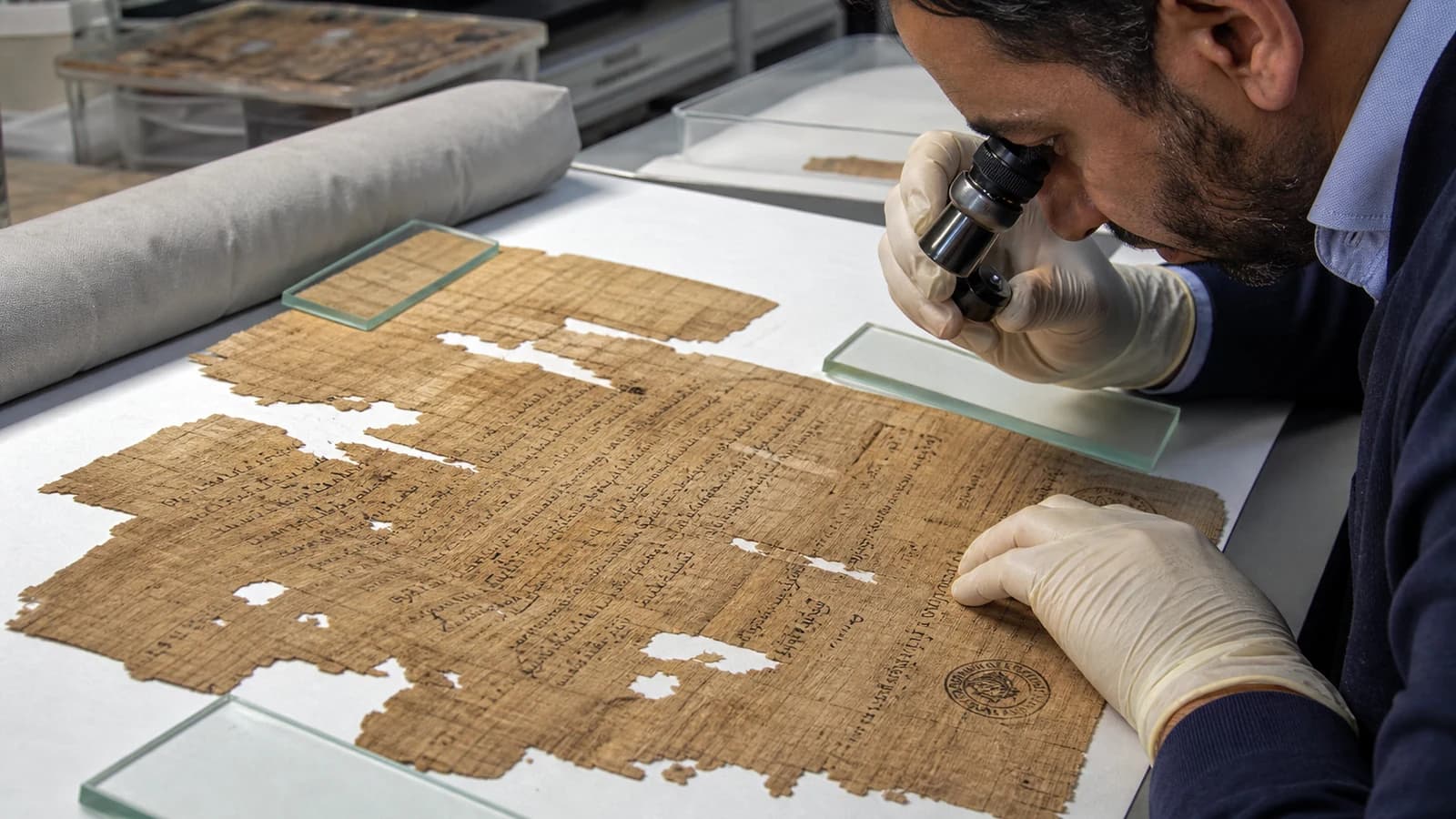
Evaluating a papyrus fragment requires close attention to its physical characteristics. Fiber direction, sheet reuse, seals, handwriting styles, and damage patterns provide essential data for dating and attribution. These material features often indicate how the document was stored or discarded, offering clues about its original context beyond the text itself.
Provenance history remains critical for interpreting any single fragment. A fragment’s interpretation depends on edition, reading and archaeological or collection history. Without knowledge of where a fragment was found or how it entered modern collections, its value as historical evidence is significantly diminished. Scholars must be cautious not to use one receipt to describe the whole caliphate.
Script Analysis and Dating
Changes in script style help date documents by providing visible markers of chronological progression. Formulas used in greetings, signatures, and dating lines also shift over time, offering additional anchors for establishing a timeline. As digitized collections expand comparison across vast geographic areas, scholars can identify regional variations in administrative practices more effectively.
Understanding these shifts requires distinguishing between surviving evidence and later copies. Modern reconstruction of damaged texts relies on the specific choices made by editors during publication. Researchers must remain aware that an edition represents one possible reading of a fragment, influenced by the available archaeological context at the time of study.
Ethical Considerations
The study of papyri is complicated by the ethical concerns around undocumented antiquities. Items without clear provenance risk being removed from their archaeological context, losing vital information about their association with other objects or sites. Ethical scholarship demands rigorous verification of ownership history to preserve the integrity of the archival record.
- Verify physical features such as fiber direction, seals, and handwriting.
- Check provenance for clear archaeological or collection history.
- Analyze script changes and formulas to establish a relative date.
- Cross-reference editions to understand how readings are constructed.
The cover image is an original AI-assisted document reconstruction, not a facsimile or translation of an excavated papyrus.
Sources
- Cambridge University Library: Papyrus Collections — collection scope, languages and documentary material.
- University of Manchester: Arabic Papyri Catalogue — cataloged Arabic papyrus documents.
- Mountain West Digital Library: Arabic Papyrus Collection — digitized papyrus, parchment and paper records.


