Cairo Geniza: Letters and Contracts from Mediterranean Life
How discarded writings from a synagogue storeroom illuminate trade, family and law, what Judeo-Arabic means, and why fragments require reconstruction.
The Cairo Geniza is a vast corpus of manuscript fragments associated with the Ben Ezra Synagogue in Fustat. It preserves hundreds of thousands of documents from the medieval Mediterranean, including religious texts alongside letters, contracts, accounts, petitions, and drafts. These materials offer insight into daily life for merchants, households, women, and institutions across the region.
Preservation Practices
Fragments were preserved because worn or name-bearing writing was deposited in a storeroom rather than destroyed. This practice ensured the survival of mundane documents like grocery lists and divorce settlements alongside legal contracts. The resulting collection is chaotic and fragmented, reflecting the organic nature of its accumulation.
Language and Script
Many Geniza documents are written in Judeo-Arabic, an Arabic language commonly transcribed using the Hebrew script. This linguistic phenomenon demonstrates the cultural integration of Jewish communities within the broader Arabic-speaking world. It is not a separate code or dialect but a reflection of how Jewish scribes adapted their writing systems to local environments.
Dispersal and Digital Reunion
Fragments were dispersed globally through sales, donations, and acquisitions, ending up in libraries across Europe, America, and Asia. Modern digital initiatives aim to reunite these scattered pieces, allowing scholars to reconstruct documents that were once part of single manuscripts. This digital reunion is crucial for understanding the original context.
Historical Insights and Bias
The Geniza provides evidence of trade networks, social interactions, and administrative practices in the medieval Mediterranean. It reveals the lives of women who managed households and conducted business, as well as the challenges faced by merchants navigating long-distance trade. However, researchers must account for survival bias.
- Distinguish between religious texts and secular documents.
- Note that Judeo-Arabic reflects cultural integration.
- Account for fragmentation and organic accumulation.
- Recognize the role of digital reconstruction projects.
The Cairo Geniza is a testament to the resilience of Jewish communities and the complexity of medieval Mediterranean life. It should be understood as a dynamic archive that reflects the realities of its time, rather than a static collection of artifacts. By examining both the contents and the context of these fragments, historians can reconstruct a nuanced picture of daily existence in the Islamicate world.
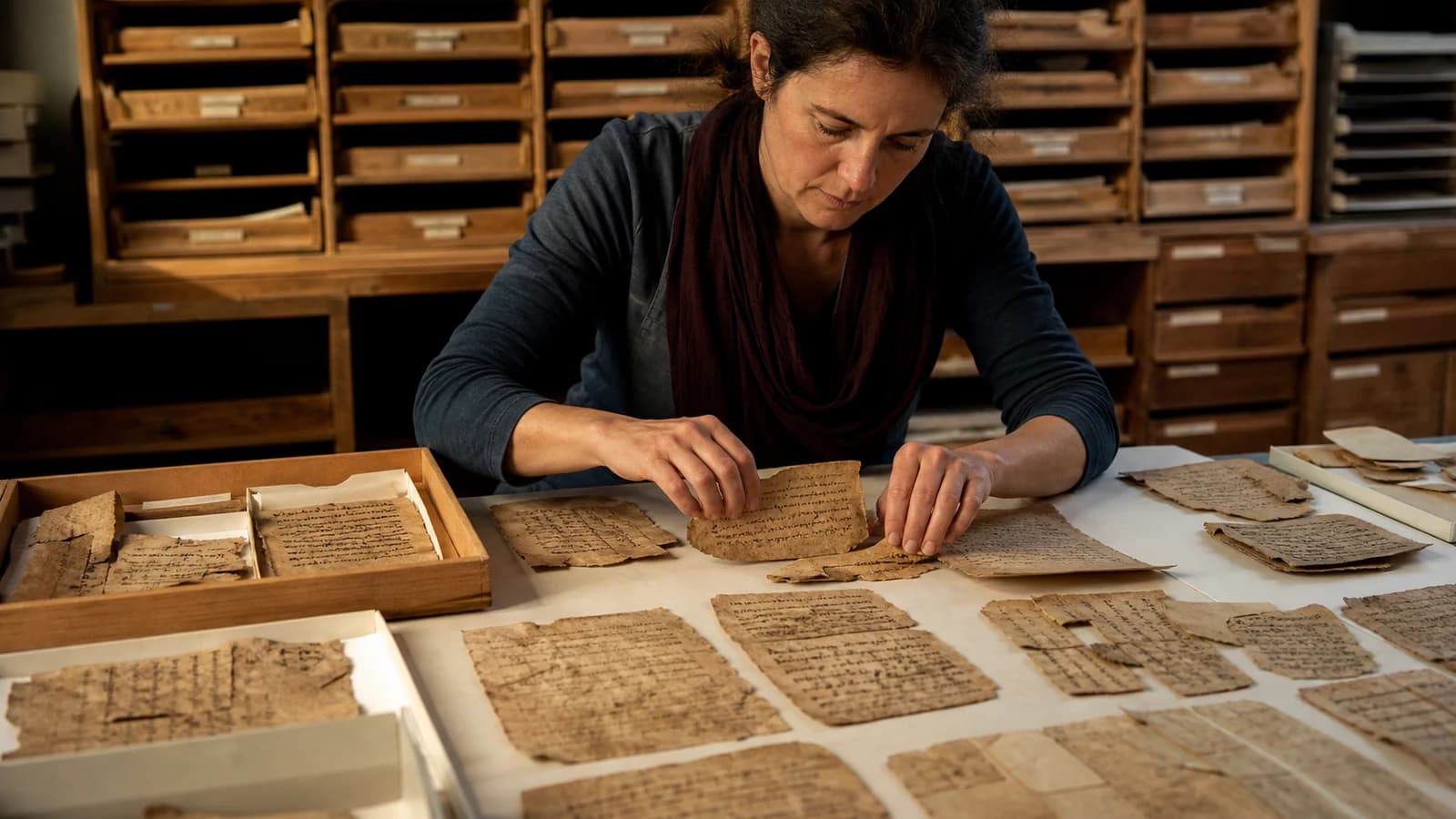
The cover image is an original AI-assisted archive reconstruction, not a photograph of the Ben Ezra Geniza or a facsimile of a real fragment.
Sources
- Princeton Geniza Lab: What Is the Cairo Geniza? — corpus origin, scale and languages.
- Princeton Geniza Project: Corpus — document types, metadata and digital reconstruction.
- University of Cambridge: Discarded History — collection history and research value.


