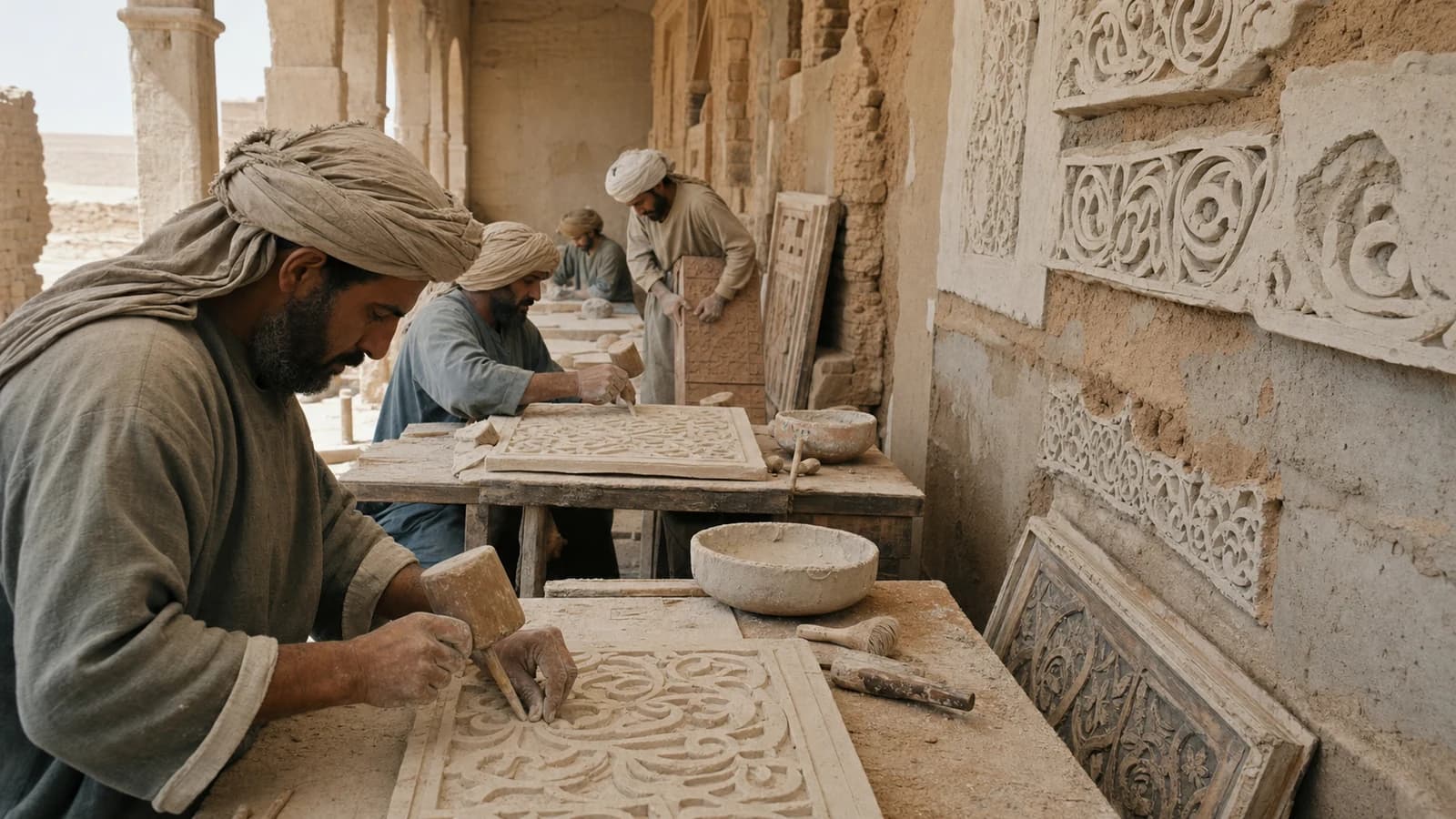
How Samarra Stucco Became an Abbasid Design Language
A source-critical guide to Samarra stucco, Styles A, B and C, beveled carving, molded repetition, Abbasid architecture, archaeological labels and wider influence.
The importance of Samarra is not that one workshop suddenly invented all Islamic ornament. The rapidly built capital concentrated patrons, builders, molds, materials and designs on an extraordinary scale between 836 and 892. Its buildings preserved a large body of plaster decoration, and related forms appeared across Abbasid-connected regions and in wood, stone, ceramics and other media. The three style names are modern scholarly tools, not labels that Abbasid craftspeople left on their walls.
Samarra stucco at a glance
| Question | Best-supported answer | Important caution |
|---|---|---|
| Where and when? | Samarra, Iraq, especially during its period as Abbasid capital from 836 to 892. | Related beveled forms may predate the capital and appear beyond Iraq. |
| What material? | Gypsum-rich plaster or stucco applied as architectural surface decoration. | “Stucco” can cover different mixtures, layers and techniques. |
| How many styles? | Three conventional groups, usually called A, B and C. | They are archaeological classifications, not a proven simple timeline. |
| What is Style C? | The beveled style: repeated abstract or pseudo-vegetal shapes defined by slanting cuts and shallow relief. | Not every object called “Samarra style” was made at Samarra. |
| How was it produced? | Both carving and repeatable molding or stamping were used. | Technique varies by style, building, layer and object. |
| Why did it spread? | Imperial networks, mobile craftspeople, reproducible patterns and court fashion helped related forms travel. | Similarity alone does not prove direct copying from one workshop. |
A multilayered panel complicates the idea of one simple beveled technique
Qatar Museums identifies its Samarra stucco panel as object SW.15.1999 and dates it to the ninth century. Its collection study emphasizes a multilayered beveled cut that Herzfeld's original account did not discuss. The authors report that this particular technique had, at the time of their study, been observed only in stucco revetments from Samarra. That limited observation concerns technique, not every abstract motif or every object described as Samarra style.
The distinction matters when comparing the panel with the Met's earlier, probably Raqqa carved capital, object 36.68.1. A capital and a wall revetment serve different architectural roles; related sloping ornament does not establish identical manufacture or a shared workshop. Record the support, layers, cut and findspot alongside the pattern. The useful comparison is between documented objects and processes, rather than a claim that every beveled surface followed one recipe.
Why Samarra became an artistic laboratory
Caliph al-Mu‘tasim established the new Abbasid capital north of Baghdad in 836. The city served the court and army and expanded along the Tigris through palaces, barracks, houses, gardens, racecourses and congregational mosques. UNESCO emphasizes its preserved plan and its unusual scale. Because the caliphal court returned to Baghdad in 892, much of the urban fabric was not repeatedly rebuilt in the same way as a continuously occupied capital.
Speed and scale created unusual demand for interior finishes. Mud brick and baked brick supplied much of the structure, while plaster could cover walls, articulate dados and friezes, and turn large surfaces into coordinated decorative programs. Samarra’s role follows the earlier founding of the Round City of Baghdad in 762, but its linear urban landscape, military setting and archaeological survival make it a different kind of Abbasid capital.
What stucco means in this context
Stucco is a surface material rather than a single recipe. In Samarra discussions it usually means plaster, often gypsum-based, that could be spread over masonry and then carved, pressed, molded, painted or assembled in repeating panels. A finished wall could conceal the ordinary structural material beneath a highly controlled visual skin.
Plaster offered several advantages. It set quickly, could be worked while moist, accepted fine detail and allowed a design to be repeated with molds. Damage and archaeological removal can make it difficult to reconstruct the complete sequence of underlayer, finish, pigment and repair. Museum fragments are therefore pieces of architecture, not originally autonomous framed artworks.
Who created Styles A, B and C
The letters are not Abbasid names. German excavations led by Friedrich Sarre and Ernst Herzfeld at Samarra between 1911 and 1913 recovered and documented large quantities of ornament. Herzfeld grouped the material by formal features and numbered the categories. K. A. C. Creswell later relabeled them A, B and C in an order that encouraged readers to see a progression.
That history matters because classification shapes interpretation. A museum label saying “Style C” tells us that an object fits a modern comparison group; it does not prove that ninth-century patrons ordered “Style C” or that every example was produced after A and B. Qatar Museums notes that Herzfeld’s formal study did not fully address technique, composition, architectural function or cultural context. Current research can retain the useful names while revising the story they once implied.
Style A and recognizable vegetal carving
Style A is generally associated with deeply carved plant ornament whose leaves, vines and scrolling stems remain recognizable. The relief can create strong divisions between raised design and recessed background. Its forms connect with longer late antique, Sasanian, Byzantine and early Islamic traditions rather than beginning from a blank slate.
Calling it “naturalistic” is relative. The plants are ordered, repeated and transformed to fit architectural surfaces; they are not botanical illustrations. Style A is valuable because it makes continuity visible. The development of Abbasid ornament involved selecting and reorganizing inherited forms, not simply replacing representation with geometry overnight.
Style B and the transformation of plant forms
Style B retains vegetal ancestry but makes the shapes flatter, more regular and more abstract. Repeated leaves and half-palmettes can be separated against drilled or punched grounds. Contours matter more than modeling, and the viewer may move between recognizing a plant and reading an autonomous pattern.
The category’s boundaries are not perfectly fixed. Individual fragments may share features assigned to different groups, and complete rooms could use several techniques. It is safer to describe the actual depth, motif, ground treatment and repetition of a panel than to let the letter alone carry the whole explanation.
Style C and the beveled cut
Style C is the group most often identified as the Samarra or beveled style. Its curved, symmetrical motifs are cut or modeled with sloping edges so that foreground and background flow into one another. Recognizable leaves may be transformed into repeated lobes, spirals and hooked forms. The result is low, continuous relief rather than a sharply isolated plant on a deep ground.
The Metropolitan Museum describes the beveled style as a vegetal design slant-cut until foreground and background become almost indistinguishable. “Abstract” therefore does not necessarily mean without vegetal history. A motif can cease to depict a specific leaf while preserving the rhythm of splitting stems, paired forms and continuous growth.
Carving, molding and repeatable production
Some Samarra plaster was carved directly, but repeat patterns could also be produced with molds or stamps and joined into long revetments. Repetition suited the scale of palaces and houses. A modular process did not eliminate skilled decisions: craftspeople still prepared plaster, aligned units, adjusted corners and openings, cut details and applied finishing or color.
The word “industrial” is sometimes used for the quantity and repeatability of Style C production. It should not be confused with a modern mechanized factory. The relevant innovation was coordinated serial manufacture within premodern building practice. Molds reduced the cost of extending a pattern and helped make a court style transferable, but surviving multi-layered beveled cuts also show that not every surface was a simple one-step impression.
How ornament organized Abbasid interiors
Stucco often covered the lower parts of walls as dados or formed friezes around rooms and openings. Repeated fields could unify spaces built from ordinary brick, while changes in scale or motif marked thresholds and focal points. Painted plaster and figurative wall fragments show that Samarra interiors were not limited to beige abstract relief.
The British Museum preserves pieces excavated from palaces, private houses and the Great Mosque. One carved fragment from the mihrab area has squared beveled ornament; another painted fragment came from a domestic context. These findspots remind us that “Samarra art” crossed religious, residential and ceremonial settings. A museum case assembles objects that originally served different rooms and viewers.
Was the beveled style invented at Samarra?
Samarra supplies the largest and most influential archaeological corpus, but origin claims require caution. The Met’s beveled-style capital, probably made at Raqqa in Syria in the late eighth century, predates the 836 foundation of the Abbasid capital. The museum explicitly connects it with the decorative language later known from Samarra.
The best conclusion is therefore not “Samarra invented the beveled cut from nothing.” Forms and techniques had precedents and may have developed at several Abbasid centers. Samarra’s extraordinary building program standardized, multiplied and made the language visible on a scale that allowed later scholarship to name it after the site.
How the style travelled beyond Iraq
Related abstract and beveled ornament appeared from Egypt and Syria to Iran, Central Asia and Afghanistan. The mosque of Ibn Tulun in Cairo, built in 876–879, is frequently discussed in relation to Samarra because its patron and building culture were connected to the Abbasid military world. The David Collection notes the spread of Samarra-style relief from Egypt to Nishapur during the ninth and tenth centuries.
“Spread” should describe a network, not a row of identical copies. Craftspeople moved; governors imitated court architecture; portable objects circulated; patterns crossed between media; and local workshops combined incoming forms with existing practice. A similar curve in Cairo and Iran may indicate shared Abbasid fashion without proving that the same mold or person travelled to both.
From plaster walls to wood, stone and ceramics
The beveled visual language was not confined to stucco. The Met notes its popularity in wood, metalwork and pottery, while museum objects show related sloping relief on stone and gypsum. When a pattern moves between materials, the tool and surface change: a woodcarver, stoneworker and plasterer cannot make exactly the same cut in exactly the same way.
This translation across media is part of the style’s historical importance. It made abstraction recognizable as an Abbasid-era design choice rather than a recipe bound to one building material. The House of Wisdom history offers a parallel warning about capital-city networks: influence was created by institutions and people across several places, not by one legendary room generating everything.
Did Samarra stucco create the arabesque?
Public histories often call the beveled style a major step toward the arabesque. That is useful if “arabesque” means later systems of continuous, branching vegetal ornament. It becomes misleading when it imagines one inventor or a clean birth date for every form later placed under that European art-historical term.
Samarra demonstrates powerful transformations: vegetal reference became harder to isolate, repetition dominated large fields, and positive and negative space became visually interdependent. Later Islamic ornament developed through many regions, materials and workshops. It inherited possibilities from Samarra without being a mechanical continuation of Style C.
Excavation, museums and lost architectural context
Modern knowledge of the stuccoes depends heavily on early twentieth-century excavation, drawing, photography and division of finds. The Met’s essay on Herzfeld describes the pioneering documentation, while British Museum records preserve excavation numbers and findspots. These archives allow fragments now dispersed among Baghdad, Berlin, London, New York, Doha, Copenhagen and Washington to be compared.
They also expose a limitation. Removed panels lose their original height, neighboring motifs, color, lighting and relationship to human movement. Early excavators often privileged formal classification over construction sequence and household use. Responsible interpretation uses museum fragments together with site plans, field records and material analysis rather than turning a detached square into the complete history of a room.
Why conservation changes what can be known
Samarra Archaeological City has been on UNESCO’s List of World Heritage in Danger since its inscription in 2007. Conflict, encroachment, urban growth, bulldozing, weathering and limits on site management have affected an enormous archaeological landscape. Stucco is especially vulnerable to water, salts, erosion, exposure and poorly designed repair.
The World Heritage Committee’s 2026 decision retained Samarra on the danger list and requested stronger documentation, monitoring and impact assessment. Conservation is not separate from interpretation: when a wall surface disappears, scholars lose evidence about technique, sequence and architectural context. Digital archives and condition records cannot replace the material, but they can preserve relationships that an isolated fragment cannot show.
Common mistakes about Samarra ornament
- “A, B and C were ninth-century workshop names.” They are modern scholarly classifications.
- “The three letters prove a strict chronology.” The groups may overlap, and their sequence is debated.
- “Style C has no connection to plants.” Its abstraction can preserve the structure and rhythm of vegetal forms.
- “Every beveled object came from Samarra.” Related examples occur elsewhere and may predate the capital.
- “Molded decoration required no skill.” Serial production still required materials knowledge, alignment, finishing and adaptation.
- “Samarra single-handedly invented the arabesque.” It was an influential stage in a much longer, multi-regional history.
- “Museum panels were made as portable pictures.” Most were parts of architectural surfaces.
How to identify a Samarra-style fragment
Begin with provenance and excavation record, not resemblance alone. Then examine material, relief depth, edge angle, background treatment, repeat unit and evidence of molding or hand finishing. Ask whether the motif remains recognizably vegetal, becomes highly stylized or merges into a continuous beveled field. Pigment or attachment marks may reveal architectural use.
Finally compare several catalogues. The Islamic Golden Age timeline places Samarra within Abbasid political history; the Abbasid Revolution guide explains how the dynasty came to power; and the Battle of Talas source guide shows why simple one-event diffusion stories need testing. Style is strongest evidence when joined to archaeology, not used in place of it.
Answers to common questions
When was Samarra the Abbasid capital?
From 836 to 892. The short capital phase produced a vast urban and architectural landscape whose partial abandonment helped preserve its plan.
What are the three Samarra stucco styles?
Style A generally uses deeply carved recognizable vegetal forms, Style B transforms them into more stylized patterns, and Style C uses shallow beveled abstract or pseudo-vegetal repetition. The categories are useful but not absolute.
Why is Style C called beveled?
Its motifs are defined by sloping or oblique surfaces rather than sharply separated vertical edges, making figure and ground appear to flow together.
Was the decoration carved or molded?
Both techniques were used. Some plaster was carved, while repeated units could be molded or stamped and then assembled and finished on the wall.
Where did the style spread?
Related Abbasid-era forms appear across a wide zone including Syria, Egypt, Iran, Central Asia and Afghanistan, and across several materials. Each case still requires local evidence.
Related Muslim Post guides
- Arabesque Art Explained: Leaves, Scrolls and Repeating Patterns
- Islamic Geometric Patterns: Compass, Grids and Star Polygons
- Mosque Architecture Terms Explained by Function
Sources
- UNESCO World Heritage Centre, Samarra Archaeological City — supports the 836–892 capital phase, city scale, architectural significance, spread of carved stucco and danger-list status.
- UNESCO World Heritage Committee, 2026 Samarra decision — provides the current conservation assessment, including encroachment, urban growth, deterioration and required monitoring.
- Metropolitan Museum of Art, The Art of the Abbasid Period — supports Samarra’s abstract and pseudo-vegetal beveled ornament, its use across media and its wider Abbasid influence.
- Metropolitan Museum of Art, Capital in the Beveled Style — supplies a likely Raqqa example that complicates claims that the visual language began only at Samarra.
- Qatar Museums, Abbasid stucco panel from Samarra — explains Herzfeld’s grouping, later A–B–C labels, beveled technique and limits of early formal classification.
- British Museum, carved stucco from the Great Mosque — documents an excavated Abbasid plaster fragment, its mihrab-area findspot, technique and modern collection history.
- British Museum, painted plaster from Samarra — supports the city’s dates, scale, mud-brick architecture, domestic find context and presence of painted figurative decoration.
- Ashmolean Museum teaching resource, Ibn Tulun — provides a museum-based comparison for A, B and C and the relationship between Samarra and Abbasid architecture in Egypt.
- David Collection, two stucco reliefs — supports molded repetition and the spread of beveled Samarra-style ornament from Egypt to northeastern Iran.
- Smithsonian Freer and Sackler Archives, Samarra excavation context — connects Herzfeld’s photographic archive with cross-media Abbasid motifs and the need to reconstruct architectural context.


