How Islamic Geometric Patterns Use Circles, Grids and Repeating Stars
Learn how a compass and straightedge create six- and eight-point star frameworks, how repeat units fill a surface, and what dated museum tiles and woodwork reveal about Islamic geometric ornament.
An eight-point star can begin with a circle divided into eight equal arcs and two overlapping squares. Yet the star alone is not a finished wall pattern: a maker must decide how neighboring shapes meet, which lines remain visible and how the design fits tile, wood or another material. The Metropolitan Museum of Art's overview identifies circles, squares, stars and other polygons as recurring building blocks. Historic objects show that those blocks were combined with inscriptions, foliage and images in many different ways.
This guide gives a reproducible way to see a six- or eight-point framework, then tests that diagram against actual works. It describes a possible construction, not a universal recipe recovered from every workshop. The useful distinction is between construction geometry (the guide lines), visible ornament (the selected lines or shapes) and surface design (the repeated arrangement on an object).
What makes a pattern geometric?
In this context, geometry means an underlying relationship among measured points, lines, angles and shapes. A circle can locate equally spaced points; a square can provide fourfold rotation; a hexagon can organize sixfold arrangements. Repeating those relationships creates a field of motifs. The Met describes geometric ornament as one of several nonfigural modes of Islamic art, alongside calligraphy and vegetal pattern. It also notes that geometric designs occur on architecture and on portable objects. The term therefore names a design approach, not a single shape or a single period.
A viewer may see a large star first, but the repeat often depends on smaller polygons between stars. The V&A's 1262 Iranian tile panel offers a useful example: eight-pointed star and cross-shaped tiles fit together to cover a surface. One star tile alone is not the full tessellation. The cross fills the spaces that would otherwise interrupt the repeat. The object's date and attribution belong to that particular panel; they do not date every star-and-cross arrangement elsewhere.
Geometry also does not mean an object contains nothing else. The shapes can carry painted leaves, poetry or Qur'anic writing. A wooden panel may combine an angular outline with carved vegetal detail. When describing a work, distinguish the tile's outline, its internal decoration, the assembled panel and any building from which it came. Those are four different levels of evidence. Our separate explanation of arabesque leaves and scrolls examines one design language that often intersects with geometry.
How do you construct a six-point framework?
Begin with a circle whose radius stays fixed in the compass. Pick a point on its circumference and, without changing the compass opening, step that radius around the circumference six times. In ideal Euclidean construction, the six marks are the vertices of a regular hexagon. Join adjacent marks for the hexagon. Connect every other mark to make one equilateral triangle; the three unused marks make a second triangle. Together the triangles produce a six-point star framework.
The framework gives you choices rather than one compulsory finished design. You could emphasize the two triangles, their central hexagon, or a network of lines extending from the six tips. A craftsperson might thicken selected segments into bands, weave over-and-under crossings, insert a smaller motif or crop the figure at a border. The mathematical guide lines need not appear in the final painted, cut or carved surface. This difference explains why looking only at colored areas may not reveal the construction underneath.
The exercise is a way to understand the relationship among circle, hexagon and star. It does not establish that a particular tile was produced by exactly these six compass steps. To make that historical claim, one would need evidence from the work itself, a design drawing, construction traces or a documented workshop practice. The Met's educator publication on geometric design uses compass-and-straightedge activities to teach how basic shapes can generate more elaborate patterns; a classroom demonstration and an attribution of an object's actual making process have different purposes.
How does an eight-point star come from squares?
Draw a circle, a vertical diameter and a horizontal diameter. These cross at four right angles. Bisect each right angle to place four more marks on the circle, halfway between the first four. You now have eight equally spaced points. Join the four points at the cardinal directions to form one square. Join the four diagonal points to form a second square rotated by 45 degrees. Together they create an eight-point star outline and a smaller octagonal region at their overlap.
As with the six-point exercise, the two-square diagram is a framework. A maker can retain only parts of the crossing lines, surround the star with other polygons, or use the eight-sided region as a center for further construction. There are other valid routes to eightfold designs. The number of tips tells you something about the visible geometry, but by itself cannot identify the place, century, material or religious setting of a surviving object.
The Met's thirteenth-century Kashan star tile makes this distinction tangible. Its collection record describes star- and cross-shaped lustre tiles from Iran; some bear Qur'anic text and others Persian poetry. The museum says the displayed panel was assembled later from pieces that came from different architectural contexts, religious and secular. Thus a present display can demonstrate how star and cross shapes fit without being a photograph of one intact medieval wall. Reading the individual inscriptions and the collection history prevents the geometric arrangement from erasing those different origins.
What is the repeat unit, and why does the border matter?
A motif is a recognizable figure such as a star. A repeat unit is the piece of design that can be shifted across a plane to rebuild the surrounding pattern. Sometimes the unit includes a star plus several connecting pieces; sometimes it contains only a fraction of a larger motif because neighboring units complete it. Rotation, reflection and translation are useful ways to test how parts match. A design on a dome or curved vessel may also need adjustments that a flat classroom grid does not show.
Try a practical inspection: mark two corresponding star centers and ask whether the line between them occurs again at a consistent distance and direction. Then trace a polygon edge until it reaches the next star, border or filler shape. If the relation repeats, you have evidence for a repeat unit. If the border cuts the star in half, the cropped part may still belong to the larger system. Borders can stop a repeat, redirect it, or frame a different central field; they are part of the design rather than an afterthought.
The V&A's star-and-cross arrangement is easy to read because the physical tile shapes themselves provide repeat pieces. On another object, the surface may be painted or carved over a hidden grid. A repeated appearance of an eight-point star is not enough to assert that all such surfaces use identical underlying grids. Compare the spacing, connection paths and handling of gaps, rather than treating every star as interchangeable.
How do tile, wood and other materials change the design?
Materials impose choices. Ceramic tiles must be formed, fired and fitted with joints. A painted tile can carry a geometric outline and fine figures or inscriptions inside it. Cut-tile mosaic relies on pieces that can be assembled into a larger image. The Art Institute of Chicago's twelve-point star, dated to the late fifteenth century and assigned broadly to Iran or Central Asia, is made from glazed tiles cut and reassembled as a mosaic. Its description says the piece might have belonged to a pulpit, hall or madrasa. Those possible settings should not be converted into a definite original location.
Wood has a different logic. The Met's thirteenth-century Egyptian panel, attributed to Cairo, survives as separate pieces joined by mortise and tenon. Curators suggest it may once have formed half of a sixteen-point star or occupied an edge position. That uncertainty matters: the pieces prove a particular woodworking technique and show plausible geometric arrangements, while the exact lost composition remains unresolved. The same abstract star diagram cannot replace evidence about joinery, missing sections and object history.
A third comparison comes from the Aga Khan Museum's Iznik tile AKM862, dated 1560–70. Its square ceramic format contains a central rosette and arabesque forms in color. Here a square support, radial organization and vegetal imagery coexist. If you classify only the support as a square or only the center as a rosette, you lose the layered design. Our mosque architecture glossary explains where terms such as mihrab and minbar refer to architectural functions; a decorative pattern should not be mistaken for the function of the surface it covers.
Are geometry, calligraphy and figures mutually exclusive?
No. The Met's Kashan star and cross display includes textual material. Its separate Kashan star tile showing a horse, dated around 1300, uses an eight-pointed geometric tile shape while the central image is figural. The geometry of the support does not dictate that its painted field must be abstract. Our article on people and animals in museum objects provides further examples and limits to sweeping claims about imagery.
Nor does a geometric motif automatically carry one fixed spiritual message. Repetition may invite reflection on order and continuity, but an interpretation tied to a particular maker, patron or building needs documentary or object-specific evidence. A motif can also be chosen for visual rhythm, construction, a material's possibilities or an established workshop tradition. The Met's general essay notes both inherited forms and creative elaboration across the Islamic world; that is a better starting point than claiming a universal hidden code.
The site and object type also affect reading. A mosaic in a palace, an inscription on a ceramic tile and a wooden minbar component have different functions even when they share polygonal devices. For another case where a large decorative surface's archaeological setting changes its interpretation, see our examination of Khirbat al-Mafjar's mosaics. Similar geometry across two works can prompt comparison, but it cannot by itself prove the same maker, date or meaning.
How should you examine a surviving pattern?
Start with the museum or site record: where is the object from, how certain is that attribution, when is it dated, what material is it, and is the present display an original arrangement or a later reconstruction? For the Met's Kashan panel, the “later assembled” detail changes what one can infer about its original architectural setting. For the Chicago mosaic, “Iran or Central Asia” and “might” preserve two limits on what is known. Those are not minor caveats; they define the evidence.
Next, separate the visible layers. Identify the shape of the object or tile, the construction centers and axes you can reasonably trace, the repeated unit, the internal ornament and any text. Test the repeat across more than one motif. Notice whether the design changes at corners and borders. Finally, compare with dated examples made in the same material and region before generalizing. A familiar eight-point outline is a clue to ask better questions, not a certificate of provenance.
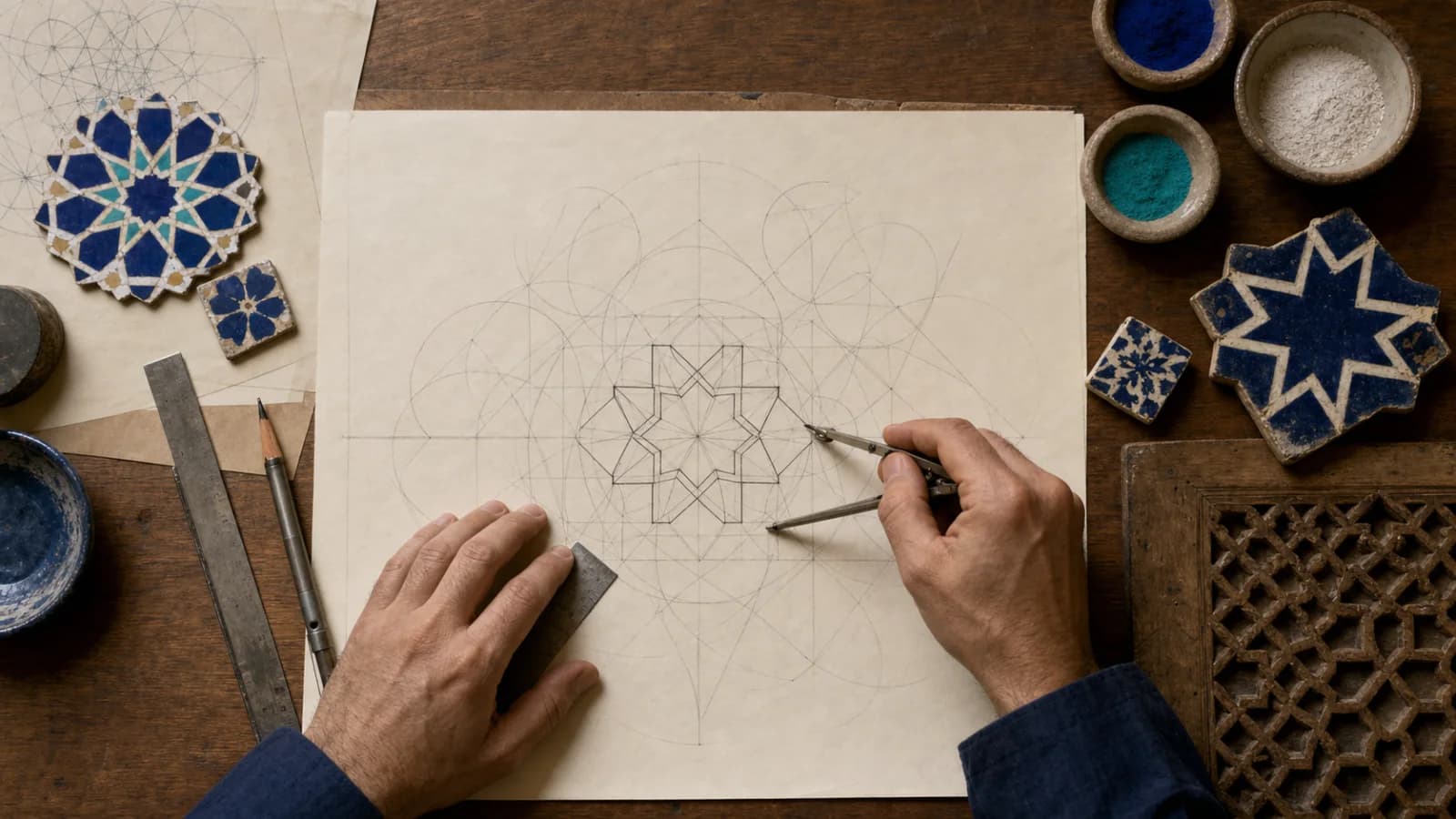
If you want to draw a version yourself, begin with the six- or eight-point framework above, choose which guide lines remain visible, and test whether your chosen unit meets its neighbors without gaps. Then decide whether the medium is paper, tile, wood or digital drawing, and let its real constraints shape the final design. A modern exercise can teach the geometry while staying honest about what it does not reconstruct from the past. The cover illustration on this page is an AI-assisted reconstruction of a design process, not a photograph of a historic workshop or object.
Sources
- The Metropolitan Museum of Art, Geometric Patterns in Islamic Art — overview of circles, polygons, stars and the coexistence of geometric, vegetal and calligraphic ornament.
- The Metropolitan Museum of Art, Islamic Art and Geometric Design: Activities for Learning — compass-and-straightedge educational constructions, distinct from proof of an object's historic procedure.
- Victoria and Albert Museum, Design and make your own Islamic tile and printed pattern — 1262 Iranian star-and-cross panel and an accessible account of repetition.
- The Metropolitan Museum of Art, Eight-Pointed Star-Shaped Tile — Kashan star/cross tiles, mixed inscriptions and the later assembly of the current display.
- The Art Institute of Chicago, Twelve-Point Star — late-fifteenth-century cut-tile mosaic and qualified possible original settings.
- The Metropolitan Museum of Art, Panel — Cairo-attributed woodworking, mortise-and-tenon joints and uncertain reconstructed placement.
- Aga Khan Museum, Tile AKM862 — dated Iznik tile with square format, radial rosette and arabesque decoration.
- The Metropolitan Museum of Art, Star-Shaped Tile — ca. 1300 Kashan horse image within an eight-pointed tile shape, showing geometry can coexist with figures.


