Qusayr Amra: Frescoes Inside an Umayyad Bathhouse
How a desert reception hall and heated bath preserve rulers, workers, hunters, animals and a zodiac dome that complicate stereotypes of early Islamic art.
Qusayr Amra is an early eighth-century Umayyad reception and bath complex located within a wider desert establishment in present-day Jordan. The site served as an elite secular retreat, featuring wall paintings that document courtly life and late antique artistic continuities. These images represent the visual culture of the ruling elite rather than the everyday visual practice of every mosque or Muslim community. Today, the site remains a vital subject of study for its architectural layout, water-lifting technology, and complex painted surfaces.
Architectural Layout and Water Infrastructure
The surviving stone structure of Qusayr Amra consists of an audience hall and a connected bath suite. The audience hall served as a reception space where the patron could meet visitors and host gatherings. To the east of this hall lies the bath complex, which transitions from a changing room to a warm room and finally to a hot room. This layout reflects the architectural traditions of the region, adapted for the private use of the Umayyad elite.
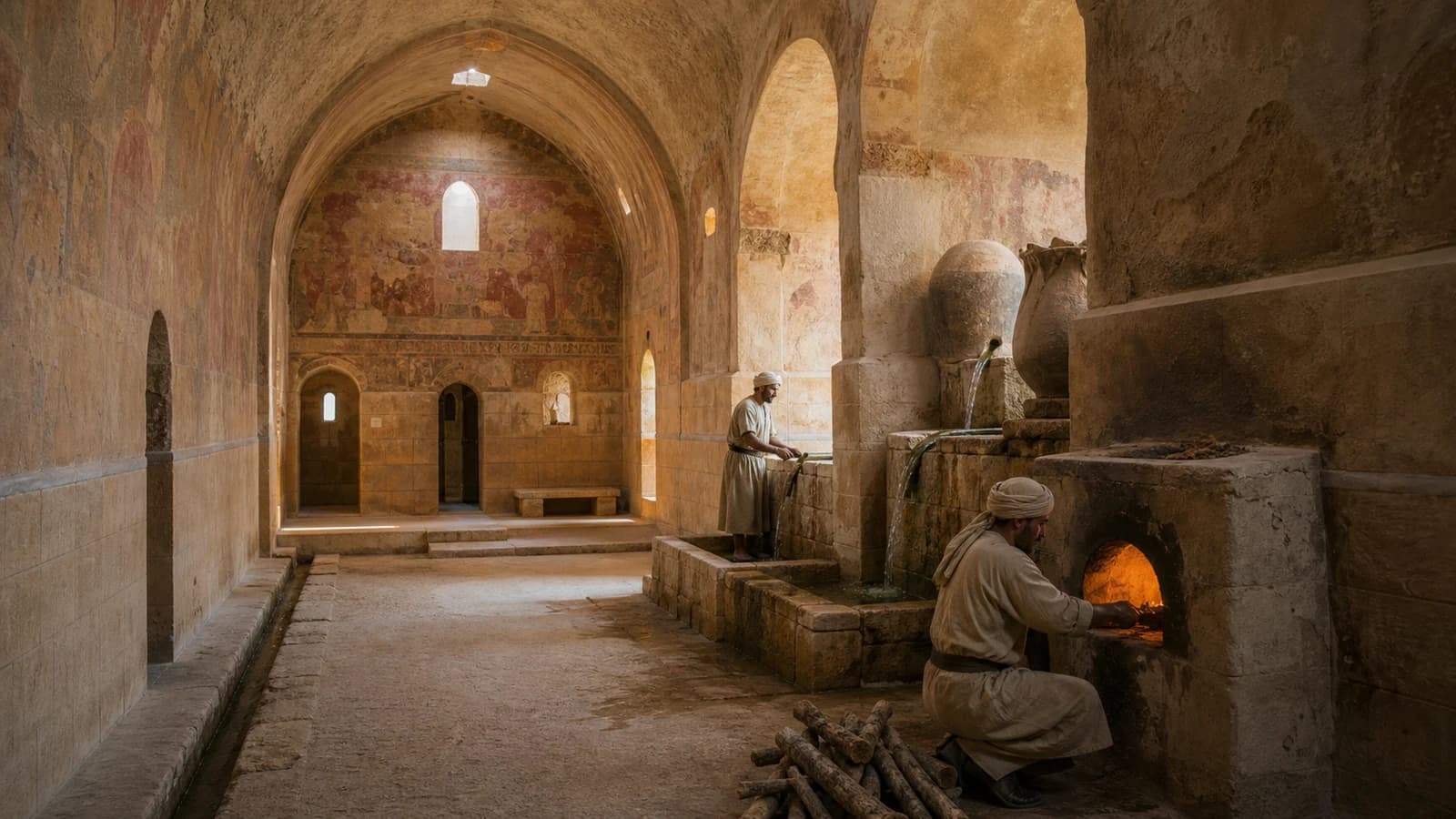
Operating this bath complex in a desert environment required a sophisticated water-lifting and storage system. Adjacent to the bathhouse, a deep, stone-lined well was excavated into the ground. A water-lifting mechanism, likely powered by animals, raised water to supply the complex. The furnace, located near the bath chambers, heated the water and the floors, while a nearby well and cistern system ensured a steady flow of water to the warm and hot rooms.
Painting Techniques and Material Studies
The wall paintings of Qusayr Amra are frequently referred to as frescoes, though modern material analysis indicates that the painting techniques are still being studied materially. Some pigments were applied directly to wet plaster, while other details may have been added after the plaster had dried. The artists utilized a range of pigments to construct their complex figurative scenes, which cover almost every flat and curved surface inside the audience hall and bath chambers.
The survival of these images is remarkable given the environmental conditions of the desert, but it also highlights the technical skill of the builders who prepared the plaster layers. The presence of these figurative paintings demonstrates that early Umayyad elite spaces utilized rich visual narratives that drew heavily on the existing artistic vocabulary of the Mediterranean world. These paintings are crucial for understanding the transition from late antiquity to the early Islamic period.
Iconography of Power, Labor, and Science
The iconographic program of Qusayr Amra is diverse, blending representations of authority with scenes of daily life and scientific inquiry. In the audience hall, the wall paintings include courtly figures, rulers, and hunting scenes. These images served to project the authority and legitimacy of the patron, reflecting the political ambitions of the Umayyad dynasty. The paintings also depict scenes of labor, including the physical work involved in constructing the estate itself.
In the hot room, or caldarium, the dome is painted with a representation of the night sky, showing the constellations of the zodiac. This dome painting represents one of the earliest surviving attempts to depict the night sky on a curved surface, reflecting the scientific interests of the Umayyad elite. The presence of Greek and Arabic inscriptions on the walls suggests a multicultural context, though the precise reading and attribution of these texts remain subjects of ongoing scholarly debate.
Patronage Debates and Conservation Challenges
The exact patronage of Qusayr Amra has been a subject of scholarly debate, as changing attributions of patronage have emerged over time. While early studies often attributed the complex to specific caliphs, more recent analyses suggest different members of the Umayyad ruling family may have commissioned the site. This distinction is important for understanding the specific courtly context in which these secular images were produced, as the site reflects the tastes of the elite rather than the wider public.
The site faces severe conservation problems that threaten the survival of its paintings. Over the centuries, the accumulation of salts within the stone, moisture penetration, and the use of old restoration materials have caused pigments to flake and darken. Additionally, modern visitor pressure and dust have accelerated the deterioration of the surfaces, prompting ongoing international conservation efforts to stabilize the plaster and clean the painted layers.
Evidence-Reading Checklist for Qusayr Amra
- Examine the architectural transition from the audience hall to the changing room, warm room, and hot room.
- Identify the presence of Greek and Arabic inscriptions on the walls to analyze the cultural context of the site.
- Locate the zodiac dome in the caldarium to study early astronomical representation on plaster.
- Assess the visible signs of salt efflorescence, moisture, and old restoration materials on the painted walls.
In conclusion, Qusayr Amra offers a unique window into the secular life, political ambitions, and artistic tastes of the Umayyad ruling class. The wall paintings demonstrate that early Islamic elite culture did not develop in isolation but actively adapted late antique visual traditions. Preserving these fragile plaster surfaces remains a critical task for modern archaeology, ensuring that this complex monument can continue to be studied in its physical integrity.
The cover image is an original AI-assisted reconstruction of the Qusayr Amra bath complex in use, not a copy of its frescoes or a measured restoration.
Sources
- UNESCO World Heritage Centre: Quseir Amra — architecture, paintings, hydraulic system and conservation.
- The Met: Qusayr Amra — discovery and art-historical interpretation.
- UNESCO: Qusayr Amra Documentation — rooms, construction and painting conservation.
Related reading
- How Khirbat al-Mafjar's mosaics shaped palace space
- How the medieval hammam managed heat and water


