What Is Suzani Embroidery? Seams, Stitches and Museum Examples
See how suzani makers drew and embroidered separate cloth widths. Compare Bukhara and Nurata museum textiles by ground fabric, stitch and design.
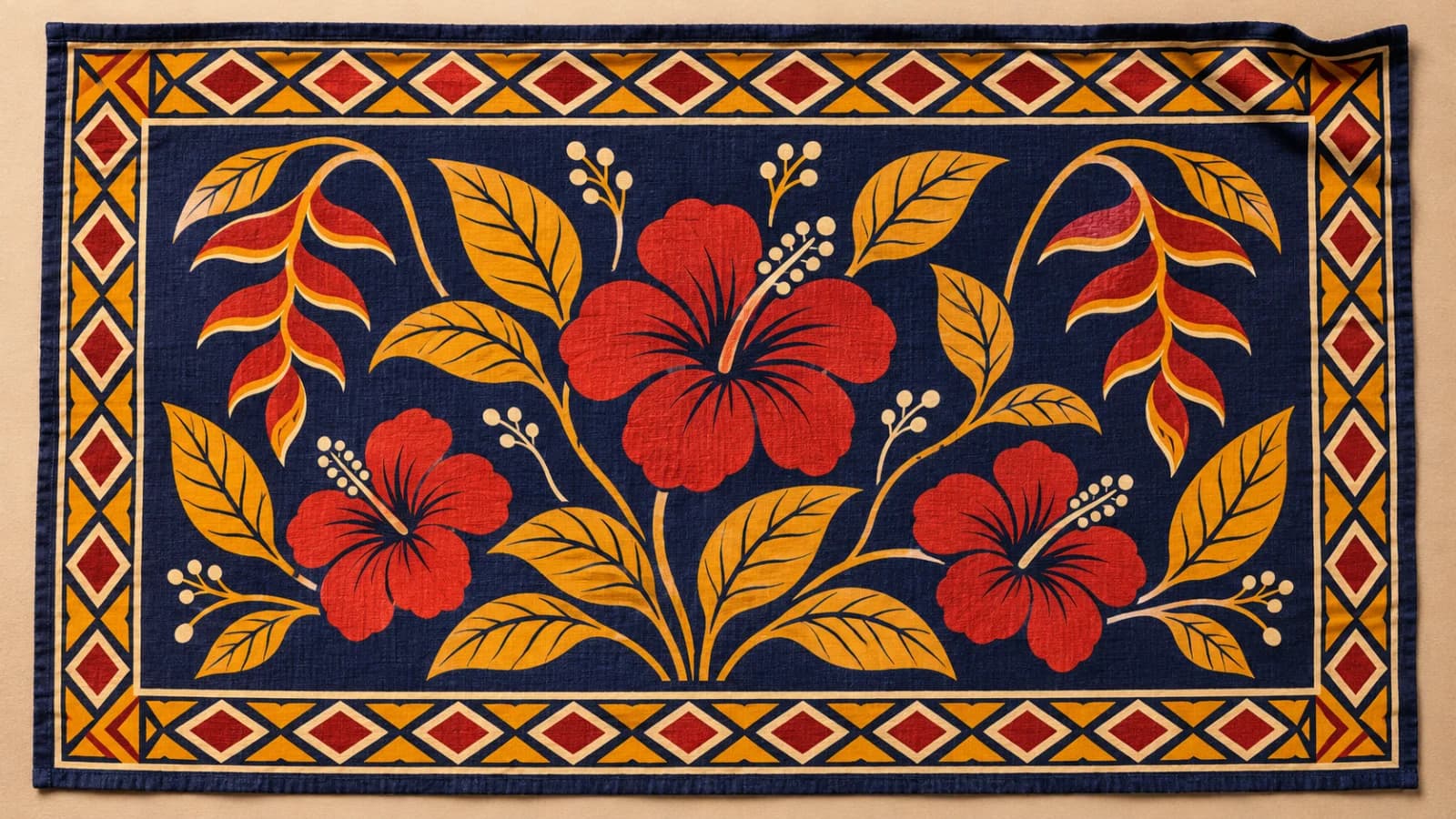
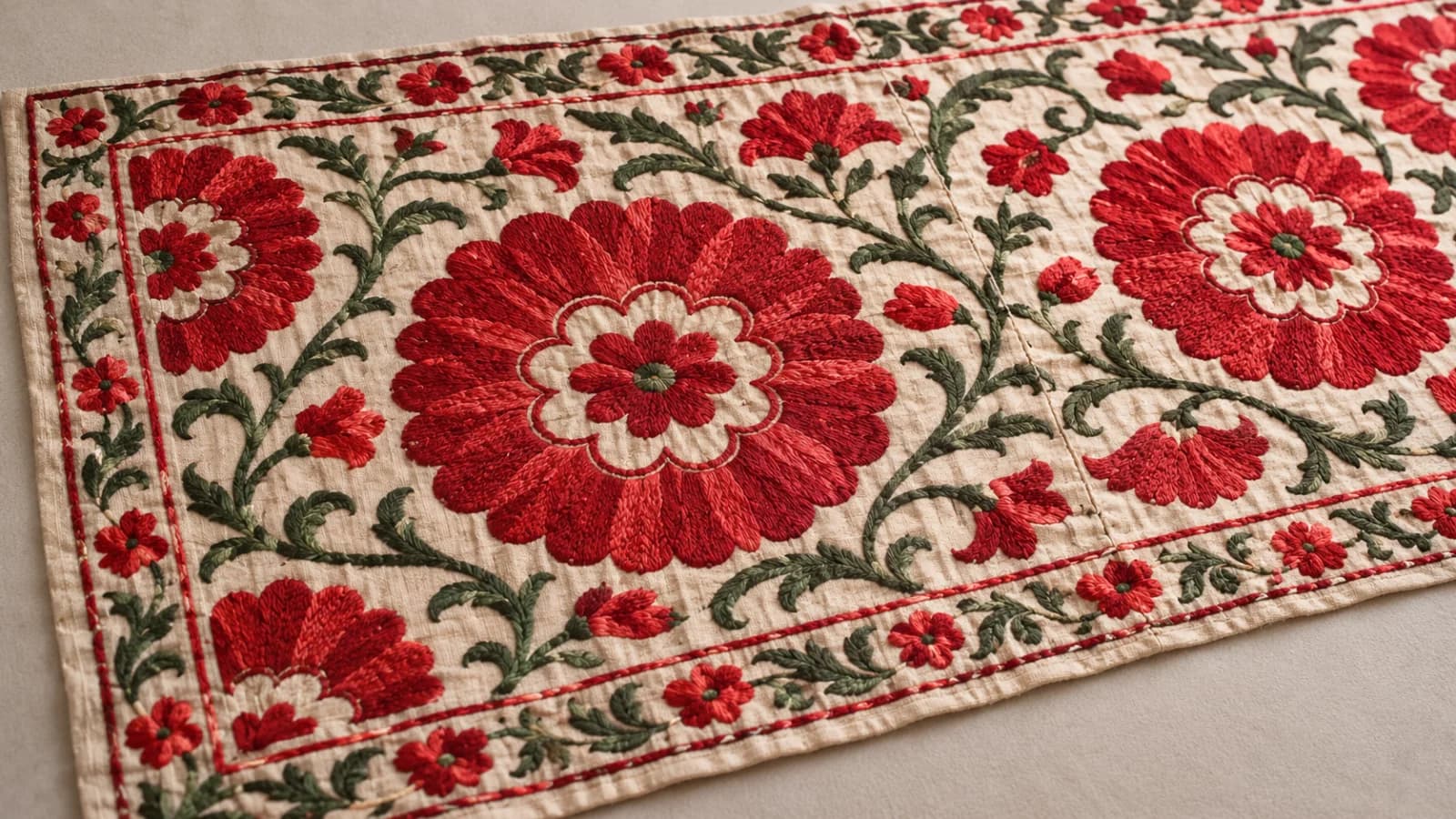
A suzani is an embroidered textile associated with Central Asia, often made by stitching silk designs onto lengths of woven cloth. Historic examples from what are now Uzbekistan and Tajikistan include covers, hangings and other household furnishings. Makers often joined cloth widths to draw one design, separated them for stitching and sewed them together again. A flower that shifts slightly at a seam can be a clue to how the work was shared.
A wedding textile that could furnish a room
The Cleveland Museum of Art traces the name to suzan, meaning needle in Persian and Tajik. The word identifies an embroidery tradition found in a range of textile sizes and uses. Large pieces could cover a bed, hang against a wall or partition a room. The Met describes hangings used at weddings in Nurata to dress interiors and set off spaces for guests. The larger domestic setting matters because an embroidered textile could make a temporary wall as readily as it could decorate a permanent one.
Suzanis also formed part of a bride’s trousseau in the settings documented by the museums. Cleveland’s account of its Shakhrisyabz example describes mothers and daughters making embroideries and displaying them on special occasions. The chapter by L. Carmel and M. Niyazova in UNESCO’s History of Civilizations of Central Asia describes large and smaller furnishings alongside textiles made for other tasks, including wrapping goods and covering wall niches. A catalogue title such as “hanging” or “curtain or bedcover” gives the reader the type of furnishing that the collection associates with the piece. A documented room, owner or occasion would come from that object’s history.
Why the pattern can shift at a seam
A large composition could begin with several narrow lengths of cloth temporarily attached in the order they would occupy in the finished piece. A skilled relative or a professional could draw the design across the joined widths. The Met’s account of the practice calls the professional draftswoman a kalamkesh. The lengths could then be separated so women in the family could embroider different portions. Joining the cloths again brought the design back into one field. Lines or colours sometimes shift a little where two completed widths meet.
The Cleveland Museum of Art’s wall hanging 1940.602 makes that process visible. It dates the hanging to 1850–1899 and lists Bukhara or Shahr-i Sabz as its origin. The museum identifies five loosely joined cotton cloths used to lay out the design, with traces of black drawing ink still visible. It records silk embroidery and tambour chain stitch. Its account explains how the household’s work could be divided and later reassembled. The National Museum of Art of Romania records four sewn pieces on its nineteenth-century suzani 93207 / 942. The cloth is 194 cm long and 146 cm wide, and the museum attributes it to Bukhara by style. Here the number of pieces belongs to an individual object with its own measurements and attribution.
Look for the join in the ground fabric before interpreting a break in a stem. If the two halves of a leaf meet at different heights exactly along a seam, the position of the break gives a reason to examine the panel construction. Cleveland’s suzani 2016.89, probably embroidered in Shakhrisyabz in 1800–1850, provides a documented example. Its catalogue records six plain-weave cotton strips and identifies mismatched motifs at the joins as evidence of separate embroidery followed by reassembly.
Reading the ground cloth and the embroidery separately
The ground is the woven cloth that supports the design. The embroidery thread sits in and on that cloth. Carmel and Niyazova describe plain-weave cotton as a common ground in late eighteenth- and nineteenth-century examples, with linen also reported. Silk was the usual embroidery yarn in the examples they discuss, alongside some uses of cotton and wool. The description “silk on cotton” therefore gives two materials and two roles in the same textile. For another example of reading fabric and applied threads separately, the guide to materials and embroidery in the kiswah explains how embroidered bands are added to a woven covering in a different textile tradition.
Stitch names supply further information. Chain stitch forms a line of linked loops. The Royal School of Needlework describes tambour as embroidery worked with a fine hook on cloth held taut, and identifies chain stitch as its most common stitch. Couching secures a length of thread lying on the cloth with stitches that hold it down. A catalogue may also identify a particular stitch by the part of a pattern it fills or outlines. Cleveland lists kanda xajol, and occasionally bosma, as filling stitches on 2016.89 and ilmoq as an outlining stitch. The labels describe the stitch roles on that textile.
A close view of a petal can show a filled area and the line that defines its edge. A wider view shows how that petal sits in a spray, medallion or border. Comparing the two views helps explain why a single textile can have several stitch names in its catalogue. For the early nineteenth-century Nurata hanging at the Met, the museum identifies couching, chain, satin and buttonhole stitches on the same cotton ground.
A Bukhara cover with a linen ground
The Metropolitan Museum of Art’s 21.114.3 is an early nineteenth-century cover attributed to Bukhara in present-day Uzbekistan. The museum gives the height as 161.9 cm and the width as 241.3 cm. The medium field specifies silk embroidery on linen. The curatorial description also explains a general workflow using widths of homespun cotton. Read the material line for the fibre identified in this specific cover and the process description for the broader practice.
Prominent rosettes and palmettes fill the cover’s border, while the stems and scrolls in the field are finer. The museum singles out chain stitch in its account of the workmanship. The visual distinction is easiest to see by following the larger forms around the perimeter, then tracing the thinner branching lines inside it. The guide to leaves, scrolling stems and repeating vegetal ornament gives other examples of looking at the relationship between branches and leaves as a design, apart from naming the individual flowers.
A Nurata hanging with a central medallion
The Met’s 07.72, also from the early nineteenth century, is attributed to Nurata and measures 217.2 cm high by 170.2 cm wide. Its material is silk embroidery on cotton. The museum describes a central medallion surrounded by flowering shrubs and floral sprays, with relatively soft colours. It notes affinities between the floral designs in the field and forms seen in Mughal textiles. The observation concerns the designs. The record attributes this hanging to Nurata.
The two Met pieces place visual weight in different parts of the cloth. The Bukhara-attributed cover is wider than it is high and puts large motifs along the border. The Nurata-attributed hanging is taller than it is wide and draws the eye to a centre surrounded by flowering forms. One has linen beneath the silk thread and the other has cotton. Looking at orientation, arrangement and ground together gives the reader more to compare than a general label such as “floral embroidery.” The museum comparison of kaftans and abayas takes a similar approach to fabric and construction in garments, with separate records for each piece.
How far can a regional style take you?
Cleveland’s curtain or bedcover 1916.1311 shows how a design can be associated with a different place from its catalogue attribution. The museum currently catalogues its early nineteenth-century textile as from Ura Tube, Tajikistan. It identifies a plain-weave cotton ground with silk embroidery. Its description compares the central fanlike bouquet, corner motifs and wide border with features characteristic of Bukhara work. The visual comparison can stand alongside the geographical field. Each tells the reader what kind of evidence is being reported.
The museum’s wall hanging 1940.602 retains two possible origins. Its description places flowering plants and blossoms within a diamond-shaped lattice of leaves. In that case, following a flower across the field reveals both botanical and geometric order. The guide to grids, symmetry and repeating forms in Islamic design provides vocabulary for describing that arrangement. A textile may contain a strong geometric framework and still be catalogued as a floral embroidery. Carmel and Niyazova note that individual embroideries may show features associated with more than one production centre. The Romanian catalogue also explains how style informed its attribution.
What to record when comparing two suzanis
Start with the material line, the measurements and the object number. For the Bukhara cover, enter silk on linen and use the dimensions for 21.114.3. For the Nurata hanging, enter silk on cotton and use the dimensions for 07.72. Recording the object number with the material helps keep the technical observations attached to the right textile.
Then sketch the composition in words. Does the border carry the largest flowers? Is there a centre from which smaller forms radiate? Follow one motif towards a join, checking whether the thread ends or changes position as it reaches another width. A close-up may reveal traces of a drawn design, as documented on Cleveland’s five-width hanging. A full view helps determine whether the join passes through a single motif or divides two separate rows.
Finally, preserve the level of certainty in the record. “Attributed to Nurata,” “Bukhara or Shahr-i Sabz,” and “compared with work from Bukhara” describe different findings. If the catalogue gives several possible uses for a furnishing, keep those possibilities with the object. The cloth can tell a detailed story about how the design was laid out and made, even when the surviving record gives less information about the first household to use it.
Museum records and technical references
- The Metropolitan Museum of Art, cover attributed to Bukhara 21.114.3
- The Metropolitan Museum of Art, hanging attributed to Nurata 07.72
- Cleveland Museum of Art, five-width wall hanging 1940.602
- Cleveland Museum of Art, suzani with floral sprays 2016.89
- Cleveland Museum of Art, curtain or bedcover 1916.1311
- National Museum of Art of Romania, suzani 93207 / 942, via Museum With No Frontiers
- L. Carmel and M. Niyazova, “Textile Arts in Transoxania,” section on suzani embroidery, UNESCO
- Royal School of Needlework, StitchBank embroidery techniques