Kaftan vs Abaya: Garment Meanings, Regional Forms and Museum Examples
Compare kaftan and abaya through documented Moroccan, Qatari and Syrian garments. Learn why cut, layers, place and date matter more than a broad clothing label.
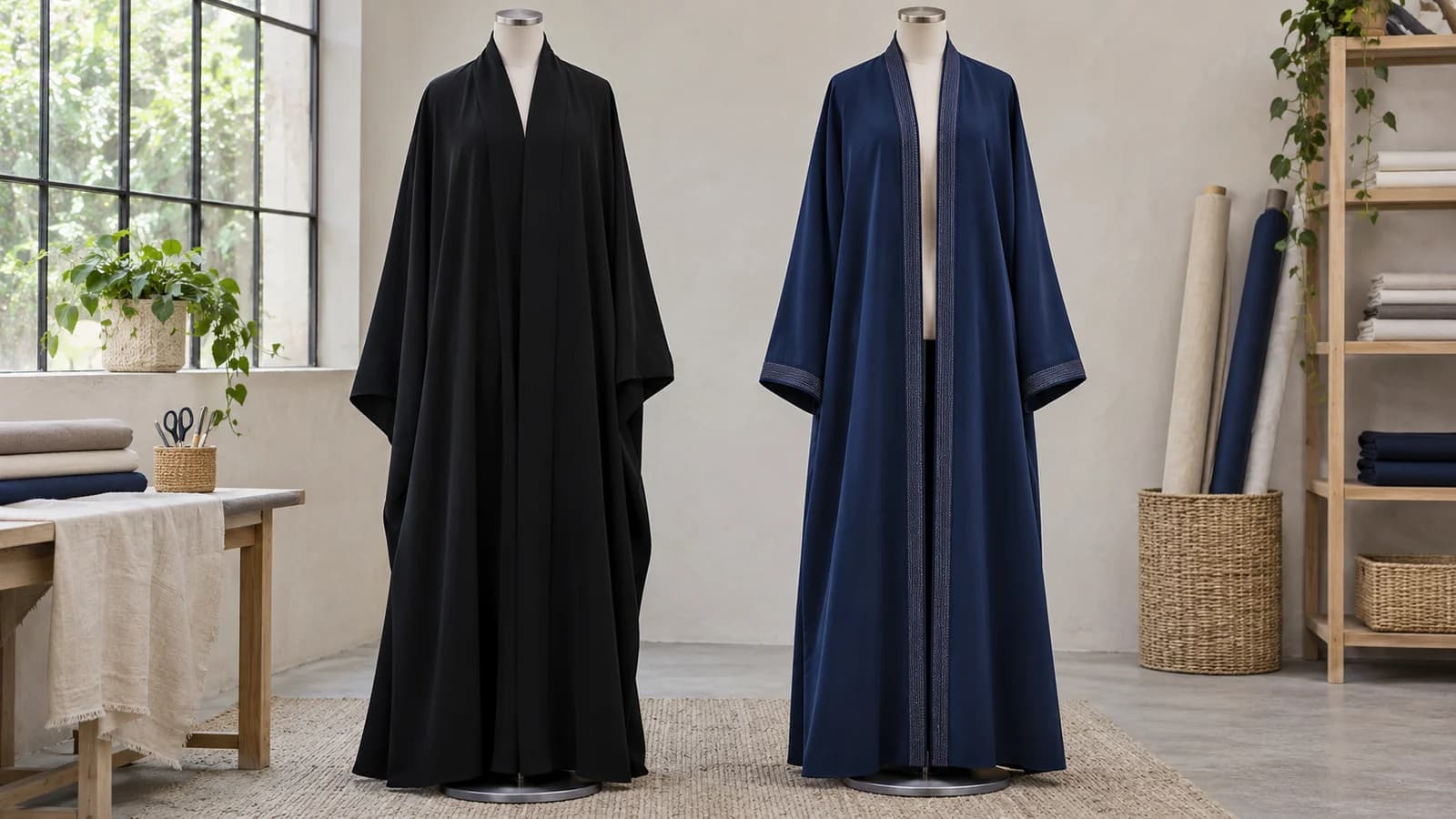
A kaftan and an abaya are names for garments, but the distinction needs a place and a period. In the Moroccan examples discussed here, the kaftan is a long, front-opening garment with sleeves and elaborate textile work. Qatar Museums describes an abaya as an outer garment worn over other clothing, including a twentieth-century example worn from the head. These are useful documented forms, rather than a complete worldwide dress code.
The names alone do not settle fabric, colour, fastening or the identity of a wearer. A historical collection can explain a particular object, while a contemporary seller may use a broad label for a different cut. Begin with the garment’s construction and context, then compare the terminology.
Kaftan and abaya: compare the garment as well as the name
A useful comparison asks where the item was made, when it was worn and how it relates to other layers. The same broad clothing vocabulary can cover local variations. The following distinctions apply to the documented examples on this page; a product listing or an unlabelled photograph still needs its own description.
| Question | Kaftan examples here | Abaya examples here |
|---|---|---|
| Which setting? | Moroccan collection records and a living Moroccan craft tradition | A Qatari outer garment and a piece within a Syrian collection group |
| What construction matters? | The front opening, sleeves, fastening and relationship to a belt or other garments | The outer layer, its support from head or shoulders and its relationship to the rest of the outfit |
| What identifies the material? | The record may specify velvet, silk, cotton, embroidery or brocade | The Qatari example specifies silk and metal thread |
| What should stay open? | A precise maker or first owner when the record does not name one | The history of an assembled outfit when the institution says that history is uncertain |
Caftan and kaftan are common English spellings. Their appearance in different records does not automatically identify different kinds of garment. Equally, sharing a spelling does not make two objects identical. A catalogue number, date and place provide a more precise reference than a clothing name on its own.
These distinctions also keep garments separate from other parts of an outfit. Our guide to hijab, niqab, burqa, khimar and chador explains several covering terms. A long garment and a head covering may be worn together while remaining different items with different names.
Two Moroccan kaftans show why the details matter
The Museum With No Frontiers record for Museum of the Udayas 5432/D3922 describes a nineteenth-century women’s kaftan from Tetouan, Morocco. It identifies velvet, gold embroidery and frogging, with a front opening, long wide sleeves and braided buttons fastening the upper part. The catalogue relates its shape and decoration to a particular local form.
The entry also offers an account of the garment’s spread and possible links with Ottoman dress. Its wording includes qualifications about proposed introduction and travellers’ testimony. Those proposals should remain qualified. An account explaining one Moroccan tradition does not by itself establish a single uncontested origin for every garment called a kaftan across all regions.
The Met’s Moroccan kaftan C.I.41.86.9 is dated to the early twentieth century. Its medium is silk, cotton and metal-wrapped thread, with brocaded decoration. The museum relates its large floral pattern to Ottoman textiles and discusses the import of luxury fabric from Lyon into Morocco. Its suggestion of an elite urban wearer remains an interpretation, rather than the documented biography of a named owner.
These two records support a precise comparison of locality, date, fabric and decoration. They do not require the same material for every kaftan. Velvet with applied embroidery and a brocaded fabric call for different descriptions of how the surface was made. A viewer who records only gold decoration loses information about the technique.
For a classroom comparison, place the two object numbers beside their materials before comparing the photographs. Then identify which features the institutions actually explain. A similar colour or floral design may make a useful visual connection, but it cannot fill a missing maker’s name or prove that the same workshop produced both garments.
A Qatari abaya belongs to a layered wardrobe
Qatar Museums’ 2026 account of Qatari women’s wardrobes presents the twentieth-century abaya QNM.2015.25.1. It is black silk with metal thread, worn over the head rather than the shoulders. The account discusses a local naming change from daffa to abaya and describes the form becoming common in the 1960s. That chronology belongs to the Qatari setting being described.
The same article places the abaya alongside daily dresses, scarves and festive overgarments. Its thaub nashal examples belong to a layered wardrobe rather than one garment doing every job. A photograph showing only the outer layer may therefore omit much of the outfit. The name of that outer layer does not identify the fabric or cut underneath it.
This example is especially useful when a modern image search presents only shoulder-worn garments. The Qatari record documents a head-worn form, so the present-day search results cannot define the whole history. Conversely, one historical example does not tell a viewer how every contemporary abaya is cut or worn.
A responsible caption retains the institution, object number, material and twentieth-century date. If it mentions the 1960s, it attributes the statement to the local history in the article. Saying that the abaya itself was invented everywhere in that decade would be a much broader claim than the source supports.
A Syrian collection group is not automatically one person’s outfit
The Met’s group C.I.39.91.6a–e includes a festive dress, abaya, agal headcord and two headscarves, dated to the late nineteenth–early twentieth century. The museum says the pieces were probably made in Syria, while noting uncertainty about whether they were assembled for sale to the tourist market. That uncertainty is central to interpreting the group.
The catalogue identifies a festive thob associated with the Qalamoun region and describes its white linen and long triangular sleeves. It provides separate measurements for the component garments. The record therefore allows discussion of specific pieces while leaving the original relationship between all of them unresolved.
A museum display can bring related objects together for study without proving that one documented person wore the full arrangement on one occasion. Preserve the distinction between collection grouping and historical ensemble. A title listing several items is useful identification, but it is not automatically an ownership history.
When a reproduced photograph crops out the caption, the arrangement can look more certain than the written record allows. Return to the institution’s explanation before describing it as a complete traditional costume. The relevant question is what evidence connects the pieces, not simply whether they look visually compatible.
Why thobe is not a single universal category
The related words thobe, thawb and thaub also need context. The Getty Art & Architecture Thesaurus entry for thawbs describes long Arab robes or overgarments in the Arabian Peninsula and explicitly notes regional differences. A controlled vocabulary can help organise records, while the description of an individual garment supplies its local details.
The Palestinian Museum’s Jalaya, 0002.01.0029, is catalogued from the Akka region around 1920–30. The museum describes a front-opening overcoat form with short sleeves, worn over a white thobe whose long embroidered triangular sleeves extend beyond it. This is a concrete example of the word thobe appearing in the description of a dress and a layered outfit.
Read alongside the Syrian festive dress and the Qatari thaub nashal, these records show why an introductory definition should not reduce every thobe to a men’s white robe. The gendered use, local name and particular construction belong to the relevant setting. Translation needs to preserve those details rather than forcing each item into the most familiar shop category.
For example, a caption can retain jalaya as the local name and then explain the overcoat and underdress relationship. Calling every visible layer an abaya would remove useful information. The aim is to help the reader picture how the pieces relate, while remaining clear about which institution provides the identification.
What UNESCO recognition says about the Moroccan caftan
UNESCO inscribed Moroccan Caftan: art, traditions and skills on the Representative List of the Intangible Cultural Heritage of Humanity in 2025. Its description concerns a living tradition of garments, occasions and craft knowledge. It identifies varied styles and fabrics, a central opening and handmade decoration, with or without a decorative belt.
The account includes people of different genders and ages and describes work by weavers, tailors and artisans making buttons, braids and embroidery. Knowledge passes through families, apprenticeships and formal training. This adds a different kind of evidence to a museum object: it explains continuing skills and social practices, rather than only the date and materials of a surviving piece.
The inscription should be named at its actual scope. It recognises the specified Moroccan element. It is not a substitute for researching every garment elsewhere called a caftan, and it does not supply the maker of an unrecorded object. Likewise, the date of inscription is not the date when the tradition or the garment name first appeared.
A historical kaftan and the living practice can be discussed together while remaining distinct sources of information. The museum record identifies a particular object; the heritage entry explains knowledge and practices associated with communities. Keeping that difference visible gives the reader a fuller picture of both.
Describe the cut, layers and context before choosing a label
For an unfamiliar garment, begin with what is visible and what the record states: front opening or pullover, sleeve shape, fabric, fastening, length and relationship to other layers. Then add the local name, place and period. This makes a description useful even to someone who has never encountered the term before.
Textile technique deserves its own wording. A woven pattern, an embroidered surface and applied braid are not interchangeable merely because all can look ornate in a small image. Our kiswah textile guide discusses materials, workshop production and the use of textiles at the Kaaba. It offers a comparison with textiles serving a different function from clothing, while the technique of each actual object still needs its own description.
Ornament can also include writing. Our tughra guide includes an embroidered scarf among examples of a royal calligraphic emblem on different objects. Reading such an emblem is a separate task from naming the cut of the garment that carries it. A decorative inscription does not, by itself, establish every part of an outfit’s origin. Keep the motif and the garment description distinct.
For a contemporary purchase, read the item’s actual measurements, fastening, fabric information and included pieces. A label such as kaftan set does not necessarily explain whether a belt or underlayer is included. A museum photograph provides historical context, while the seller must describe the product being offered. Similarity to a collection image is not evidence of antique origin.
For a visit to a religious space, use the host’s practical guidance rather than assuming that one named garment is required everywhere. Our first mosque visit guide explains how to ask about local arrangements. Clothing vocabulary helps describe an outfit; it does not reveal a stranger’s faith, nationality or personal reasons for wearing it.
The most useful distinction is therefore specific: this Moroccan kaftan has this construction and textile; this Qatari abaya forms this outer layer; this Syrian group has this documented uncertainty. Those statements answer a reader’s question with examples they can check, while preserving the variation that the garments themselves demonstrate.