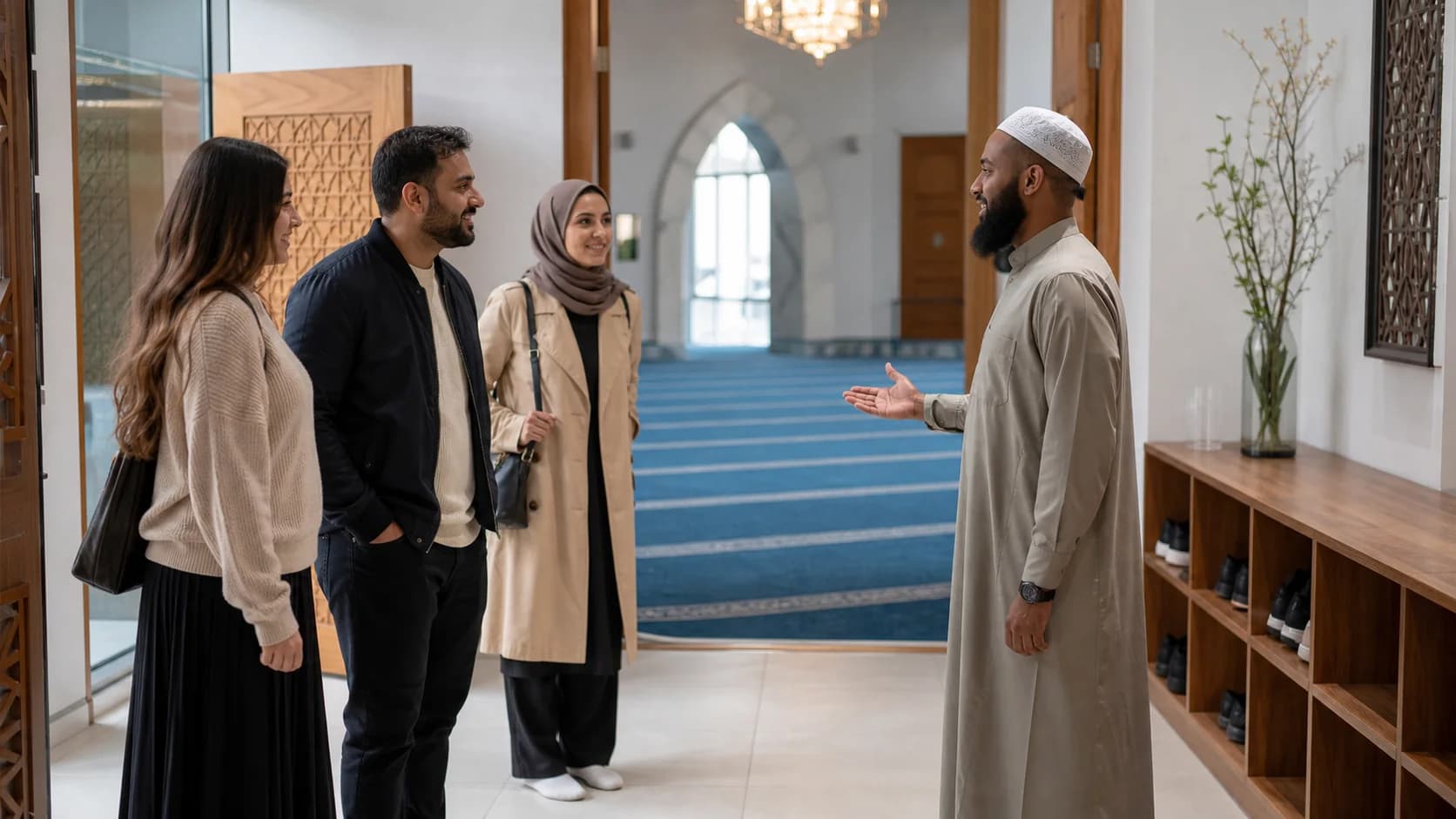
Visiting a Mosque for the First Time
Plan a first mosque visit with practical guidance on booking, clothing, shoes, prayer observation, children, accessibility and photos. Check the host mosque’s rules for the visit you choose.
A mosque may be a small neighbourhood prayer room, a large community centre or a landmark with scheduled tours. The Muslim Council of Britain’s Visit My Mosque guide describes open days with different activities and explicitly notes that not every mosque can host one. The Cambridge Central Mosque tour page and East London Mosque tour page publish different booking and visitor arrangements. This guide helps you prepare and know what to ask; it cannot supply the current rules for every building.
Choose the kind of visit before you travel
First decide whether you want a building tour, an open day, a quiet conversation or to observe worship. That choice affects the time, entrance and person you should contact. A tour may include architecture, a question session and an explanation of prayer. An open day may be aimed at neighbours or school groups. During an ordinary prayer, worshippers have come to pray, so a visitor should not assume that someone is available to provide a long guided introduction.
| Your reason for visiting | What to check on the mosque’s own page or by phone |
|---|---|
| Guided tour or school visit | Whether booking is required, group size, meeting place, duration and whether a prayer will be observed. |
| Open day | The event date, visitor entrance, programme and any changes to access or photography rules. |
| Observing a daily or Friday prayer | The actual congregational time, when to arrive, the viewing area and whether a guide will be present. |
| Private conversation or learning about Islam | Whether an imam, volunteer or education team takes appointments; do not assume someone is free during worship. |
For example, Birmingham Central Mosque asks visitors to arrange visits ahead of time and describes a tour with a guide, questions and possible prayer observation. East London Mosque asks groups to book, while individuals who arrive without a booking may ask reception whether staff can offer a tour. Those are two local policies, not contradictory universal rules. If a venue’s page is old or unclear, use its current contact route rather than a third-party directory’s hours.
Before leaving, check the address, entrance, public transport and whether the visit is free or has a booking process. The place and time of a Friday congregation may differ from a building’s general visitor hours. A concise message is enough: “This would be my first visit. I would like to observe a prayer or tour the building. Is that possible on [day], where should I meet a host, and is there anything I should wear or bring?” Add any access or language need to the same request.
Dress for the actual venue and room
Modest, clean, comfortable clothing is a reliable starting point. Clothes that cover arms and legs and allow you to sit easily work for many tours; you do not need to buy special ethnic or religious clothing. A prayer hall and an exhibition space can have different expectations. The host mosque’s instructions take priority over a generic online checklist.
The differences are concrete. Cambridge Central Mosque’s guided-tour page asks adult visitors to cover their arms and legs and asks women to bring a headscarf before entering its prayer hall. Birmingham Central Mosque’s visit page asks for modest dress and says female visitors may cover their heads. The Visit My Mosque visitor guide likewise says mosques differ and that a prayer room may request a covering. These examples show why “all women must cover” and “a scarf is never needed” are both poor universal instructions.
If you are unsure, ask the host whether a scarf is required for your specific visit and whether one can be borrowed. Check seasonal comfort as well: you might move between a courtyard, wash area, classroom and carpeted hall. If attending as part of a school or a group, share the venue’s stated dress guidance before the day rather than surprising guests at the door.
Find the point where shoes come off
Shoes are normally removed before entering a carpeted prayer area. The threshold is often inside the building, rather than at its outer door. Follow the shoe racks, signs or host’s directions; put shoes together so they do not block an exit. Socks are usually fine, but the mosque can tell you what applies to its floor and visit. Do not step back onto the prayer carpet with outdoor footwear while retrieving a bag.
The Islamic Center of Midland’s visitor guide explains shoe removal as a way to keep the prayer floor clean. East London Mosque locates its shoe racks outside prayer halls, while Birmingham Central Mosque asks for removal only in particular areas. A mosque can also contain offices, cafés and classrooms where the same rule does not apply. Look for the prayer-hall boundary instead of treating the entire site as one room.
If removing footwear is difficult because of a disability, orthotic device or injury, contact the venue before you go. Cambridge says it can provide shoe covers for people unable to remove shoes on its tour; the Midland centre describes observing from outside its prayer area. Neither option can be assumed elsewhere. Ask what route preserves both your access and the hall’s floor requirements. If you pass wash facilities, remember that they are for worshippers preparing for prayer, not an obligatory stop for someone simply observing. Our wudu explainer describes the practice if you want that background.
Observe prayer without interrupting it
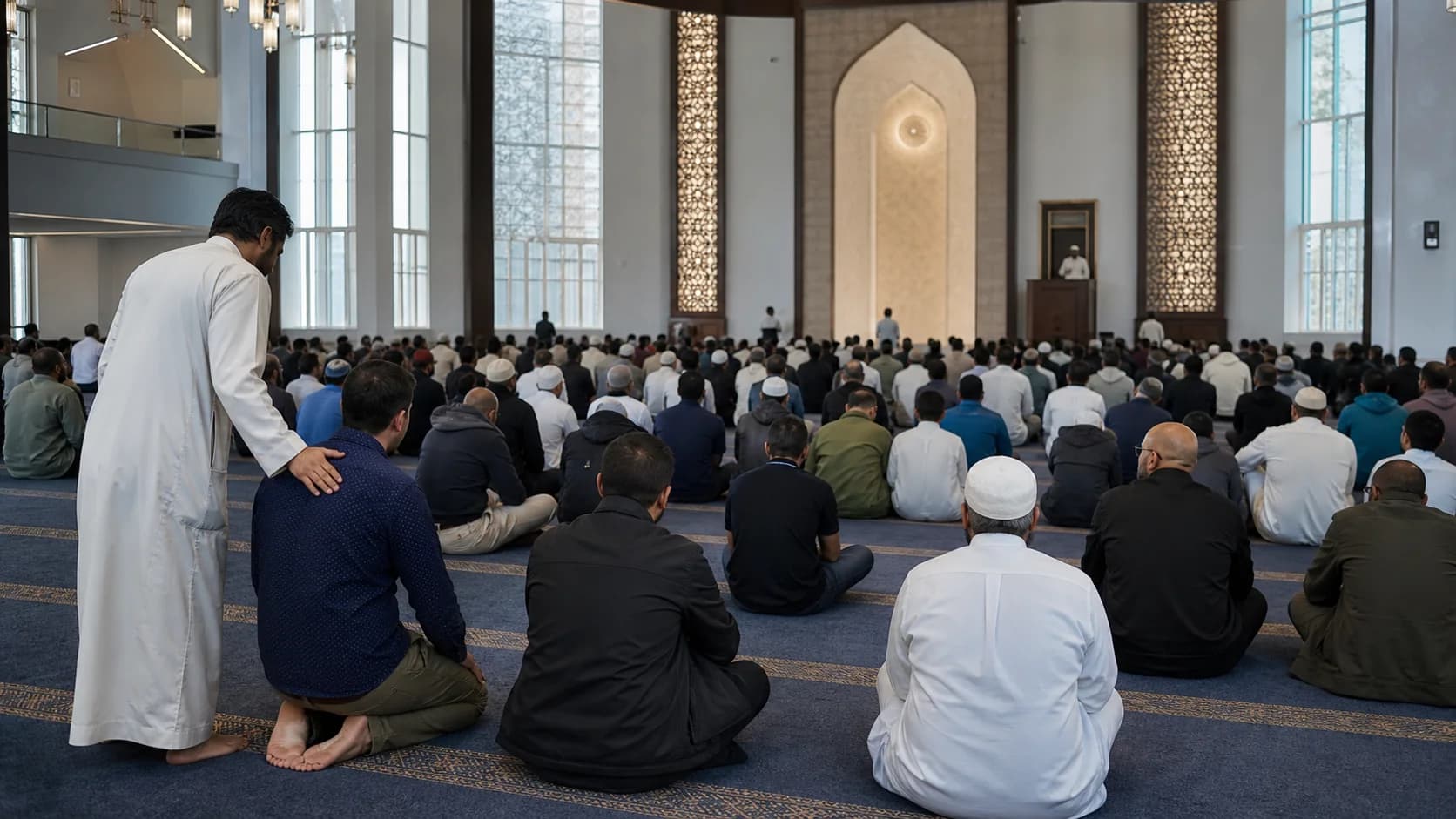
Tell a receptionist, volunteer or host that you are visiting for the first time. Ask where guests may sit or stand, when the service begins and whether questions should wait until it ends. Silence the phone and follow the host’s route. Do not walk between people in prayer or directly in front of someone praying. The Midland mosque’s guide gives this specific walking instruction; it is more useful than a vague request to “be respectful.”
You do not have to copy the movements to observe. A guide may explain what you hear and see before or after the service. The call to prayer, adhan, and the shorter call immediately before congregational prayer, iqama, have different roles; our explanation of adhan and iqama provides that context. The prayer direction is indicated within the hall by its qibla wall and often a niche called a mihrab; the pulpit used for a sermon is a minbar. Our mosque architecture glossary explains these features without assuming every building has the same layout.
Different rooms or levels may be used by men, women and families. Ask where your host would like a mixed group to observe. Avoid treating the first door you see as an invitation into any occupied space. Food and drink are commonly kept outside prayer halls; Birmingham and East London each state their own restrictions. A visitor can raise questions after the congregation has finished, when someone is free to answer.
What changes if you visit on Friday?
Friday congregational prayer, Jumu’ah, includes a sermon followed by prayer. It can be a good opportunity to understand community life, but it may be crowded and time-sensitive. The Bait-ul-Ehsan Mosque visitor page sets out its own Friday call, sermon and welcome arrangements and explicitly invites visitors to observe. The times on that page are for that mosque, not a timetable to use for another city or denomination.
Ask your chosen mosque when its congregation begins, how early a guest should arrive and where to wait during the sermon. At a busy service, a short instruction from a greeter may be all the conversation possible before worship. Do not step over occupied rows to find a seat or start photographing just as people assemble. If you want to ask many questions, arrange a tour or return at a quieter time. Our first Jumu’ah guide gives more detail for someone preparing to attend that service, while the host remains the source for its current timings.
It is easy to confuse an advertised prayer time with permission to drop into any part of a building. One mosque may have a dedicated viewing area, another a reception desk, and another no guide available that day. A short advance call can prevent an awkward interruption for both visitor and worshippers.
Ask before taking photographs or recording
Permission to photograph a dome or courtyard is not permission to publish a recognisable image of a person praying. Ask the mosque about cameras, then ask the people who would appear in a photograph. Keep the phone away during prayer unless the venue has specifically arranged a media visit. These distinctions matter for children’s activities, private conversations and close images of worshippers.
The local rules again differ in detail. Cambridge Central Mosque allows tour pictures but asks visitors not to photograph or film people praying. East London Mosque allows personal-use photography that avoids worshippers and asks people making non-personal images to seek its media team’s permission. Bait-ul-Ehsan Mosque requires permission for photography inside its prayer hall. Check whether you may share an image online, even if taking it for personal memory was allowed.
If a guide says that a photo is unsuitable, put the device away without turning the conversation into a debate. A sketch or a question about an architectural feature may be a better way to remember the visit. A normal spoken greeting is enough; if you are unsure whether someone welcomes a handshake, let that person initiate it. The Midland mosque’s guide notes that some people do not shake hands across genders, so a friendly verbal greeting avoids an unnecessary assumption.
Plan for children, groups and access needs
Children can often join a visit, but supervision and programme details matter. Cambridge Central Mosque welcomes children of all ages on tours and asks that they be supervised. Birmingham Central Mosque describes educational activities for visiting school groups, while East London Mosque limits normal group size and requests advance booking. A family, teacher or group organiser should ask whether a tour includes stairs, long standing periods, quiet prayer observation or child-friendly activities.
Accessibility cannot be inferred from a photograph of a front entrance. Ask about the step-free route, lift, seating, toilets, hearing or sensory needs and whether the prayer-hall rules have an accommodation. Cambridge describes accessible parking, lift access and shoe covers; East London says its tour route is wheelchair accessible but has no on-site parking. Those distinct details are precisely why an individual guest should check a venue’s own current page or speak to its visits team.
For a school visit, confirm the number of pupils and accompanying adults, where the group meets, whether photos of children are permitted, and where questions can be asked. The Visit My Mosque school-visit planning guide advises teachers to coordinate facilities, activities, consent and prayer-time awareness with the host. A prepared group can spend the visit learning instead of discovering essential arrangements at the door.
A simple arrival sequence
At the entrance, find reception or a volunteer who is not praying. Say, “Hello, this is my first visit. I booked a tour” or “May I observe the prayer? Where should I go?” Show a booking confirmation if you have one. Follow the route you are given, put shoes in the designated place and silence your phone before entering a prayer hall. If a scarf or shoe cover is required for your visit, ask where to obtain one.
Once you are settled, look and listen without feeling required to perform a ritual. Save detailed questions for a host who has time after prayer or during the tour. If your interest is architectural, ask about the spaces you actually see rather than assuming that every mosque has a minaret, dome or identical prayer-room plan. If the arrangement offered that day does not meet your access needs, ask for another time or format rather than attempting to navigate a restricted route yourself.
The best first visit is a real visit to a real community, with the visitor aware of the host’s instructions. Check the venue, choose the right occasion, and ask one clear question when you arrive. Those small steps are more dependable than any claim that one dress code, schedule or photography rule applies to all mosques.
Sources
- Muslim Council of Britain, Visit My Mosque visitor guide — explains variation among open days, modest clothing and shoe removal; it is a visitor-programme guide, not a rulebook for every mosque.
- Cambridge Central Mosque, guided tours and visitor questions — gives one venue’s booking, clothing, footwear accommodation, child, accessibility and photo rules; its times and requirements must not be projected onto other venues.
- Birmingham Central Mosque, visits and tours — specifies advance booking, tour activities, designated shoe-removal areas, modest clothing and food rules for its own site.
- East London Mosque, guided tours — distinguishes group bookings from possible individual walk-ins and states its visitor dress, shoe, photo and access arrangements.
- Bait-ul-Ehsan Mosque, plan your visit — illustrates an individual mosque’s Friday welcome, prayer-observation invitation, clothing, shoe, child and photography instructions; its posted times apply there only.
- Islamic Center of Midland, Visiting a Mosque — gives practical instructions about shoes, phones, walking near worshippers and handshakes; its local advice does not override a different host’s guidance.
- Muslim Council of Britain, guide to organising a school mosque visit — supports advance coordination of group facilities, photography consent, activities and prayer-time awareness; it addresses school organisers rather than all visitors.