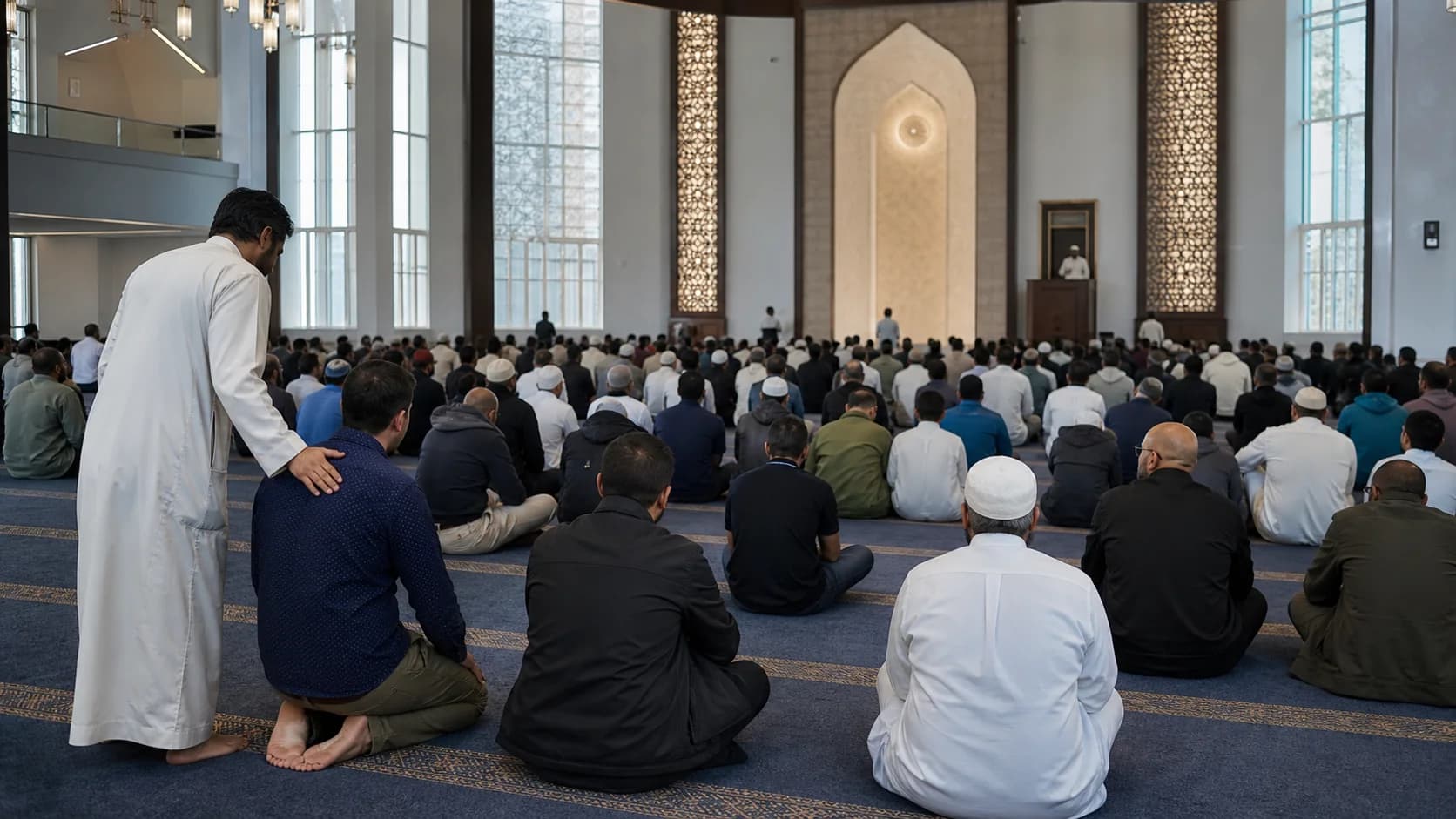
What to Expect at Your First Jumu'ah Prayer
A practical first Jumu'ah guide to sermon and prayer times, entering the mosque, listening to the khutbah, joining the two-unit prayer, observing as a guest and asking for help if late.
For your first Jumu'ah, check the mosque's current khutbah (sermon) start, not just a general midday prayer time. Arrive with time to find the right entrance, prepare for prayer and settle before the sermon. The sermon is followed by a two-unit congregational prayer led by an imam. If you are visiting to observe rather than pray, tell a host and ask where guests may sit. The exact timetable, entrance and visitor arrangements belong to the mosque you choose.
Jumu'ah is the Friday congregational service held during the midday prayer period. Qur'an 62:9 addresses believers when the Friday call is made and tells them to proceed to remembrance of God. That verse explains the place of Friday worship; it does not itself give a visitor timetable or resolve every personal question about attendance. This guide covers the practical sequence you can expect, while your mosque and a qualified local scholar are the right sources for your own religious circumstances.
Read the mosque's Friday schedule before you leave
Look specifically for khutbah, Jumu'ah, jama'ah or salah on the mosque's official site. A city's generic Dhuhr time tells you when the midday prayer period begins; it need not tell you when this mosque starts its Friday sermon or congregation. Some mosques publish several Friday sessions. Confirm which session you intend to attend, the address of its entrance and whether a language announcement or introductory talk happens before the main sermon.
The labels can describe different moments even on two reputable mosque websites. Cambridge Central Mosque's prayer page explicitly lists khutbah starting times for two congregations. East London Mosque's timetable says its Friday Zuhr jama'ah entry marks the Jumu'ah prayer and that the khutbah starts about half an hour beforehand. Birmingham Central Mosque's Friday notice separates its Urdu and English speech from the main Arabic khutbah. These examples show why copying one clock time or one label into another mosque's plans can make you late.
If the official notice gives only “Jumu'ah 1:30,” ask what begins at 1:30: an introductory talk, the khutbah or the prayer. Ask whether there is one service or several and which one has the language or access arrangement you need. Check again close to the day, particularly around clock changes, holidays or special events. Save the mosque's own page or contact details rather than relying on a third-party prayer-time app for its operating schedule.
Decide whether you are praying or observing
A first-time Muslim attendee and a guest who wants to observe can share the same building but have different tasks. A worshipper needs to know where to prepare and which congregational area to join. An observer needs a host's permission and a place from which to watch without interrupting worship. Do not assume that a Friday congregation is a scheduled guided tour, or that being welcome at one mosque means access to every room at another.
The Muslim Council of Britain's visitor guide describes mosque visits and notes that an open-day arrangement differs from an ordinary visit. Its clothing and shoe guidance is useful background for guests, but the host mosque decides what applies at its own Friday service. For example, the Bait-ul-Ehsan Mosque in Monroe, Washington, run by the Ahmadiyya Muslim Community, explicitly invites visitors to observe its Friday service and says greeters are available. That is a real invitation for that venue, not a universal visitor policy or schedule.
If you are observing, a short message can settle the essentials: “I would like to observe Friday prayer for the first time. May I attend this week, where should I enter, and where may guests sit?” Mention a child, wheelchair route, hearing need or desired language if relevant. If you are joining the prayer but are new to the mosque, ask where the worshipper entrance, wash area and appropriate prayer space are. You can ask before Friday so that the busiest minutes are not spent finding a person who is free to help.
Prepare for the hall without making Friday a test
Wear clean, modest, comfortable clothes that let you sit and move easily; follow any more specific instruction from the venue. Plan for travel, a queue, shoe storage and finding the right room. If you need ritual washing before prayer, allow enough time to do it without blocking a busy wash area. Our wudu guide explains the steps and where recognised schools differ; a visitor who is only observing does not have to perform wudu to be a guest.
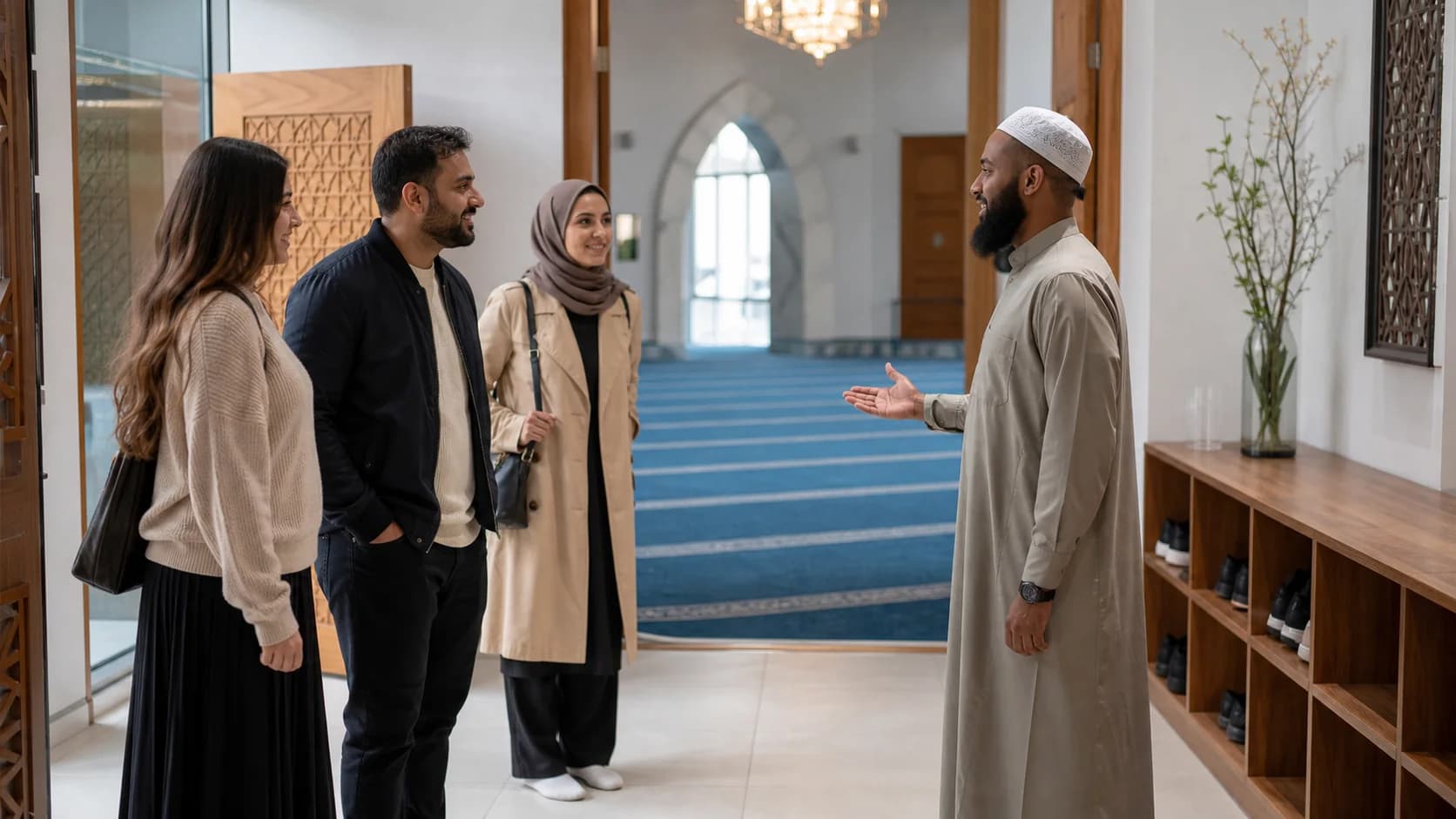
At the entrance, look for signs, shoe racks or a volunteer. Remove shoes at the boundary the mosque indicates rather than assuming the entire building has one rule. The Islamic Center of Midland's visitor sheet explains its shoe practice and asks guests to silence phones and walk behind, not in front of, someone who is praying. Those are concrete ways to avoid interrupting others. Put your phone on silent before entering and keep a bag from blocking an aisle or exit.
If pain, mobility, sensory needs or anxiety make a crowded floor difficult, contact the host about seating or a quieter accessible space. A chair, upstairs hall or viewing area may exist, but its location cannot be inferred from another mosque's website. Ask where to wait if a room is full. Do not move someone else's aid, cross occupied rows to reach the front or take a reserved space without asking an usher.
Know what the call, sermon and prayer mean
The adhan is a call to prayer. The khutbah is the Friday sermon; in many mosques it has two parts with a brief pause. After the sermon, an iqama, a shorter call announcing the congregational prayer, may be heard before people stand in rows. The imam then leads a two-unit prayer. The Midland centre's Friday visitor sheet describes a call, two sermon parts with a pause, another call and the congregation standing to follow the imam. Bait-ul-Ehsan's own page likewise describes a sermon followed by two units of prayer.
You may hear a talk in the local language before the main khutbah, as Birmingham's notice illustrates. You may also hear an announcement or see people perform optional prayers before or after the core service. Those surrounding elements vary. The safest way to orient yourself is to identify the khutbah start and the congregational prayer, then let a host explain the rest. Our adhan and iqama explainer gives more detail about the two calls without treating any one site's clock times as a rule.
The sermon speaker may stand at a minbar, a pulpit in or near the prayer hall. A mihrab is a niche associated with the prayer direction. These terms can help you follow an orientation from a volunteer; they are not a map of every building. The mosque architecture glossary explains what those features do. If the room you enter has no familiar-looking dome, minaret or raised pulpit, follow signs and people responsible for the service rather than trying to infer the route from an image.
During the khutbah, listen and leave room for others
Once the khutbah begins, stop conversations and put away messages, cameras and other distractions. A first-time attendee can listen without understanding every Arabic phrase. If there is a pause between parts of the sermon, do not assume the entire service is finished. Watch for the transition to the congregational prayer and follow the host's or usher's instructions about where to stand. Taking notes or asking a long question can wait until after worship.
If you arrive while the sermon is underway, enter quietly and take an appropriate available place. Do not push across occupied rows or step in front of someone already praying. A late visitor should ask an usher where to observe, rather than entering a prayer line merely to blend in. A worshipper should use the local mosque's direction for where to join; the exact consequence of missing the sermon is a question of religious guidance, not something a general visitor article can decide for every person.
The khutbah is not an opportunity to record worshippers without consent. Bait-ul-Ehsan's visitor page, for example, requires permission for photographs inside its prayer hall. Other venues set their own rules. If you need an image for a school assignment or publication, ask before the day and explain its intended use. The general first mosque visit guide covers visitor etiquette, family arrangements and photography in more detail.
Join the prayer row when the congregation stands
After the sermon, the congregation forms rows and follows the imam in two prayer units, often called rak'ahs. If you are participating, find an available place without walking over people. Follow the imam's movements rather than beginning each movement ahead of him. If you are uncertain where to stand, ask a nearby volunteer with a brief gesture before prayer begins; do not carry on a conversation across the row once the congregation starts.
A person new to congregational prayer does not need to master every difference in hand position or optional practice during the first Friday. Some neighbouring worshippers may follow different recognised traditions. Keep your attention on the shared prayer led by the imam. If you have a personal question about a movement, a missed part or a physical limitation, note it afterward and ask someone qualified at the mosque. An observer should stay in the place the host identified and need not copy the movements to participate as a guest.
Leave an aisle clear if an usher directs you away from a full room. Families or visitors may be directed to a separate area; follow that venue's current signs. Birmingham's published notice, for instance, identifies a particular floor for its women's prayer facilities. It does not establish the floor plan of the next mosque you visit.
If you are late, ask the right question afterward
Being late has two practical stages: you may miss the sermon, or you may arrive after the congregational prayer has already started. Do not run through the hall to recover time. If the prayer is in progress, a worshipper can ask an usher where late arrivals join; if a separate hall is in use, follow its instructions. A guest observing should still seek the designated visitor place. The most useful immediate question is “Where should I go now?” rather than a hurried debate over a legal ruling at the doorway.
After the imam finishes, tell a qualified local imam or teacher when you arrived and what part of the prayer you joined. Ask what, if anything, you need to complete according to the guidance followed in that community. The answer can depend on details a general article cannot see. The same applies if you were travelling, ill, caring for someone or uncertain whether Jumu'ah applies to you personally. This guide deliberately avoids assigning individual obligations or prescribing a universal late-arrival formula.
If you miss a planned service altogether, check whether the mosque has another congregation and ask its staff for the current schedule. Cambridge's own page shows two khutbah start times; Birmingham's notice describes one congregation at the time checked. This variation is why the next available option must come from today's local notice, not from a generic promise that a second service will exist.
Leave space for questions and plan the next visit
At the end of prayer, give people a moment to finish their personal devotion and collect belongings. If another congregation follows, move a conversation out of the hall when asked. Tell a volunteer that this was your first Jumu'ah and ask one or two concrete questions: “Which time on your website is the sermon?” “Where is the wash area?” “Who can explain the part I missed?” A focused question usually gets a more useful answer than trying to learn every optional practice at once.
Keep a link to this mosque's own Friday notice and note which entrance and session worked for you. Next week may have a different speaker, language, room or clock time. The stable pattern is the sermon followed by congregational prayer; the dependable operational details are the ones the host currently publishes. If you came only to observe and would like a longer explanation, arrange a tour or another conversation rather than holding up people departing after a crowded service.
Sources
- Qur'an 62:9 on Quran.com — provides the direct scriptural reference to the Friday call and remembrance; it is not used here to determine detailed legal rulings.
- Cambridge Central Mosque, prayer times — explicitly labels khutbah starts for its two Friday congregations, showing what its own published times mean.
- East London Mosque, prayer times — says its Friday Zuhr jama'ah time denotes Jumu'ah prayer and its khutbah begins about half an hour earlier at that mosque.
- Birmingham Central Mosque, Friday notice — distinguishes an Urdu and English speech from the main Arabic khutbah and states the current number of congregations at its own venue.
- Islamic Center of Midland, Visiting a Mosque — describes its Friday sermon-to-prayer sequence and practical visitor instructions for shoes, phones and walking near worshippers.
- Bait-ul-Ehsan Mosque, Plan Your Visit — gives its own visitor invitation, greeter arrangement, Friday sequence and photography rule; this is an Ahmadiyya community's local programme.
- Muslim Council of Britain, Visit My Mosque visitor guide — gives open-day visitor guidance and the distinction between a planned tour and other visits, not a universal Friday service policy.