Star and Crescent Meaning: History, Objects and Context
Explore the star and crescent through museum objects, lunar timekeeping and humanitarian emblems, with clear limits on what the symbol can tell you.
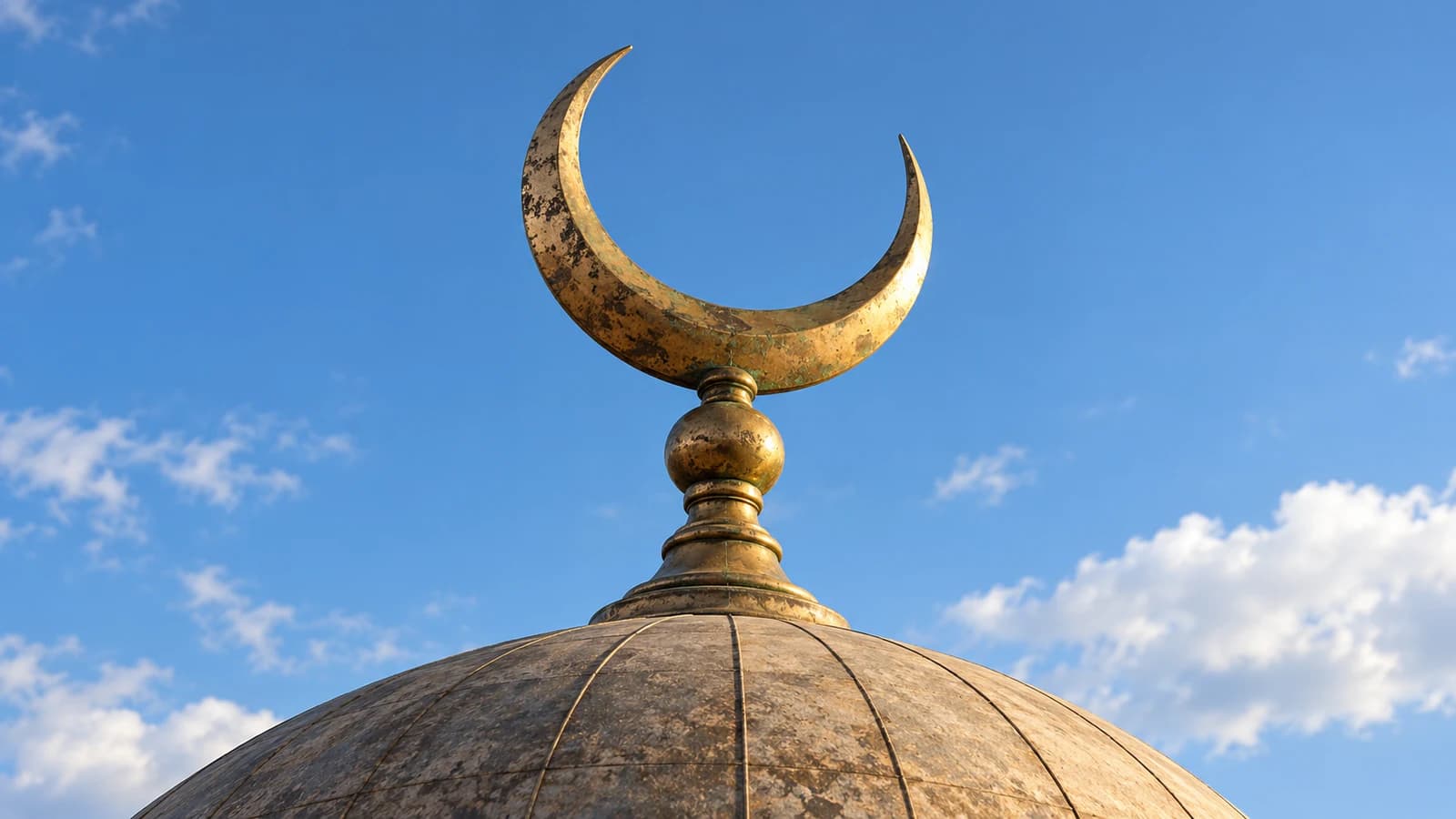
The star and crescent is widely associated with Islamic cultures and appears in several national and institutional settings. Its meaning depends on where it appears, who uses it and when the object was made. A crescent on a building, an Ottoman banner, a modern ornament and the red crescent of a humanitarian organisation should not all receive the same explanation.
There is also a difference between a crescent by itself and a crescent paired with a star. Historical objects can contain one, several or differently arranged motifs. Looking carefully at a dated example is more useful than assuming that every familiar shape records one origin story or states a religious requirement.
Begin with the object rather than a universal label
When identifying a symbol, first describe what is actually present: a curved moon shape, a star with a particular number of points, an inscription, a colour and a surrounding design. Then identify the object’s maker, date, place and purpose where these are documented. Recognition is a starting point for interpretation, not the completion of it.
| Setting | Useful evidence | What the shape alone cannot establish |
|---|---|---|
| A building finial | The building’s history and the finial’s installation or replacement record | The original date of the whole building or every visitor’s beliefs |
| A historic banner | Museum number, inscriptions, textile and dated comparisons | A universal flag used by all Muslims in every period |
| A modern decorative object | Maker, commission, gift record and design explanation | That the object itself survives from the period it evokes |
| A humanitarian emblem | The authorised institution and the rules governing its use | A statement of the religion of the people receiving help |
This approach also avoids confusing a building’s function with one piece of decoration. A mosque’s prayer space, direction of prayer and furnishings have their own roles. Our mosque architecture glossary explains the mihrab, minbar and minaret by function, so a rooftop ornament need not carry the whole explanation of the building.
The historical record is broader than one founding story
Nebi Bozkurt’s section on the crescent as a symbol in the TDV encyclopaedia’s Hilal entry surveys uses across different societies, coins, architecture and Ottoman objects. It discusses earlier forms as well as later associations. That breadth is a reason to avoid presenting one modern design as though every historical crescent were an identical emblem.
A claim about the first appearance of a motif requires different evidence from a claim about its later popularity. An object can demonstrate use in a particular place and period without proving the earliest invention. Likewise, a later historian’s proposed explanation is not the same kind of evidence as a contemporary inscription or a dated surviving object.
Stories about a decisive dream, conquest or striking reflection may be memorable. Before repeating one as history, ask which early record reports it, when that record was written and whether the account concerns the crescent alone or a specific star-and-crescent arrangement. Without those details, an engaging narrative can quietly replace the evidence needed for a claim of origin.
For a short caption, there is no need to solve the entire history. It can be more accurate to identify a documented Ottoman example or a modern Turkish-made ornament and explain that particular use. A limited, supported description tells readers more than an absolute sentence about all countries, all centuries or all Muslim communities.
An Ottoman banner with a documented crescent
The British Museum’s banner As1980,Q.211 is catalogued as Ottoman, made in Turkey and dated 1650–1700. The record describes silk and metal-thread decoration. A central crescent carries text linked to Quran 61:13 together with an invocation, while other areas contain names and further religious inscriptions.
The museum explains that banners of this kind helped identify Ottoman regiments in battle and expressed an appeal for divine protection and success. This supplies a specific historical setting for the crescent: a military textile whose imagery and writing work together. It does not turn the banner into a timeless standard for every Muslim population.
Notice the difference between identifying the crescent and identifying its inscription. Someone can recognise the curved outline without being able to read the text. If the writing matters to a caption, use the museum’s transcription or a qualified reading rather than guessing a familiar phrase from a distant photograph.
Our explanation of Bismillah and the basmala offers a related vocabulary distinction. A recognisable religious expression and a recognisable shape are separate features. Neither should be inserted into the description of an object simply because it seems likely to be there.
A modern ornament can draw on an older tradition
A different example appears in the Royal Collection Trust’s record for ornament RCIN 188008. It identifies a 2013 object made by the Turkish firm Hiref Tasarim. The account relates its design to the Beykoz glass tradition of Istanbul and records its presentation to the then Prince of Wales by the King and Queen of Jordan.
The Trust notes the appearance of crescents on Islamic buildings and processional standards, along with national and cultural associations in formerly Ottoman regions. Its explanation connects a modern object to wider traditions without dating the ornament itself to the Ottoman period. The distinction between an object’s manufacture date and its design references is essential.
A modern decorative piece can therefore be evidence of continuing interest, a diplomatic gift or a maker’s interpretation of a tradition. Its presence in a historical collection does not make it ancient. When sharing a museum photograph, retain the catalogue date and accession number alongside any discussion of the older styles it recalls.
The same care applies to architectural photographs. A finial may have been replaced during restoration even when the building beneath it is much older. A picture alone rarely supplies that sequence. Where the installation history is unknown, describe what is visible and leave the age of that component unassigned.
The Moon’s calendar role is a different question
A crescent can also evoke the Moon and lunar timekeeping. Quran 2:189 associates lunar phases with determining time and pilgrimage. That is relevant to understanding the calendar connection, but a passage about timekeeping should not be treated as a design specification for a modern flag or a requirement for every mosque roof.
NASA’s explanation of lunar phases describes the changing portion of the Moon’s sunlit surface that observers on Earth see. A crescent is one phase appearance; the Moon has not physically changed into a thin curved object. The scientific diagram explains illumination and viewpoint, while an emblem is a human-made representation with its own setting.
The US Naval Observatory’s note on crescent visibility further separates the calculated astronomical new Moon from the visibility of a young crescent. Visibility depends on observing conditions and geometry, among other factors. A decorative crescent in a poster is therefore not a report that a crescent has been sighted in a particular city on a particular evening.
Daily prayer timing raises another distinction: the familiar five prayer times relate to solar events and their interpretation, while lunar months concern a different cycle. Our guide to prayer-time calculation methods explains the daily timetable question. Neither a stylised crescent nor a national flag can supply a local Fajr time.
Why the red crescent needs its own explanation
The International Committee of the Red Cross’s emblem guidance describes the red cross, red crescent and red crystal in their humanitarian roles. It distinguishes protection in armed conflict from identification of National Societies and explains that their use and misuse are governed by international and national rules.
In its 2017 explanation of the three emblems, the ICRC explicitly says they are not religious symbols. This institutional explanation matters even when a viewer associates the crescent shape with Islamic cultures elsewhere. The meaning of an authorised humanitarian emblem cannot be inferred solely from the shape’s use in a different context.
Consequently, a red crescent on a humanitarian organisation’s materials should not be captioned as proof of the faith of every worker or recipient. Nor should an unrelated decorative motif be described as carrying the same protective status. Identifying the organisation and the purpose of the display is part of an accurate description.
For an actual proposed use of a humanitarian emblem, consult the responsible institution’s current rules. This page explains the distinction between settings; it does not confer authorisation to adopt a protected emblem as a general badge. That is a concrete reason to preserve colour, institutional identity and context when describing one.
Write a caption that the evidence can support
A useful caption names the object or institution, gives its documented date and place where available, describes the motif and attributes the interpretation. For example, the British Museum banner can be introduced with its catalogue number and date range before explaining the crescent’s inscription and the museum’s account of regimental use.
Keep manufacture, later ownership and modern display separate. A gift date need not be a manufacture date unless the record says so; a museum acquisition date need not be the age of the object. When a catalogue gives a range or an attribution, retain that uncertainty rather than replacing it with a precise year or a confident origin.
For a visit to an active religious building, ask before photographing people or entering restricted areas; our first mosque visit guide covers those practical questions. Reading architecture respectfully includes recognising that the people present are not exhibits and that a motif cannot reveal an individual’s whole religious identity.
The strongest explanation can be quite specific: this banner used the crescent in this setting; this modern ornament references an older craft; this institution defines its emblem for humanitarian purposes. Those statements give the reader evidence they can check, while leaving room for the different histories that a familiar shape can carry.
Sources and collection records
- TDV: Nebi Bozkurt on the crescent as a symbol.
- British Museum: Ottoman banner As1980,Q.211.
- Royal Collection Trust: ornament RCIN 188008.
- Quran 2:189: lunar phases and determining time.
- NASA: Moon phases.
- US Naval Observatory: crescent visibility.
- ICRC: uses and protection of humanitarian emblems.
- ICRC: the emblems are not religious symbols.