Assalamu Alaikum Meaning and How to Reply
Learn the meaning of assalamu alaikum, its Arabic spelling and familiar reply, with pronunciation help, short dialogues and carefully explained source texts.
Assalamu alaikum is an Arabic greeting meaning “peace be upon you.” Its familiar reply is wa alaikum assalam, meaning “and upon you be peace.” The greeting opens an exchange with another person; the reply returns that wish. You may also see the words written as as-salamu alaykum, salam alaikum or assalamualaikum.
Learning the pair together is more useful than memorizing the opening alone. It gives a newcomer something clear to say when greeted, while leaving room for the introductions, questions and local courtesies that follow. A greeting’s literal meaning and the way a conversation unfolds are related, but they are not identical.
Assalamu alaikum and the reply in Arabic
The opening is السلام عليكم; the reply is وعليكم السلام. A practical transliteration is as-salamu alaykum and wa alaykum as-salam. The word salam concerns peace, and the opening wa in the response adds “and.” The reply places the same wish back with the person who offered it.
The Peace Corps’ pre-departure Arabic materials for Jordan teach the two lines as a greeting-and-response pair in the first lesson. The lesson gives other expressions separately, including marhaba for hello and a morning greeting with its own response. That organization is a useful reminder to learn exchanges rather than a disconnected list of translated words.
| Part of the exchange | Arabic | Readable transliteration | Meaning |
|---|---|---|---|
| Opening greeting | السلام عليكم | As-salamu alaykum | Peace be upon you |
| Returning the greeting | وعليكم السلام | Wa alaykum as-salam | And upon you be peace |
If you are reading a text message, joined spelling can hide the boundary between words. Look for the exchange as a whole rather than assuming that a form with fewer spaces expresses a different greeting. In your own writing, a consistent, readable spelling helps the other person recognize what you mean.
Spelling and pronunciation without overcomplicating the greeting
English transliterations use different conventions. Assalamu alaikum is familiar and easy to search for; as-salamu alaykum shows more of the word boundaries. More detailed transliterations may use long-vowel marks or a special character for an Arabic consonant. Those marks can help a language student, but ordinary messages often omit them.
For a first approximation, think of the opening in manageable sound groups: as-sa-laa-mu, then a-lay-kum. Let the long vowel in salaam remain audible. This is an English reading aid, not a substitute for hearing Arabic. The Jordan teaching materials include an accompanying audio lesson precisely because written transliteration leaves part of pronunciation unexplained.
Cambridge Dictionary’s entry for salaam includes a greeting sense and describes it as a shortened form of the longer Arabic phrase. A short salaam in a message may therefore perform the same broad social job as a greeting, although it does not reproduce every word of the full formula.
The same dictionary also records noun and verb senses associated with a physical gesture. Those are separate uses of the English word. Reading them does not establish that someone must bow, make a particular movement or touch another person whenever they say assalamu alaikum. Words and accompanying gestures should be understood in the actual setting.
A simple conversation: greeting, reply, then the next sentence
Here is a short illustrative exchange. It is a language example rather than a transcript from a particular visit:
Visitor: Assalamu alaikum.
Host: Wa alaikum assalam. Welcome.
Visitor: Thank you. My name is Amina. Is this the entrance for today’s tour?
The first two lines complete the greeting pair. The visitor then introduces herself and asks the practical question. Keeping those jobs separate makes the conversation easier: a religiously meaningful salutation does not need to carry the additional meanings of “thank you,” “where should I go?” and “may I come in?”
A second example could occur between colleagues. One person writes, “Assalamu alaikum, Farid. Is our meeting still at ten?” Farid can return the greeting and answer the question. If the timing is uncertain, the uncertainty belongs in the answer about the meeting. The greeting itself is not a promise, a confirmation or a request to postpone.
In a written introduction, keep the greeting on the same footing as the rest of the message. An example might read: “Assalamu alaikum. My name is Layla, and I am writing about the community class on Saturday.” The reader receives the salutation and the reason for contact without needing to guess either. If you reply to that message, return the greeting and address the class question. Repeating a longer formula several times does not supply the missing date, location or answer.
When you miss the words or cannot follow a rapid reply, a plain request for repetition is useful. You can say that you are learning Arabic or ask the speaker to repeat the phrase slowly. There is no need to pretend you understood an instruction simply because you recognized the opening greeting.
Visitors planning a first mosque visit can pair this language practice with the mosque visit guide. The greeting starts the encounter; information from the host settles details such as entrances, photography and where a visitor should wait.
The religious context of returning a greeting
Qur’an 4:86 tells its audience to answer a greeting with an equal or better one. This gives reciprocity a clear religious place: the person addressed takes part in the exchange by returning goodwill. The verse’s instruction helps explain why learning the response matters alongside learning the opening.
The verse does not print a complete language lesson for every circumstance. Questions involving a particular worship setting, disputed legal interpretation or interfaith interaction need more than a line from a phrasebook. A general explanation can identify the principle of returning a greeting without pretending to resolve all of those questions.
Longer forms can add God’s mercy and blessings. Sunan Abi Dawud 5195 narrates successive greetings containing the basic peace formula, then mercy, then mercy and blessings. This supplies a specific textual example for expressions such as as-salamu alaykum wa rahmatullahi wa barakatuh, rather than treating the extra words as improvised decoration.
A learner should first recognize which words were spoken and understand the basic response. Memorizing the longest possible formula is a different task from conducting a courteous conversation. If you are learning how a particular community teaches the fuller exchange in religious practice, use that community’s qualified instruction for the details.
Who starts the greeting? A narration and its scope
Sahih al-Bukhari 6231 discusses initiation in several situations: the younger greets the older, a person passing greets someone sitting, and a smaller group greets a larger one. The narration places greeting within ordinary encounters between people, rather than treating it only as a formal opening to a speech.
These examples show why learners encounter etiquette alongside vocabulary. The words have a meaning, while the exchange also expresses attention to another person. However, a short educational article should not turn this narration into a universal rulebook for every modern workplace, school corridor or online conversation.
For a visitor, the practical point is straightforward: notice the people present, listen when you are greeted and respond audibly enough to be understood. If introductions are being handled by a host, follow the introduction instead of interrupting it with a performance of everything you have memorized.
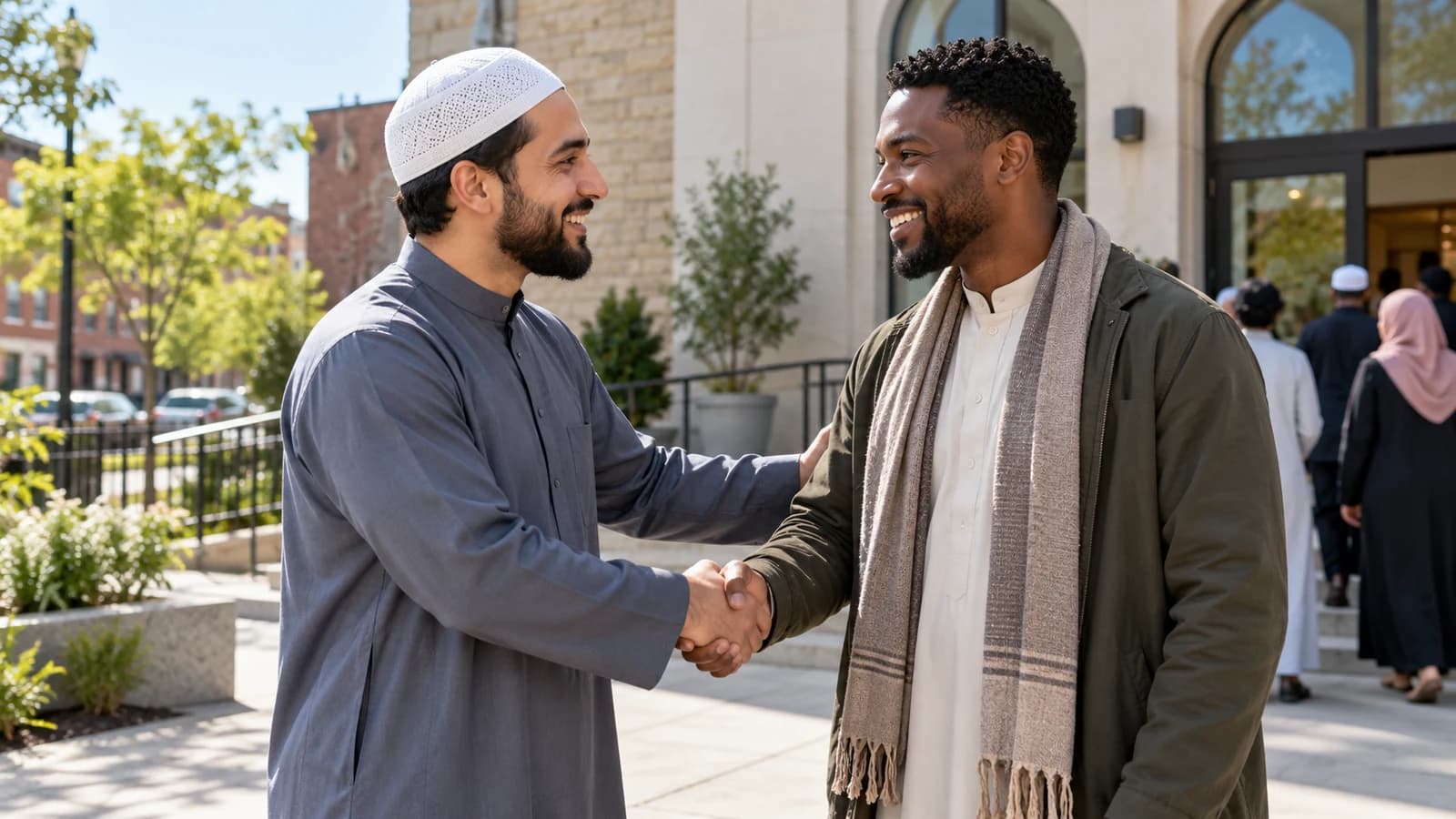
Physical contact is another question. A greeting can be returned in words without presuming that the other person wants a handshake, an embrace or a photograph together. Follow the actual person’s cues and the host’s explanation of the setting. A phrasebook translation cannot give consent on someone else’s behalf.
What regional teaching materials can and cannot tell you
A university orientation document offers a useful comparison with the Jordan language lesson. Zayed University’s Western Teacher meets Eastern Learner, dated January 2010, presents the Arabic peace greeting to newcomers in a Gulf educational setting. Its introduction explicitly warns that cultural pointers do not describe every individual.
That warning matters as much as the phrase itself. A guide written for one university community at one time is evidence of what its author was teaching newcomers. It cannot establish how every Arab, every Muslim or every student now prefers to be greeted. The Jordan manual similarly introduces speech in Jordan and acknowledges dialect differences.
The 2022 paper Greeting Strategies in English and Arabic: A Contrastive Study treats greetings as social and pragmatic actions. Its useful contribution here is that a greeting does more than transfer a dictionary meaning: it helps people open and maintain a relationship. Broad comparisons between languages still need to be read with attention to their scope.
A newcomer can learn from these materials while leaving room for the person in front of them. An ordinary hello, a locally familiar greeting and a religious salutation may all occur in the same multilingual environment. Knowing one phrase does not establish someone’s identity, their beliefs or the language they prefer for the rest of the conversation.
Greeting, gratitude and prayer are different uses of language
Assalamu alaikum addresses another person with a wish of peace. Alhamdulillah expresses praise or gratitude; inshallah relates a plan or hope to God’s will. Our guide to inshallah, mashallah and alhamdulillah explains their different conversational functions. They can appear together in an exchange, but one does not automatically replace the others.
Likewise, a greeting is not a complete explanation of ritual prayer. The dua and salah guide separates personal supplication from the structured prayer. The adhan and iqama guide treats the calls associated with prayer in their own sequence. Recognizing familiar Arabic words is a starting point for understanding each setting.
To use assalamu alaikum with confidence, learn the opening and response together, listen to the person who greets you and continue with an ordinary conversation. That small exchange is already complete: a wish of peace offered, acknowledged and returned.
Sources
- Cambridge Dictionary, salaam: the greeting sense and its relation to the longer phrase.
- Peace Corps, Pre-Departure Arabic Language Materials for Jordan: greeting-and-response pair on printed page 1; archival copy hosted by Live Lingua.
- Qur’an 4:86: responding to a greeting.
- Sunan Abi Dawud 5195: examples of fuller greetings.
- Sahih al-Bukhari 6231: examples concerning who initiates a greeting.
- Zayed University, Western Teacher meets Eastern Learner: a 2010 orientation guide and its caution about individual differences.
- Adab Al-Kufa Journal, Greeting Strategies in English and Arabic: A Contrastive Study: a paper published in December 2022.