Suhoor vs Iftar: Meal Times, Meanings and Local Timetables
Suhoor is the meal before dawn; iftar breaks the fast at sunset. Learn the terms, read the right timetable columns and plan a respectful invitation.
Suhoor is the meal eaten before dawn in preparation for a fast. Iftar is the breaking of the fast at sunset, and the word also commonly describes the meal or gathering around that moment. The two belong to opposite ends of a fasting day. Neither term names a fixed menu, a worldwide clock time or the celebration of Eid.
The practical distinction is between dawn, sunrise and sunset. A timetable can list all three, together with prayer congregation times and an event’s arrival time. Reading the wrong column can create a much bigger misunderstanding than spelling suhoor as suhur. This guide explains the vocabulary and how to check the arrangements for a particular place and date.
Suhoor and iftar at a glance
| Question | Suhoor | Iftar |
|---|---|---|
| What does it describe? | A meal before dawn, in preparation for fasting | Breaking the fast, and often the associated evening meal |
| Which boundary matters? | The start of the fast at dawn | The end of the day’s fast at sunset |
| Which prayer is nearby? | Fajr, the dawn prayer | Maghrib, the sunset prayer |
| Is the menu fixed by the name? | No; the word identifies the meal’s place in the fasting routine | No; a light opening and a larger meal can be separate |
| Can one printed time work everywhere? | No; check location, date and the timetable’s method | No; check local sunset and the host’s programme |
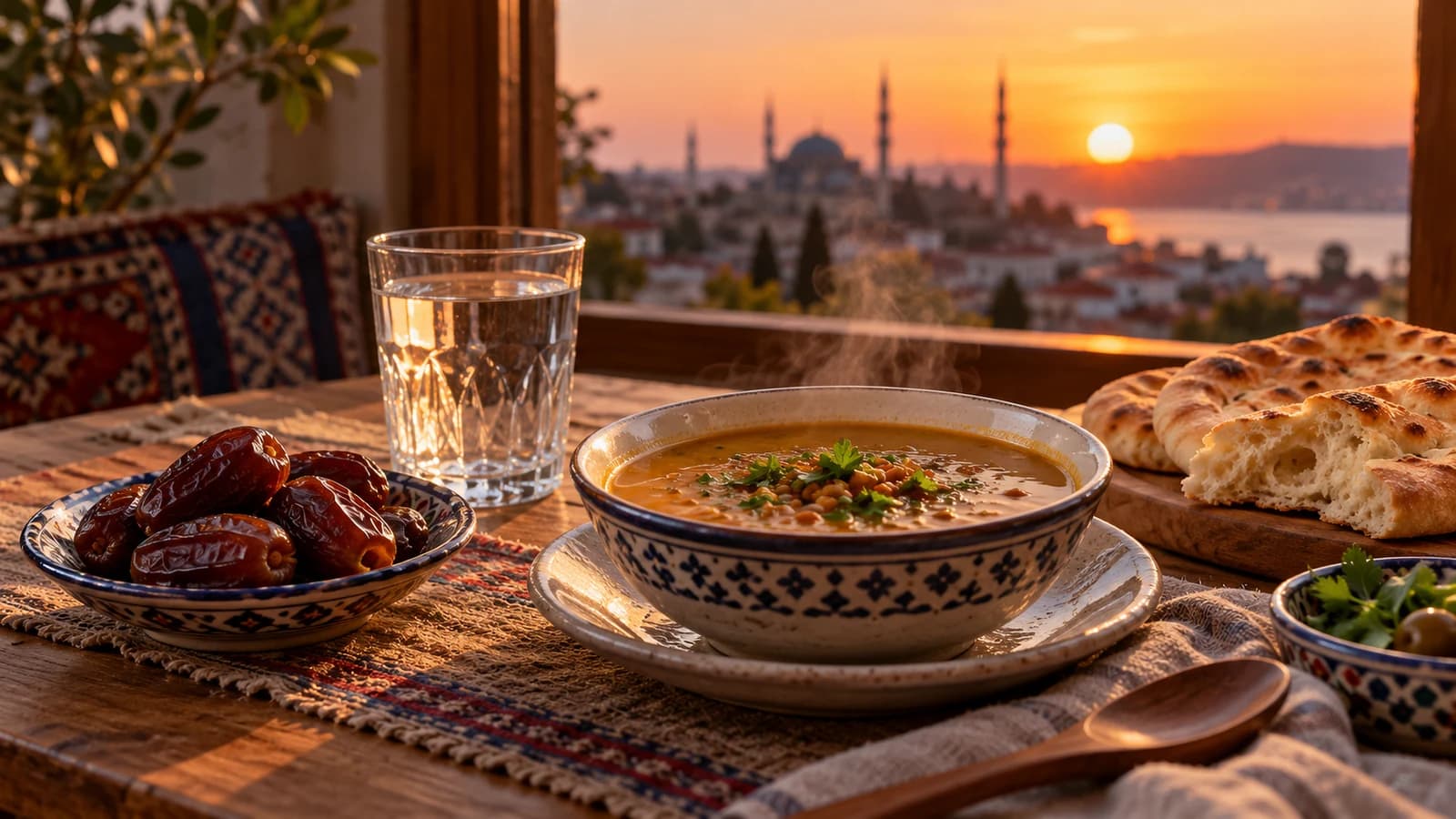
The TDV encyclopaedia’s entry on sahur places the meal before the beginning of dawn. Its entry on iftar explains the term for breaking a fast and the customs that developed around it. Those definitions describe the function of the meals. A photograph of a particular family’s table shows one way of serving them, rather than an ingredient list that defines either word.
Why dawn and sunrise must stay separate
Quran 2:187 describes eating and drinking until the light of dawn becomes distinguishable, followed by completing the fast until night. In ordinary local Ramadan schedules, the beginning of the fast is associated with Fajr and its end with sunset. Sunrise is a later event than dawn. Replacing “before dawn” with “before sunrise” can therefore give a reader the wrong impression about when eating stops.
A printed schedule may include a column headed imsak, another headed Fajr and another headed sunrise. Read the publisher’s notes: an imsak column may represent an earlier precautionary reminder rather than a second sunrise calculation. Do not assume that every organisation uses that label in exactly the same way, or subtract an invented number of minutes from an unrelated app.
For example, a hypothetical timetable might show a fasting boundary, a later Fajr congregation and a still later sunrise. The congregation is the time worshippers gather for prayer; it does not move dawn. If someone says “we meet at Fajr,” ask whether they mean the prayer’s beginning or the mosque’s congregation. The difference matters when arranging a shared meal or a journey.
Our guide to prayer-time calculations and app differences explains why Fajr figures can differ between methods. Where local religious guidance is needed, identify the timetable and authority your community follows. A vocabulary article cannot settle every high-latitude or exceptional-location question from a single universal clock setting.
Sunset, Maghrib and the invitation’s start time
Iftar is linked to sunset, but a community invitation can begin earlier so people can arrive, find a seat and receive water or dates. The time printed beside “doors open” is not automatically the time to break the fast. Similarly, a restaurant booking or a speech programme cannot be used as evidence of the solar event.
Sahih Muslim 1098a records encouragement to break the fast promptly. This concerns the appropriate time having arrived; it is not permission to treat any early event announcement as sunset. If a programme lists an arrival time, an iftar time and a prayer time, retain those separate labels when forwarding it to guests.
The Islamic Society of Britain’s March 2022 guide for schools outlines a day that includes a pre-dawn meal, Fajr, sunset iftar and Maghrib. It is useful evidence of how those activities fit together. It is not a current timetable for every school, city or Ramadan.
Someone attending a gathering can ask the host two straightforward questions: “When should I arrive?” and “When will the fast be opened?” If the event also includes a congregational prayer, ask where guests should wait during it. These questions allow the organiser to explain the actual programme without making assumptions about every household’s routine.
What the meal traditions do and do not specify
Sahih al-Bukhari 1923 records an encouragement to take suhoor and associates it with blessing. That religious description should not be turned into a promise that one particular breakfast prevents every difficulty during a fast. The report does not supply a universal calorie target, a shopping list or a medical assessment of an individual’s circumstances.
Sunan Abi Dawud 2356 describes the Prophet opening his fast before prayer with fresh dates, dried dates when fresh ones were unavailable, or water when dates were unavailable. Sunnah.com attributes the grading “Hasan Sahih” to al-Albani. The report explains a remembered practice; it does not say that every iftar must become a large banquet or prescribe a numbered serving for every guest.
A family might offer a small opening, pray and then serve dinner. Another gathering may organise its space and service differently. Describe what the host actually says rather than treating one sequence as a full account of every Muslim community. If you are explaining the phrase said before eating, our Bismillah guide separates that expression from the names of the meals themselves.
Menus also require their own questions. The word iftar does not identify allergens, ingredients or a particular restaurant’s certification. A guest who needs those details should ask the caterer or host directly. Our introduction to what halal means provides the broader vocabulary; the actual food still needs to be described accurately.
Check a timetable for the right place and day
Before copying a time into a message, confirm the city or coordinates, the calendar date and year, the time zone and any daylight-saving setting. Also read which organisation issued the schedule and whether a number means the prayer begins, a congregation assembles or an event starts. A saved image from a previous year can look perfectly clear while being unsuitable for the present date.
Islamic Relief Worldwide’s Ramadan article describes suhoor as pre-dawn and the next eating occasion as after sunset. The useful point here is the day’s sequence. Its general lifestyle discussion is not being used to assign a personal eating or drinking plan to everyone who reads this page.
A practical message can say: “Please arrive at the hall by the time shown on the invitation; the organiser will announce the local iftar time.” If sending an actual time, include its date and city instead of writing only “iftar is at seven.” Those details help someone distinguish an example from an instruction and recognise when travel changes the relevant location.
If two schedules disagree, compare their labels and method notes before averaging the numbers. Ask the publisher or local religious adviser to explain the difference. For the distinction between the call to prayer and the announcement of a congregation, see adhan and iqama explained. A later congregation does not, by itself, redefine the beginning of a prayer’s time.
Reading an invitation without mixing up the times
Consider an invented event notice that lists reception, a short welcome, opening the fast and dinner service as four separate activities. The reception time tells guests when the venue is ready; the opening time is the item to compare with the organiser’s local timetable. The dinner service may follow a prayer break. This example describes how to read labels, rather than supplying actual times for any city.
When adapting that notice into another language, preserve each activity’s label. Translating all four as “dinner starts” removes information guests need. Keep the organiser’s contact details with the invitation so questions about access, seating or the prayer break go to someone who knows the venue. If a timetable image is attached, make sure its location and date remain visible when cropping or forwarding it.
Spelling, invitations and everyday courtesy
Suhoor, suhur and sahur are common ways the Arabic term appears in Latin letters and different language settings. An invitation may use a familiar local word as well. Transliteration variation alone is not evidence of a different meal. If a label is unfamiliar, ask whether it means the meal before dawn or the gathering at sunset.
Iftar can describe the act of opening the fast, a family meal or a larger organised event. Its use on a poster does not tell you the event’s admission arrangements. Confirm whether registration is needed, whether non-fasting guests are welcome and whether children or companions should be included in the booking. A public-looking photograph does not establish that a private gathering is open to everyone.
A guest can follow the host’s explanation about seating, the opening of the fast and the transition to prayer. Asking before photographing people or sharing details of their observance is a useful courtesy. People may have personal reasons for not fasting, and an invitation is not a reason to request a public explanation of those circumstances.
Finally, iftar is a repeated event during fasting days; Eid al-Fitr names the festival at the end of Ramadan. A community can advertise both, but the words do different jobs. Knowing whether a message concerns a daily meal, an evening prayer or a festival booking makes the next practical question much easier to ask.
Sources for the terms and timing
- TDV: sahur, the pre-dawn meal.
- TDV: iftar and its religious and social uses.
- Quran 2:187: dawn and the fasting period.
- Sahih al-Bukhari 1923: encouragement to take suhoor.
- Sahih Muslim 1098a: prompt breaking of the fast.
- Sunan Abi Dawud 2356: dates and water before prayer.
- Islamic Society of Britain: Ramadan guide for schools, March 2022.
- Islamic Relief Worldwide: the Ramadan daily routine.