How Prayer Times Are Calculated and Why Apps Differ
Understand Fajr and Isha angles, Asr settings, high-latitude rules and time zones, then compare prayer apps with your mosque's published timetable.
Prayer times are calculated from the Sun's position for a particular place and date, then interpreted through a selected prayer-time convention. Two apps can therefore show different Fajr or Isha times even when both have the correct city. Before changing an alarm, compare their location, time zone, calculation method, Asr setting, high-latitude rule and any manual adjustments.
A mosque's congregation time is a further question. An app may display when a prayer period begins, while the mosque publishes the time people actually stand together to pray. This guide explains how to identify the difference and compare schedules without assuming that every disagreement means an astronomical error.
What a prayer-time calculation actually produces
A calculator starts with a date and geographical coordinates. It estimates where the Sun will be relative to the observer, finds the relevant solar events, and converts those results into local clock time. Latitude affects the Sun's daily path; longitude affects its timing relative to the chosen time zone. The calculation is specific to that place and day, rather than a permanent set of clock readings.
The U.S. Naval Observatory publishes a solar-coordinate algorithm suitable for estimating sunrise, sunset and solar transit. Those astronomical quantities are inputs to a timetable. They do not, by themselves, choose a religious convention for interpreting dawn, twilight or the afternoon shadow.
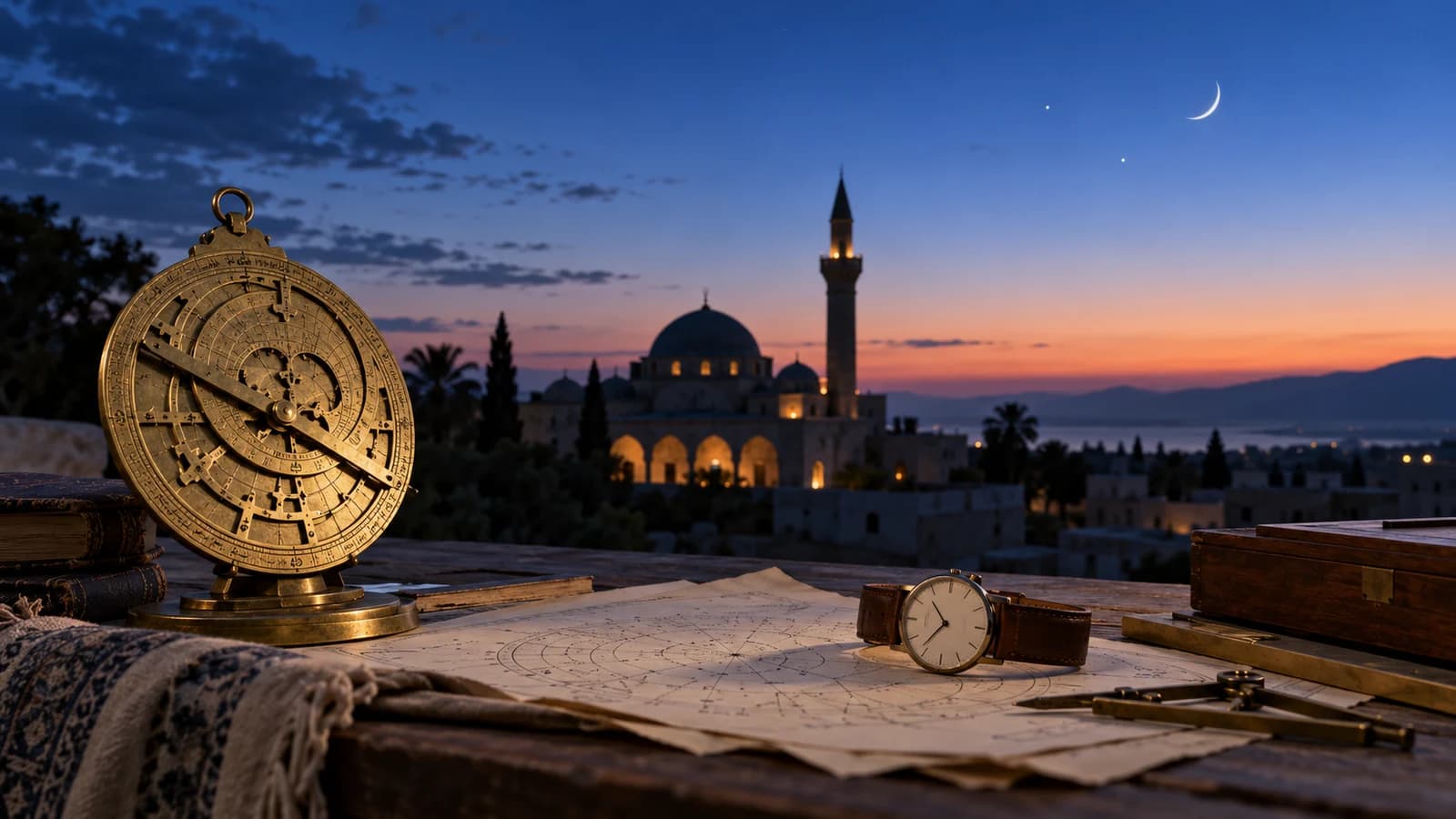
Separate three layers when reading a schedule: the astronomical model, the prayer-time convention, and the local arrangement for congregational worship. That distinction also explains why the history of the muwaqqit, the mosque timekeeper, involves both calculation and the practical needs of a community.
Why Fajr and Isha calculation methods differ
Fajr is associated with dawn; Isha with the disappearance of evening twilight. Software commonly represents these conditions through a solar depression angle: how far the Sun's centre lies below the horizon. An angle such as 18 degrees describes a position, rather than a fixed number of minutes before sunrise or after sunset.
During an ordinary morning in which both positions occur, the Sun reaches 18 degrees below the horizon before it reaches 15 degrees. The larger depression angle therefore gives an earlier calculated Fajr. In the evening the order reverses: reaching the deeper angle takes longer, so it gives a later calculated Isha. The size of the clock-time difference varies with the date and latitude.
The PrayTimes calculation documentation describes several conventions, including angle-based and fixed-interval approaches. Their coexistence matters more than the number of settings in an app. Selecting a different convention changes the assumption used to turn the solar position into a prayer-time boundary.
Reading a method preset without treating it as a universal ruling
The following examples are documented software presets, not a statement that every mosque in a named region uses identical settings. The table is a way to identify what a menu selection means before comparing two apps.
| Preset commonly shown in software | Fajr depression angle | Isha parameter |
|---|---|---|
| Muslim World League | 18° | 17° |
| North America / ISNA | 15° | 15° |
| Karachi | 18° | 18° |
| Umm al-Qura | 18.5° | 90 minutes after Maghrib in the documented base preset |
These values appear in the Adhan library's calculation-parameter guide. Its Umm al-Qura documentation also calls for an additional 30-minute Isha adjustment during Ramadan. An app can implement that seasonal change automatically or leave it to its configuration; check the app's own documentation rather than assuming the displayed method name settles the question.
For a useful comparison, record the actual parameters where available. Two products may share a familiar method label while applying different offsets or seasonal rules. A named preset also does not prove that the numbers were imported from an institution's published timetable.
Astronomical twilight is a definition, not the whole religious discussion
Astronomers use standard twilight boundaries. The Naval Observatory's definitions place civil twilight at a solar depression of 6 degrees, nautical twilight at 12 degrees and astronomical twilight at 18 degrees. These categories describe illumination and solar geometry. They do not establish that every religious authority must identify Fajr with the same boundary.
In an article published by the Fiqh Council of North America, Shaykh Mustafa Umar examines the difficulty of equating observed dawn with a single universal angle. His discussion supports distinguishing an approximate calculation from local observation and advises following a trusted local scholar or institution when uncertainty remains.
This is why a weather website's label for dawn cannot simply replace a prayer timetable. Ask what definition the source is using. The disagreement might concern the interpretation of twilight, rather than whether either service knows where the Sun is.
Why the Asr setting can change only the afternoon time
Asr is commonly calculated using the length of an object's shadow in addition to the shadow present at solar noon. One convention uses one additional object-length; the Hanafi setting commonly uses two. The distinction is about the afternoon threshold, not a separate time zone.
For an illustrative one-metre object whose noon shadow is 0.2 metres, those thresholds would be total shadows of 1.2 and 2.2 metres. This example explains the arithmetic only; it is not a measurement from a particular mosque or a substitute for a complete calculation. The noon shadow must not be silently omitted.
PrayTimes distinguishes the two Asr shadow conventions. If two otherwise matching schedules disagree mainly at Asr, inspect the school or shadow-factor setting before changing Fajr and Isha. A single afternoon difference is a useful clue about which assumption to investigate.
High latitudes require an additional question
In some seasons at higher latitudes, the Sun does not reach a selected twilight angle during the night. A calculation based on that crossing then has no ordinary result. This differs from selecting the wrong city: the required astronomical event may genuinely be absent.
Software offers different ways to estimate times in such circumstances, including rules based on portions of the night or reference places and dates. These are additional conventions, not observations that the Sun crossed an angle it never reached. An app should make its adopted rule discoverable.
The PrayTimes manual documents high-latitude settings separately from the main calculation method. When travelling north or south, record both. Ask the local mosque which seasonal timetable it follows; do not copy a comfortable-looking time from a distant city and assume it applies locally.
For comparisons, choose several dates around the period in question. An agreement in winter cannot establish that two apps handle persistent summer twilight in the same way. Note any blank, estimated or specially annotated entries rather than treating them as normal angle crossings.
Check local time, daylight saving and the selected date
The Sun does not move an hour when a country changes its clocks; the civil label attached to the event changes. The NIST local-time explanation describes the one-hour daylight-saving adjustment used in much of the United States, while also identifying places that do not observe it. The rule is geographical and date-dependent.
An almost uniform one-hour disagreement across a day's schedule is therefore a reason to check the time zone and daylight-saving state first. It is not proof of the cause: a manually added offset can produce a similar pattern. Compare the underlying settings before diagnosing an app.
Use the date local to the place being displayed. A traveller checking a destination schedule late at night may still be viewing today's date at home. A saved screenshot, downloaded annual calendar or cached widget may also show a different day from the live timetable. Write the city and full date above the times when sharing them with somebody else.
Published mosque timetables and app calculations answer different needs
A published timetable may come directly from a religious institution rather than from the app's own calculation. Singapore offers a clear example: MUIS publishes its Muslim prayer timetables on the government open-data portal. The collection identifies the publishing agency and the years covered. Compare an app claiming to reproduce that timetable against the actual published year and date.
That comparison is different from testing a generic preset labelled Singapore. One is a published dataset; the other is a calculation configuration. Even if the numbers are close, the source of the numbers is still a separate fact.
Congregation times need their own check. The East London Mosque explains that congregational prayers take place at specified times in its timetable. Arriving at the opening of a prayer period does not necessarily mean the congregation is beginning then. Our guide to adhan and iqama explains the vocabulary used in these columns.
A practical sequence for comparing two prayer schedules
Compare the same inputs before choosing between the outputs. The sequence below is an editorial troubleshooting method: it organizes the settings documented above so that changing one variable does not hide another.
- Match the place. Record the selected city and coordinates if the app exposes them. Check that a saved home location has not remained active while travelling.
- Match the day and clock. Use the same local Gregorian date and time zone. Check automatic daylight-saving handling before adding a manual hour.
- Identify the source. Is the service calculating times, importing an official annual timetable, or reproducing a mosque's schedule? Record the source name and year.
- Compare the convention. Note the Fajr and Isha method, any fixed Isha interval, the Asr setting and the high-latitude rule.
- Inspect adjustments. Check per-prayer offsets, rounding and seasonal settings. Keep a note of the original configuration before changing it.
- Read the correct column. Compare period-start with period-start and congregation with congregation. For worship arrangements, resolve the remaining question with the mosque or trusted authority whose timetable you follow.
If a discrepancy remains, send a precise report rather than saying that the app is wrong. Include both sources, the place, full date, displayed values and settings. A screenshot helps when it includes column labels; a cropped time without its date or source can make the question harder to answer.
Questions that a timetable alone cannot settle
Does a smaller difference mean an app is more accurate? Not necessarily. Two apps can agree because they use the same assumptions. First identify the reference you are comparing against and the convention it adopts.
Can I use sunrise as the deadline for finishing suhoor? Sunrise and Fajr are different events. Quran 2:187 describes the daily fast beginning with dawn. Use the appropriate Fajr entry in the timetable you follow, and ask your religious authority about any separately labelled precautionary imsak time.
Does checking the qibla fix prayer-time differences? No. A bearing answers which direction to face; a timetable answers when a prayer period begins. Both use location, but the calculations are different. Our guide to prayer rugs and direction discusses that separate part of preparing a prayer space.
The useful outcome is a known source with understood settings. Prayer-time calculation can explain why two schedules differ, while a community's published timetable establishes its own arrangements. Readers interested in the longer history of calculation can continue with our explanation of zij astronomical tables.
Sources and scope
Prepared by the Muslim Post Editorial Desk on 1 November 2026. This explainer compares astronomical definitions, documented software settings and examples of published institutional timetables. It does not issue a ruling that one calculation convention is compulsory for all communities, and it does not publish a location-specific daily prayer schedule.
- U.S. Naval Observatory: computing approximate solar coordinates
- PrayTimes: prayer-times calculation
- Adhan: documented calculation parameters
- U.S. Naval Observatory: rise, set and twilight definitions
- Fiqh Council of North America: fifteen or eighteen degrees
- PrayTimes: user manual
- NIST: local-time questions
- MUIS: Muslim prayer-timetable collection
- East London Mosque: congregational prayer arrangements
- Quran 2:187: dawn and the daily fast