Tasbih and Prayer Beads: Meaning, Counts and Museum Examples
Understand tasbih as praise and as prayer beads, why 33 and 99 appear, how counters differ from remembrance, and what museum objects can show.
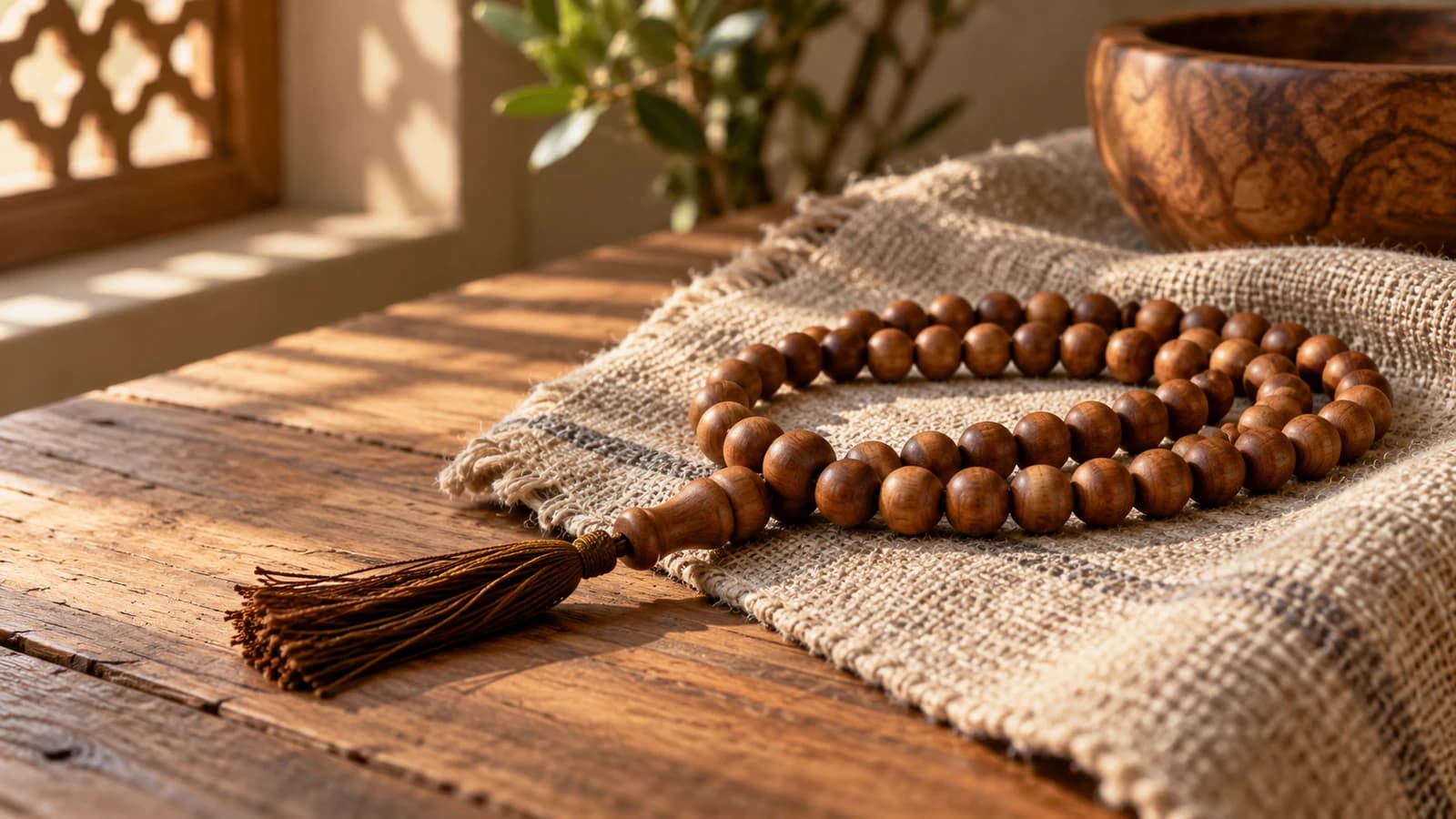
Tasbih means glorifying Allah; in everyday usage, the word can also refer to prayer beads used to keep count during remembrance. The practice, the words being recited and the counting device are related, but they are not identical. A strand with 33 or 99 beads does not by itself tell you which text a person is reciting or which religious guidance they follow.
This distinction makes it easier to understand both a devotional instruction and a museum label. One concerns remembrance; the other describes a surviving object, which may have been repaired, restrung or incompletely preserved. Neither should be used as a substitute for the other.
What tasbih means, and why the same word names an object
The TDV Encyclopaedia of Islam’s entry on tasbih treats the religious term as acknowledging Allah’s transcendence above imperfection. Subhanallah is a familiar expression of that glorification. Dhikr, usually rendered as remembrance, is broader: tasbih is one form within it rather than a synonym for every possible devotional text.
A separate TDV entry on counting beads describes the instrument used to follow repeated remembrances. Regional vocabulary differs. Tasbih, tespih, misbahah and subhah may appear in English descriptions, catalogues or shops. A change in spelling does not necessarily identify a different religious object, while a familiar name does not prove that every strand has the same construction.
Suppose someone says they have finished their tasbih. They may mean an act of remembrance rather than the purchase, manufacture or counting of a physical necklace. In a shop, the same word may refer to the beads themselves. Establish the context before translating the expression. This is also why a picture of beads cannot supply the wording of a supplication: the text must be identified separately.
For related expressions, our guide to inshallah, mashallah and alhamdulillah explains why words that frequently occur together can still express different ideas. Praise, glorification, a declaration of faith and a request for help should not be flattened into one generic English word.
Why 33, 99 and 100 appear in discussions of prayer beads
Sahih Muslim 597a records a particular remembrance after prayer: glorification, praise and magnification repeated 33 times each, followed by a declaration that completes a total of 100. The arithmetic of that report is straightforward: three groups of 33 make 99, with the final declaration counted separately. That does not mean every individual object must have exactly 100 identical beads.
A shorter strand can be followed through more than one circuit; a longer strand can include sections and larger dividers. A terminal or marker bead may have a structural role rather than being interchangeable with every counting bead. Consequently, the advertised number and the number of visible pieces in a photograph may follow different conventions. Ask what the number includes before drawing a conclusion about the intended arrangement.
The association with Allah’s 99 names is also prominent in descriptions of Islamic prayer beads. It helps explain a cultural and devotional connection; it should not be converted into a claim that a person holding such a strand is necessarily reciting a particular list of names at that moment. There are multiple remembrances, circumstances and reported counts. A general object description cannot settle all of them.
If you are following a specific religious instruction, identify its wording, occasion and reference before choosing a counting aid. This guide explains the relationship between counts and objects; it does not prescribe a new sequence by combining fragments of different reports. Our distinction between dua and salah is useful here: a counting aid is not itself the structured ritual prayer.
Fingers, beads and digital counters answer a counting question
Sunan Abi Dawud 1501 records an instruction to count remembrances on the fingers. Its collection page labels the report hasan according to al-Albani. Keep that named grading attached to the reference rather than presenting an anonymous claim about scholarly agreement.
This is direct evidence that a string of beads is not the only counting method discussed in the transmitted material. It does not allow a museum object, a product advert or this article to settle every later disagreement about the preferred use of beads. Readers seeking a ruling for their practice should consult a qualified teacher who can explain the relevant reports and the school or interpretation being applied.
A digital counter likewise records a number; its display cannot establish attention, understanding or the religious status of the words counted. Choosing a convenient device is a practical matter distinct from making a claim that its material or mechanism creates additional spiritual value. A seller’s statement that a counter has a particular benefit needs its own evidence.
For beginners, an ordinary study note can keep the text, its meaning, its reported setting and any specified count together. Our morning dua and adhkar guide uses that approach for a small set of identified texts. It does not imply that every morning remembrance uses the same count or that an object is required to learn one.
A British Museum strand shows why condition and provenance matter
The British Museum’s prayer-bead record 2016,6028.2 describes 99 black-coral round beads inlaid with silver pins. It dates the object approximately to the 1880s–1890s and gives Istanbul or Sanaa as uncertain production possibilities. Those question marks are part of the evidence, not a defect to remove when retelling the object’s history.
The same record explains that the strand was restrung in Morocco in 2016 and that some white beads may be later additions. This makes the object particularly useful for learning to read a catalogue. Its current arrangement is not necessarily a complete, untouched record of its first construction. Acquisition, repair, production and place of use are different stages in its biography.
A caption should therefore preserve the museum number, approximate date and uncertainty about origin. It should not turn the place where an object was acquired into a definite workshop location. Nor should it describe every visible component as original when the institution explicitly identifies later restringing.
Two Met records distinguish reconstruction from a surviving count
The Met’s carnelian strand 48.101.70 is dated to the ninth–twelfth centuries and was excavated at Nishapur, Iran. The beads were found together but placed in a modern arrangement. The catalogue says they may have belonged to prayer beads. That is an attributed use, not proof that the modern display preserves an original devotional sequence.
By contrast, the Met’s silver beads 1981.5.1 are attributed to Morocco and dated to the nineteenth–early twentieth century. The institution proposes an original total of 99 or 100, while noting that some beads have been lost. It lists 89 matching beads and two beads of different sizes among the surviving components.
These records demonstrate different kinds of incompleteness. A reconstructed string may preserve genuine old beads without preserving their old order. A surviving string may have lost components, so its present total cannot simply be treated as its intended original total. Counting what appears in a museum photograph is a starting observation, not a complete historical conclusion.
The material descriptions matter too: carnelian and silver identify these particular objects. They do not establish that Islamic prayer beads must be made from either substance. A catalogue’s discussion of a protective use records a historical belief; it does not verify that an object can prevent harm.
How to identify a strand without inventing its history
Begin with what you can actually observe: approximate size, visible material, counting units, dividers, terminal pieces and signs of repair. Then keep proposed interpretations separate. A large end piece might function as a handle or marker, but its presence alone does not date the strand, identify a country or prove an owner’s religious affiliation.
For a collection object, follow its accession number to the institution’s own record. Record whether the date is exact or approximate, whether the place is stated or attributed, and whether the object has been restrung. A copied photograph can lose all three of those qualifications while retaining an impressive-looking caption.
For an everyday strand, the useful questions are simpler: what does the stated bead count include, can the user handle it comfortably, and does the seller make claims beyond the description of the object? Expensive material is not evidence of greater religious reward. A personal object also does not need a dramatic historical origin to serve as a counting aid.
Objects and religious acts need different descriptions. As with prayer rugs, material, design and individual use should not be confused with a universal requirement. Tasbih is first a practice of glorification; a strand of beads is one way people have kept count within wider traditions of remembrance.
What if a 33-bead strand has more than 33 visible pieces?
Imagine a contemporary strand advertised as having 33 beads. You count 33 similar round units, a long terminal piece and a separate fitting near the tassel. There are more than 33 visible components, but that observation alone does not show that the advertised counting sequence is wrong. The maker may be describing the round counting units rather than every assembled part. This is an illustrative example, not a description of either museum object discussed above.
The next question is how the strand is intended to be handled. Identify where a circuit starts, which pieces are counted and how a completed circuit is recognized. A divider can help someone follow a sequence through touch, while a fitting may only connect the tassel. Describing those functions is clearer than arguing about a total before establishing what was included.
Now compare an old strand with missing beads. Its current total may reflect loss rather than the maker’s plan. An unusually short string in a photograph therefore needs a different explanation from a complete modern strand with a separate end marker. The material record, its condition and the seller’s or museum’s wording should be read together.
The same care applies to the words being counted. Subhanallah expresses glorification, al-hamdu lillah expresses praise, and Allahu akbar expresses divine greatness. They are not three ways of naming a bead. Learning the meaning of each phrase and the reference for a particular sequence gives the counting action its context. A strand can help track repetitions, but the object’s construction does not supply the text, intention or religious explanation.