Rehal Meaning: Quran Stands, Folding Book Rests and Museum Examples
A rehal supports a book; it is not the text itself. Compare folding wooden stands, stone and metal examples, and learn what museum records can establish.
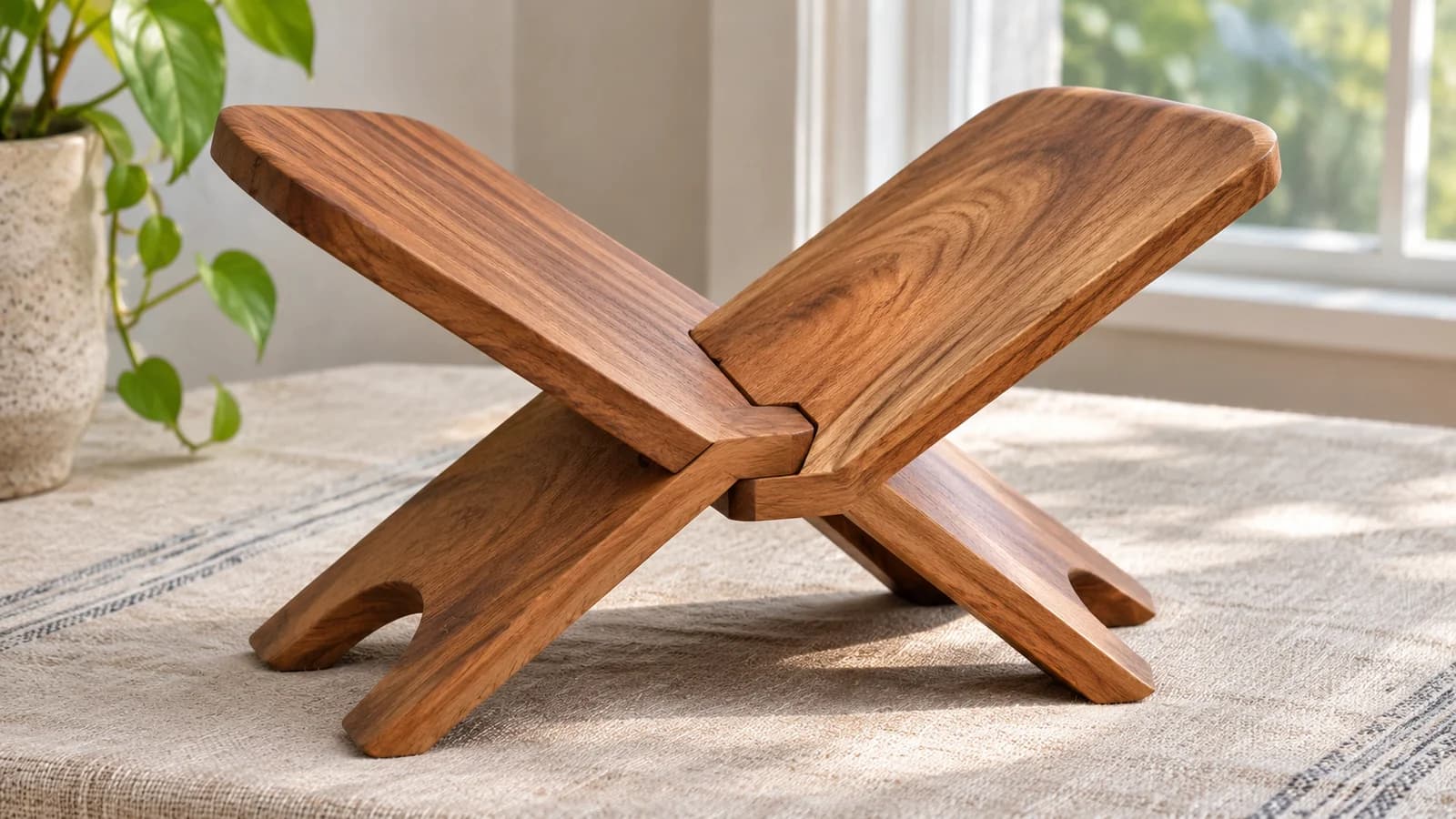
A rehal is a book rest associated particularly with reading the Quran. The familiar folding version opens into an X-shaped support, but historical records also describe other forms of book furniture. Rehal, rahle, rahla and rihal are spellings you may encounter in English-language catalogues and explanations. The object supports a material book; it is not another name for the Quran’s text.
That distinction matters when identifying an old object or preparing a reading space. A carved wooden stand, a compact stone example and a table-shaped metal support can be discussed under related headings without sharing one construction, date or history. Museum records help explain particular examples. They do not make every modern product a religious requirement or supply the provenance of an unrecorded object.
What a rehal does, and what the name does not settle
The TDV Encyclopaedia of Islam’s rahle entry describes both opening-and-closing book supports and fixed forms with a tabletop. It connects their use with reading books, raising the Quran from the ground and supporting substantial physical copies. The entry therefore provides a wider account than the small folding stand many readers first imagine.
The name should not be used to collapse the book and the furniture into one object. A mushaf is a material written copy of the Quran, while a stand is the support beneath it. Our mushaf guide explains pages, leaves and volumes. A book rest can help hold those pages at an angle, but its presence does not identify the passage, edition or recitation being studied.
Nor does the shape alone identify a user’s nationality, a workshop or a legal school. If a seller calls something a rehal, begin with its actual materials, dimensions and mechanism. If a museum uses rahla or rahle, read the record before assuming that the spelling signals a different type. Names and classifications can vary across languages and institutions.
How the familiar folding form supports a book
In the common X-shaped arrangement, two intersecting panels form the legs below and a resting surface above. Opening the panels creates space for a book; closing them makes the object easier to store. TDV discusses interlocking wooden construction and several kinds of fixed and combined furniture. This is evidence of variation, rather than a single manufacturing recipe required for every stand.
For an everyday object, the useful description separates structure from ornament. Identify the panels, the joint and the resting surfaces before describing carving or inlay. An ornate pattern does not tell you whether a stand fits a particular book. Equally, a simple surface does not make an object less useful as a support. The task is to understand what the item is designed to hold.
A historical folding mechanism needs a different approach from an ordinary new purchase. A photograph does not establish the condition of a joint, the completeness of the parts or whether the object may safely be opened. In a collection, use the institution’s handling arrangements. Reading a catalogue is not permission to test a mechanism or place a heavy volume on an old object.
A dated Iranian stand at The Met
The Met’s Stand for a Qur’an Manuscript, 10.218, is dated 761 AH/1360 CE and made in Iran. Its medium is teak, carved, painted and inlaid. The record gives different dimensions when closed and open: the closed height is 130.2 centimetres, while the open dimensions are 114.3 by 127 by 41.9 centimetres. This is substantial furniture, rather than a pocket-sized accessory.
The museum’s educational discussion explains its interlocking panels, layered carving and inscriptions. It identifies a madrasa setting through the inscriptions and discusses the maker’s name, Hasan ibn Sulaiman of Isfahan. The current collection record presents a more qualified and differently expanded version of that name. Keeping the accession number makes it possible to compare the records without accidentally treating a name variation as a second object.
The decoration includes writing as well as vegetal and geometric forms. The educational account identifies a cypress within a niche-shaped composition and blessings associated with Muhammad and the Twelve Imams. Its accompanying discussion cautions against drawing a simple conclusion about sectarian identity from those references alone. Describe the particular inscription and the curator’s interpretation, rather than assigning every owner or reader an identity from one motif.
The open and closed measurements offer a practical catalogue lesson. A height quoted without its condition can be misleading. Before comparing two stands, check whether the figures describe the open object, the folded object or a detail. A discrepancy between dimensions may concern the measurement state rather than an error in the record.
A stone example challenges the assumption that every rehal is wooden
LACMA’s Qur’an Stand (rehal), M.73.5.118, is dated around 1800 and catalogued as made in Bhera, Panjab, in present-day Pakistan. Its materials are light green lizardite serpentine and a steel frame inlaid with gold. The object demonstrates why a familiar name does not establish a wooden construction.
Material identification also needs care. A pale green surface may look like a familiar decorative stone in a small photograph, but the collection’s stated material is more precise than a viewer’s colour-based guess. Use that identification in a caption. The word rehal identifies a type of use; it does not authenticate a stone, a metal or a claimed age.
The approximate date belongs in the description too. “Around 1800” is not an exact manufacture year, and a modern geographic label should not be mistaken for the political map of that date. A concise caption can preserve both points by naming the museum, accession number, approximate date and catalogued location. It does not need to invent a maker when the institution lists the maker as unknown.
Book furniture can be portable, fixed or table-shaped
The University of Toronto’s Hidden Stories exhibition record for Royal Ontario Museum 948.84.6 describes an eighteenth-century Iranian book stand with wood and bone inlay. Its discussion places book stands in several devotional traditions, including Hinduism, Sikhism, Christianity and Islam. Book-support furniture is therefore not exclusive to one religious community simply because one particular name is associated with Quran reading.
The exhibition relates folding furniture to portability and travel. That interpretation helps explain what a form could make possible. It is not a documented itinerary for this individual object. A statement that a stand could be carried along a trade route should not become a claim that this specimen travelled through a named city unless its provenance supports that route.
A different form appears in the Museum With No Frontiers record for Shangri La’s Quran stand, 54.136.1. Dated around 1900 and attributed to Egypt, probably Cairo, it is a tall hexagonal brass structure inlaid with silver and copper. The record identifies a Mamluk Revival context and proposes that the top supported a Quran while small doors allowed storage inside.
Notice the proposed function and the date together. A revival style is not the same as manufacture during the historical period it recalls. The object’s possible use should remain possible, and its table-shaped structure should not be rewritten as an X-shaped folding stand. Related classifications can bring different forms together while the individual descriptions remain distinct.
A comparison of the collection records shows why the broad name needs a precise caption. These are documented examples, not a list of features every stand must possess:
| Record | Construction or material | Detail to preserve |
|---|---|---|
| The Met, 10.218 | Carved, painted and inlaid teak; interlocking panels | The stated dimensions change between the closed and open conditions. |
| LACMA, M.73.5.118 | Light green lizardite serpentine with a steel frame and gold inlay | The colour does not justify substituting a different stone name. |
| Royal Ontario Museum, 948.84.6 | Wood with bone inlay | The exhibition's discussion of portability does not establish a particular journey. |
| Shangri La, 54.136.1 | Hexagonal brass structure inlaid with silver and copper | The proposed Quran-support function remains qualified, and Mamluk Revival describes a later revival. |
This comparison changes the order of a useful search. Begin with the object number and the institution, then examine the material, form and dated record. Searching only for a phrase such as old wooden Quran stand can hide the stone and metal examples or encourage comparisons between unrelated objects. A catalogue identifier is usually more precise than a broad product label.
The photographs require a similar distinction between observation and identification. You may be able to see that an object is green, decorated or open. The institution may identify the mineral, interpret an inscription or supply an approximate place of manufacture. Record those statements with their source rather than presenting every detail as something visible unaided. This makes a short caption more transparent even when the image is small.
Consider a hypothetical image label that reads only “Iranian rehal.” It leaves the reader unsure whether the writer means the large fourteenth-century teak stand at The Met or the eighteenth-century wood-and-bone example in the Toronto exhibition. Adding an accession number, material and date resolves the ambiguity. The exercise does not establish that either institution's description applies to a similar-looking object elsewhere.
A reader preparing a classroom comparison can therefore use two separate columns: what the record states and what the photograph shows. The first can retain a qualified attribution such as probably Cairo; the second can describe a visible hexagonal structure. Leaving a question unanswered is useful when neither column supplies evidence. It is more informative than turning resemblance into a confident workshop attribution.
Read inscriptions and provenance as separate evidence
An inscription may identify a maker, a patron, an endowment or a religious passage. Those are different statements. A later ownership note does not necessarily name the original workshop, and a familiar divine name does not supply the rest of a damaged text. Our manuscript provenance guide explains a related discipline of keeping manufacture, ownership and later collection history separate.
Calligraphic appearance needs its own description. A catalogue may identify a script or transcribe an inscription; an uncaptioned photograph may permit neither. The Arabic calligraphy guide introduces several script names. Recognising a style is useful, but it is not an exact date, an attribution to a named artist or proof that a present-day copy is an original.
For a short research note, keep four fields: accession number, materials, date with its level of certainty, and the specific use or inscription the institution identifies. Add your own observation separately. This editorial method lets another reader see which details came from the record and which came from looking at the image.
Using a stand in a reading space
For a contemporary reading arrangement, match the support to the actual book and the way the reader will use it. The size of an open volume, the available surface and the condition of the stand are more practical questions than whether an object resembles a famous museum example. A historical description is not a product recommendation or a universal instruction about posture.
In a shared religious space, ask where reading materials belong and which objects visitors may use. Our first mosque visit guide explains how to ask such practical questions respectfully. The presence of a stand does not grant permission to handle every book or move another person’s reading arrangement.
A rehal is easiest to understand when its function stays visible: it supports a material book. Its construction, decoration and history can then be described through actual evidence. You can appreciate a plain contemporary rest and a remarkable historical example without treating them as interchangeable objects or making unsupported claims about spiritual effects.