Qalawun’s al-Mansuri Hospital: Care, Waqf and Cairo
What the Mamluk al-Mansuri hospital complex reveals about endowed medical care, staffing and patients—and what later accounts cannot prove by themselves.
Qalawun’s al-Mansuri hospital, or bimaristan, founded in late thirteenth-century Cairo stands as a major component of Sultan al-Mansur Qalawun’s architectural complex, which also included a madrasa and mausoleum. This institution was established through a waqf, or endowment, designed to provide continuous medical treatment funded by permanent revenue properties. The foundation deed detailed specific provisions for staff salaries, pharmaceutical supplies, food for patients, and the organization of specialized care spaces, reflecting a sophisticated administrative approach to public health.
The Waqf Mechanism and Financial Sustainability
The waqf system connected income-generating properties—such as shops, markets, and farms—to the recurring expenses of the hospital. This legal instrument ensured that the institution could operate independently of fluctuating state budgets, securing funds for salaries, drugs, and maintenance in perpetuity. The endowment deed served as the primary legal blueprint, specifying exactly what resources were allocated and to whom.
Historical chronicles and administrative records further elaborate on the daily operations, describing a hierarchy of medical staff that included senior physicians, junior assistants, pharmacists, and nurses. These texts emphasize the institutional scope, noting provisions for different types of patients and the variety of treatments available within the complex.
Architectural Layout and Spatial Organization
Surviving architectural elements reveal a carefully planned spatial organization designed to facilitate care and segregation. The building featured iwans, or vaulted halls, oriented toward different cardinal directions, which may have been used for seasonal comfort or specific medical specialties. These spaces were connected by corridors and courtyards, creating an environment that balanced openness with structural integrity.
The mausoleum adjacent to the hospital underscores the Sultan’s dual focus on piety and public service. However, interpreting the hospital’s original function requires caution. Later uses of the space, including its conversion into a caravanserai and later structures, complicate the reconstruction of daily medical practices. We must rely on the foundation deed for intent and surviving fragments for physical evidence, rather than assuming uniformity across all Islamic hospitals.
Medical Practice within Historical Context
The al-Mansuri hospital operated within an older Islamic tradition of bimaristan development, inheriting and adapting earlier models found in Baghdad, Cairo, and Damascus. It provided specialized care for specific ailments, potentially including mental health support, though modern interpretations often project contemporary psychiatric concepts onto medieval practices.
Prescriptions in the waqf deed highlight the importance of hygiene, diet, and medication. The institution stocked drugs from a wide geographic range, reflecting extensive trade networks. Staff were paid regular salaries and provided with uniforms, indicating a highly regulated professional environment. This administrative rigor distinguishes it from informal care practices.
Evaluating Historical Claims
Extravagant claims about bed counts or universal modern hospital origins often lack supporting evidence. Instead, historians focus on the legal and architectural records that define its actual scope. The institution was significant not because it mirrored modern hospitals, but because it institutionalized medical care as a permanent public good supported by private wealth.
- Consult the original waqf deed to understand the prescribed revenue streams and expense allocations.
- Analyze surviving architectural fragments to distinguish original hospital spaces from later additions or modifications.
- Review administrative chronicles for descriptions of staff roles and daily operational protocols.
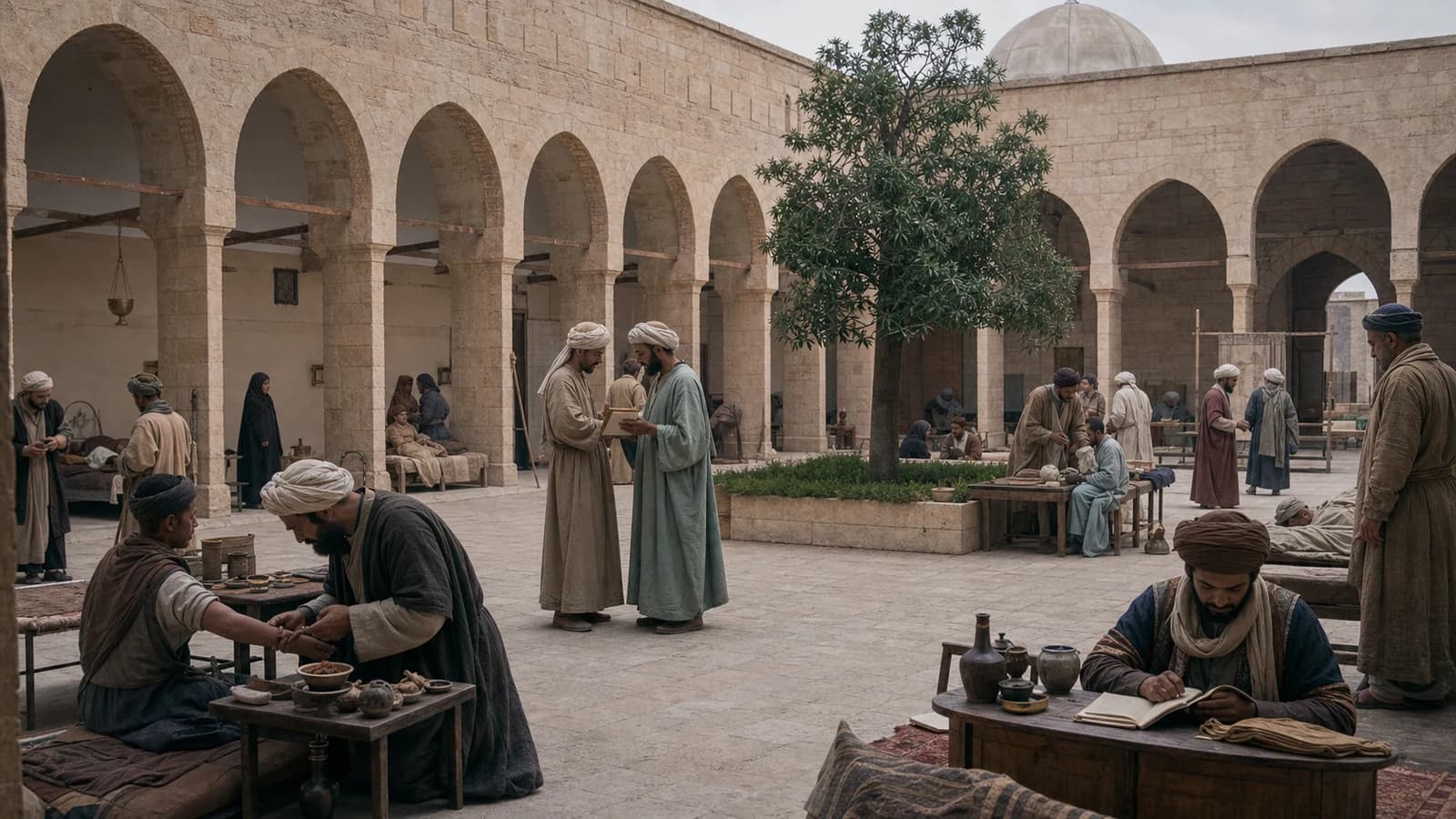
The cover image is an original AI-assisted hospital reconstruction, not a photograph or exact restoration of the medieval al-Mansuri interior.
Sources
- U.S. National Library of Medicine: Islamic Medical Manuscripts — medical institutions and manuscript context.
- PMC: The Hospital in Medieval Islam — historical discussion of bimaristans and Qalawun.
- Archnet: Complex of Sultan al-Mansur Qalawun — architectural and urban documentation of the complex.


