Medieval Islamic Pharmacy: Drugs, Formularies and Shops
How compound medicines were described, prepared and sold, what formularies reveal about specialist practice, and why recipes are not modern prescriptions.
Medieval Islamic pharmacy developed through the specialization of drug preparation, distinct from general medical practice. This evolution involved the creation of materia medica lists, compound-drug formularies known as aqrabadhin, and the organization of urban drug markets. Pharmacists operated within overlapping spheres of physician prescriptions, commercial trade, and civic regulation, relying on networks to source ingredients across vast distances.
The Nature of Formularies
An aqrabadhin is defined specifically as a formulary of compound preparations, listing recipes for mixed drugs rather than simple substances. These manuscripts record ideals and theoretical frameworks for pharmacy; they do not prove universal practice, dosage accuracy, or that every shop strictly adhered to them. Surviving texts illustrate how complex mixtures were conceptualized by scholars, highlighting the intellectual effort to standardize descriptions of ingredients.
Technical Processes in Context
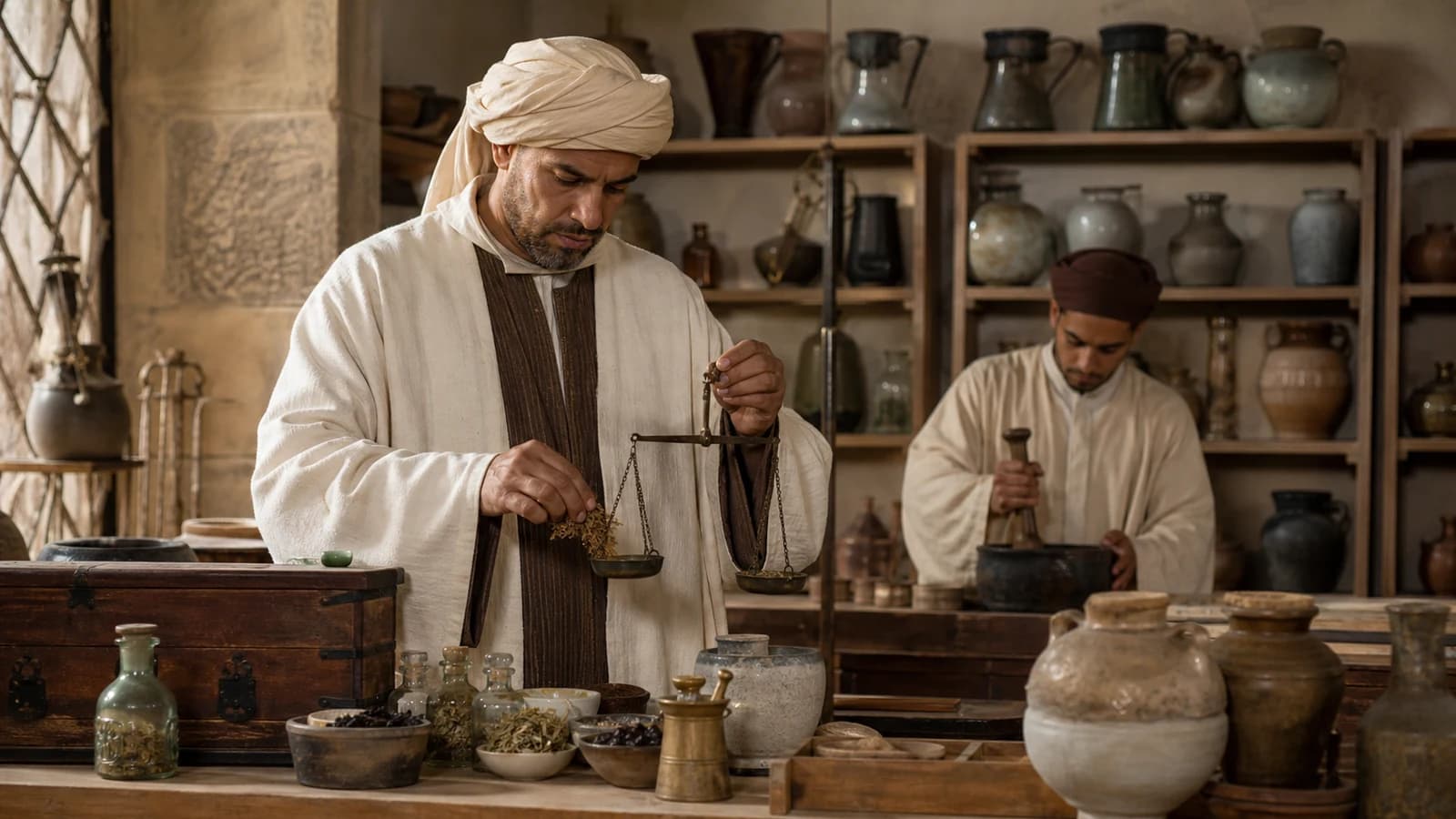
The preparation of drugs involved various physical techniques adapted from earlier traditions. Pharmacists engaged in weighing precise amounts of ingredients, grinding solids into powders, and sieving them to achieve uniform texture. Some preparations required distillation to extract essential oils or syrup making to preserve botanical materials. It is crucial to note that not all urban drug sellers utilized every one of these processes.
Smaller apothecaries might have focused on simple mixing, while larger establishments in major cities invested in more complex apparatus. The variety of available techniques reflects the diverse economic and technological landscape of medieval Islamic societies, rather than a monolithic standard. Historical drugs mentioned in these contexts must not be presented as medical advice or evaluated by modern efficacy standards.
Trade and Identification
The supply chain for pharmaceutical ingredients was extensive, requiring navigation of markets for spices, resins, and minerals. Pharmacists faced challenges related to substitution due to cost or availability, making the correct identification of raw materials essential. Misidentification could lead to dangerous outcomes, creating a shared interest between physicians who prescribed remedies and pharmacists who prepared them.
This regulatory environment aimed to maintain standards in a commercial setting where economic pressures often competed with professional obligations. The need for accurate identification underscores the practical difficulties of sourcing specific botanicals or minerals across different regions, highlighting the reliance on expert knowledge rather than written prescriptions alone.
Interpreting Evidence
Historical understanding relies on cautiously correlating written sources with surviving material evidence. Ceramic jars found in archaeological contexts are often linked to pharmacy through their shape and residue analysis, but such connections remain interpretive rather than definitive. Written recipes record what was intended, while material finds suggest what might have been stored, yet neither proves effectiveness or universal application.
- Identify compound drug recipes in surviving aqrabadhin manuscripts.
- Note that texts record ideals, not proven universal adherence.
- Distinguish between specific shop processes and general technical possibilities.
- Correlate jar residues cautiously without assuming definitive function.
The profession balanced theoretical knowledge with practical market realities. It was a complex industry shaped by trade, regulation, and cultural exchange, defined by the gap between surviving evidence of recipes and the variable reality of urban drug sales.
The cover image is an original AI-assisted apothecary reconstruction, not a photograph of a documented shop or safe guide to preparing historical remedies.
Sources
- U.S. National Library of Medicine: Pharmaceutics in Islamic Manuscripts — formularies and compound medicines.
- U.S. National Library of Medicine: Pharmaceutical Procedures — preparation methods and manuscript evidence.
- PubMed: Pharmacology in Medieval Islamic Medicine — peer-reviewed history of drugs and practice.


