What Is a Shamsa? Manuscript Sunbursts and Dedications
A shamsa is a manuscript sunburst or rosette. Compare an opening pair, a dedication, a royal name and a detached leaf to see what each design can tell you.
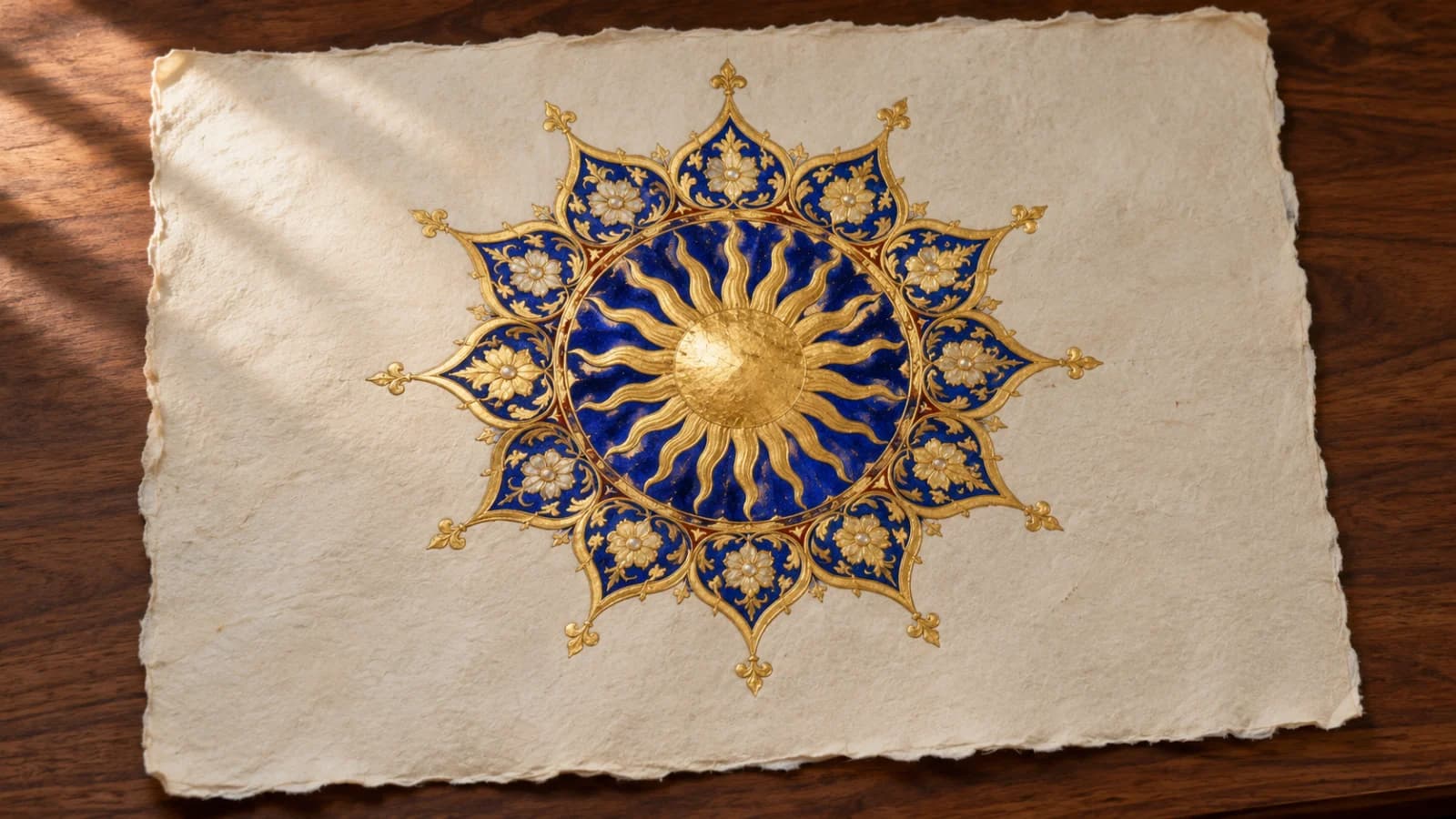
A shamsa is an illuminated rosette or sunburst found on manuscript and album pages. Its design often radiates from a circular centre. The design might contain a dedication, a name, a passage of text, a portrait or decoration. The name describes a form that can serve several purposes. The leaf's position and the inscription help establish what it did in a particular book.
How to recognise a manuscript shamsa
The name is related to shams, the Arabic word for sun. Look for a centre and the design arranged around it. Petal-like lobes, arcs, lines resembling rays and painted foliage can repeat around a shared point. The frame can have more than one band. In an inscribed example, the wording may be in the middle or run around a border, so both areas are worth examining. The Chester Beatty's guide to the Ruzbihan Qur'an illustrates the term with two facing sunbursts in a single volume.
The Royal Collection's opening shamsa from the Mughal Padshahnama, RCIN 1005025.b, gives a concrete example of how the geometry was laid out. The catalogue dates folio 1v to about 1657 and describes faint incised lines and compass holes. Painted floral details follow the geometric framework, with lapis and metallic gold among the colours and materials the catalogue discusses. The marks are evidence of how the design was constructed on this particular work. Its decorated panel measures 46.1 by 28.6 centimetres within a leaf of 58.0 by 36.4 centimetres. Royal Collection Trust, opening shamsa.
A rosette can introduce a volume or a work within it
The opening leaves of the Padshahnama contain a pair of shamsas. An illuminated opening with portraits of Timur and Shah Jahan follows on folios 2v and 3r. Here the catalogue records two distinct elements in sequence, first the sunbursts and then the facing portraits. Someone looking only at a cropped image of folio 1v would see the decorated panel without the evidence supplied by those neighbouring leaves. Royal Collection Trust, manuscript RCIN 1005025 and portrait opening.
A shamsa can mark a beginning within a book. The Walters Art Museum catalogues W.624.42A as an illuminated page from Amir Khusraw Dihlavi's Khamsa, a Mughal manuscript dated 1597–1598 and catalogued to Lahore. The rosette opens Khusraw and Shirin, the second of five poems. Gold and lapis ornament occupy the design. The museum ascribes the illumination to Husayn Naqqash and names Muhammad Husayn Zarrin Qalam as the scribe. In this example, the rosette's role comes from its position in the collection of poems and its relationship to the text, even though the ornament occupies the central design. The guide to manuscript workshops explains how those production roles could be recorded separately. Walters, W.624.42A.
A dedication can name the library the book was made for
An inscription can be more specific than a personal name. In a Persian poetry anthology dated 17 June 1418 in Christie's catalogue for lot 73, the opening shamsa carries a dedication to the library of the Timurid prince Ibrahim Sultan. The catalogue also places titles of works in the border. The centre and border therefore carry different information on the same page. The dedication in the roundel names the intended library, while the border helps identify the volume's literary contents. The manuscript includes poetry in the margins as well as in the main text panel, so the titles in the border describe a collection of works. Christie's, the 1418 anthology record.
The Morgan Library's Manafiʿ-i hayavan, a bestiary catalogued as MS M.500, gives a second named example. Its image record for folio 2r identifies the name inside the medallion as that of the patron, Shams al-Din ibn Ziya al-Din al-Zushki. The two records make the distinction between a patron named on a page and a dedication naming a library concrete. When describing either object, it helps to use the relationship the catalogue gives. A patron's name, a library dedication and a scribe's name answer different questions about a manuscript. Morgan Library, MS M.500 folio 2r.
Library dedications can also appear in other kinds of illumination. British Library Or 9454 has a dedication to the library endowed by al-Sayyid Fakhri on a Mamluk-style frontispiece, folio 2r. The catalogue dates the completion of the copy to 29 March 1379 from the colophon on folio 88r. It separately describes endowment notices elsewhere in the volume. This record identifies the dedication by its text and location. It uses the broader description of a frontispiece, which is the label to carry over when comparing it with the named sunburst in the 1418 anthology. British Library, Or 9454.
An imperial name or portrait can be a later addition
The Metropolitan Museum of Art records a rosette bearing the name and titles of the Mughal emperor Aurangzeb on the recto of a leaf from the Shah Jahan Album. The museum dates that face to about 1658 and the verso to about 1630–1640. It describes the rosette as a later addition to an assemblage made for Jahangir and Shah Jahan. For a label, those dates belong to the specified sides. A single date attached to the whole leaf would obscure the evidence for more than one stage of work. The Met, rosette 55.121.10.40.
A Cleveland Museum of Art leaf from the imperial album shows another way the centre of a design could change. Cleveland describes 2013.331 as a closing page. It dates the illumination to 1640–1655, the original portrait to about 1640–1650 and the alteration to after 1658. In its reconstruction, the shamsa originally had a plain gold disc and the portrait of Aurangzeb was probably added after he took the throne. The current centre presents a portrait, while the surrounding illumination has its own history. These two album records explain why reading a royal name or seeing a portrait is the beginning of a dating question. Dating the leaf requires knowing what the record says about the different surfaces and additions. Cleveland, closing shamsa 2013.331.
A verse, a plain centre and the spaces around them
In the mid-sixteenth-century Ruzbihan Qur'an from Shiraz, the Chester Beatty identifies Quran 17:88 in white writing across a pair of opening shamsas. The words in this case are part of the scripture carried by the book. A description of the centre can therefore identify the verse and the two facing leaves. The example also shows why a full view of a double-page opening is useful: two facing designs form a relationship that a photograph of one leaf cannot show. For the other ways manuscript decoration organises text, see the guide to Quran illumination and reading markers. Chester Beatty, CBL Is 1558, illustrated on page 49.
A dated Safavid Qur'an leaf in the Smithsonian shows what the two sides of one folio can contribute to the sequence. The National Museum of Asian Art dates F1932.67 to 1598. The recto has a shamsa with Quran 17:88 on the left side of a two-page opening. The verso participates in another illuminated opening and carries text from Al-Fatiha. One object number thus leads to two different views of the book. The record also supplies the parent manuscript number, F1932.65, alongside the separately accessioned leaf. These details locate the ornament more precisely than a close-up of its centre. Smithsonian, bound folio F1932.67.
Compare a leaf from Firdausi's Shahnama at the Cleveland Museum of Art, made in Shiraz around 1444. Cleveland describes 1945.169.a as the recto of the right leaf from a double-page frontispiece. The centre is empty. Its catalogue suggests that the space might have been intended for a name or portrait. That interpretation explains a possible use for the available space, while the empty centre gives no identifying inscription or likeness to read. The separately recorded placement within a double-page frontispiece is still informative. Cleveland, Shahnama shamsa 1945.169.a.
What remains visible on a detached leaf
The Smithsonian's National Museum of Asian Art catalogues F1933.3 as a detached leaf from an unidentified text. It dates the object to the thirteenth or fourteenth century and records Iran as its origin. The recto has eleven lines of writing in one column. The verso carries the shamsa, with a Kufic calligraphic band inside two ornamental outer borders. The museum also records the mounting of the medallion on cream-coloured paper. A viewer can thus describe the current sides, the position of the script and the visible structure of the ornament. The catalogue gives no original book position for this detached leaf. Smithsonian, folio F1933.3.
The Kufic band shows why it is worth inspecting the rim as well as the middle. The museum identifies the repeated wording in the border, so the presence of script can be confirmed even when the original text is unidentified. A script name describes the shape and treatment of the writing. The wording and its relation to the manuscript are separate evidence. The guide to Kufic and other calligraphic scripts gives examples of those visual differences.
How to describe a shamsa in a catalogue or image
Start with the complete page. Identify the roundel and its borders, then note where the writing or portrait sits. The opening of a volume can combine several kinds of decoration. In the Padshahnama, the measurements of the panel and leaf let you distinguish the painted area from the surrounding paper. For a tight image crop, use the record to find the sheet size before comparing it with the Shahnama leaf or another manuscript. Record the leaf side and number when available. In a folio reference, 1v is the reverse of leaf 1, while 2r is the front of leaf 2. A bound or digitally reconstructed sequence can show what precedes and follows a decorated page. The guide to folios and physical Quran manuscripts explains why leaf and page are different units.
For an attributed opening, name the volume or section it introduces. For a later addition, give the catalogue's separate dates for the page, ornament and insertion where those dates are recorded. For the detached Smithsonian example, a precise caption can say “illuminated shamsa on the verso of a detached leaf, Smithsonian F1933.3.” If further evidence identifies the original sequence or a patron, that information can be added with its source. A dated colophon, ownership mark or matching leaf can supply evidence of a kind that the outline of a sunburst cannot provide. See the guide to manuscript provenance and catalogue records.
Manuscripts, leaves and collection records
- Royal Collection Trust, opening shamsa RCIN 1005025.b, volume RCIN 1005025 and portrait frontispiece.
- Walters Art Museum, opening of the second poem in the Khamsa of Amir Khusraw Dihlavi, W.624.42A.
- Christie's, poetry anthology for the library of Ibrahim Sultan, lot 73, and Morgan Library & Museum, patron's medallion, MS M.500 folio 2r, and British Library, dedicatory frontispiece in Or 9454.
- The Met, Aurangzeb rosette 55.121.10.40, and Cleveland Museum of Art, closing leaf 2013.331.
- Chester Beatty, Ruzbihan Qur'an CBL Is 1558, page 49, and Cleveland Museum of Art, Shahnama leaf 1945.169.a, and Smithsonian, Safavid Qur’an folio F1932.67.
- Smithsonian National Museum of Asian Art, detached folio F1933.3.