Kashkul Meaning: Sufi Alms Bowls, Materials and Museum Examples
See how Sufi alms bowls were carried and made, from carved coco-de-mer shells to metal vessels with chains, spouts and devotional inscriptions.
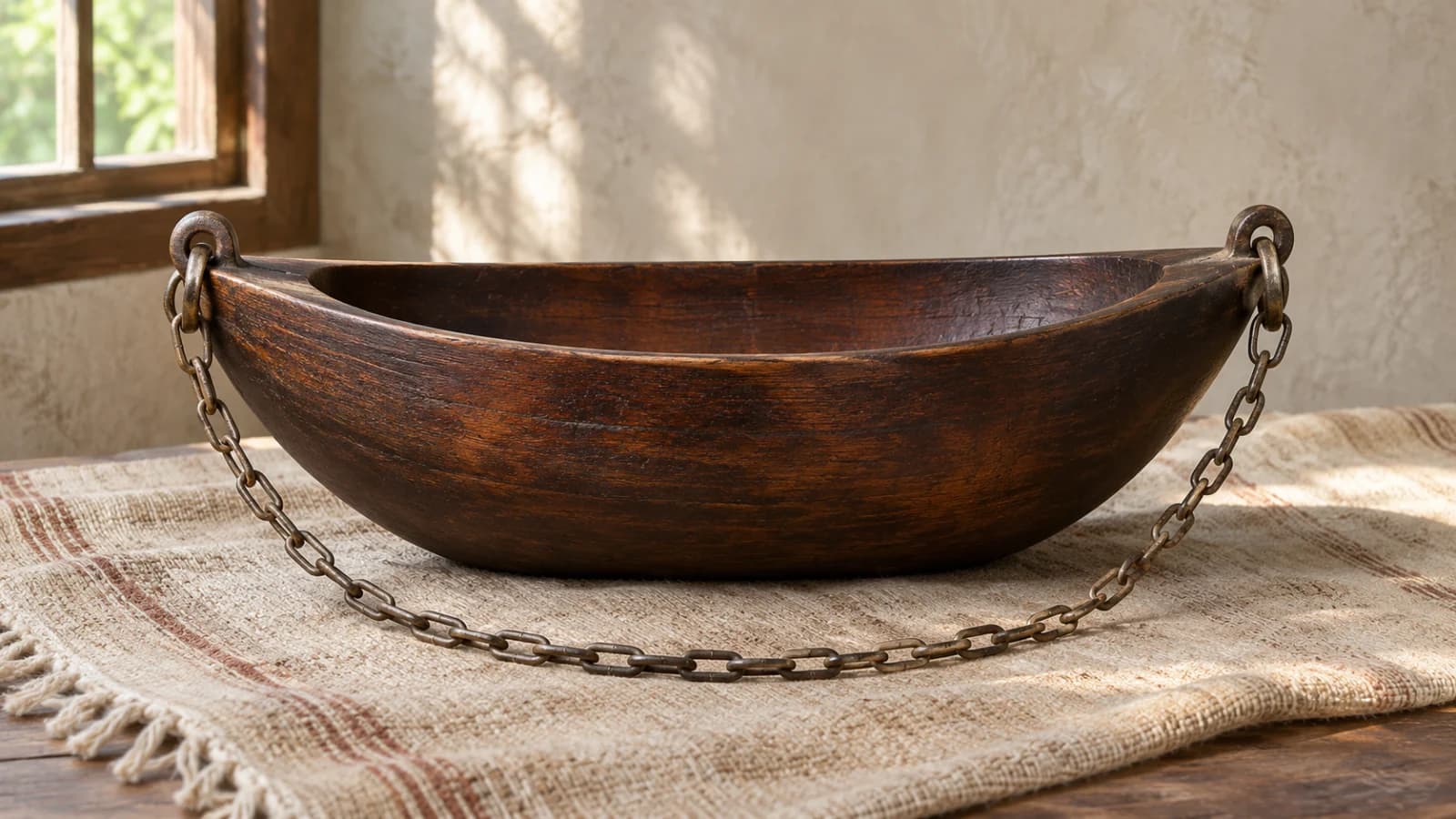
A kashkul is an alms vessel associated with wandering Sufi dervishes. Many examples have a long, curved body with upturned ends, and some have a chain for carrying. The bowl could hold gifts of money or food, and some examples could serve as drinking vessels. Museum collections contain carved nutshells, wooden bowls and metal versions that share a silhouette and vary in construction and likely use.
A bowl a dervish could carry
English museum labels use both “begging bowl” and “alms bowl.” In this setting, alms are gifts given to support someone in need. A dervish who travelled and lived on donations needed a receptacle that could be moved as readily as it could be held out to receive a gift. A chain spanning the ends of the vessel freed the user from having to keep a hand on its rim while walking. The Aga Khan Museum describes hand and neck carrying for its brass bowl, while the Sharjah Museum of Islamic Civilization describes carrying by hand or over the shoulder in its account of the type.
The vessel belongs to a wider history of Sufi devotional life. It is particularly associated with mendicants, people who lived on alms, and with a commitment to material simplicity. Other settings placed different demands on Sufi practice. A khanqah or Sufi lodge could offer a place to stay, study and gather. A portable bowl helps explain one way people sustained a travelling life, alongside the evidence for more settled institutions.
To understand the object's place among personal possessions, compare it with tasbih prayer beads. The beads support counting in remembrance or prayer, and the vessel can carry provisions or receive gifts. Each object can take on a devotional significance while retaining a practical design suited to a particular task.
Paintings provide another kind of evidence for the connection. The Met's Portrait of a Sufi, dated to the first quarter of the seventeenth century and attributed to the Deccan, probably Bijapur, includes an alms bowl alongside a flute and a fur garment. Curators use those details together to identify the type of figure depicted. A second work, Dervish Seated in Contemplation, belongs to the San Diego Museum of Art and is dated to the mid-seventeenth century, probably in Bijapur. The Met exhibition catalogue identifies the vessel beside the sitter as a kashkul and discusses the painting as an idealized image of an ascetic. The pictures show how a bowl helped viewers recognize a dervish in art. Surviving bowls supply details of the material, workmanship and inscriptions that a painter might simplify.
How a shell became a vessel
The coco-de-mer palm is native to the Seychelles in the Indian Ocean. Its large, lobed nut supplied a hard shell with a ready-made curve. Splitting it yields an elongated cavity, which could be carved or mounted to make a bowl. Museum curators have linked the material's movement across the Indian Ocean to the form's use in Iran. The Met suggests that such shells may have washed up on the southern Iranian coast. A shell's precise route to a particular workshop is a separate historical question.
The Aga Khan Museum's eighteenth-century Iranian bowl AKM640 measures 24 cm in the catalogue and is made from half of a carved nutshell. Bands of writing follow the shape of the rim. The shell is both the substance of the bowl and a surface that carries inscriptions. A second approach appears in the Met's bowl by Yar Muhammad, dated 1130 AH, or 1717–18 CE, and attributed to Iran. Its shell sits within pierced and engraved silver and gilded silver mounts. It measures 14 cm high, 30.8 cm wide and 16.7 cm deep, with the chain excluded.
The two records show how the same kind of natural material could be worked in different ways. In AKM640 the carver made the outer shell the main surface of decoration. On Yar Muhammad's vessel, the metalwork adds an openwork layer around the shell. Both retain the curved hollow as the starting point for the design.
Wood, brass and steel can share the same outline
A polished dark surface in a collection photograph can obscure the underlying material. The Met's 2018.665.2, dated to the late nineteenth or early twentieth century, is wood with camel-bone inlay. It is about 29 cm long. The museum judges that this particular piece likely served as an alms bowl. Its surface has deliberate decoration, so the presence of ornament alone tells little about whether a vessel had a practical working life.
Metalworkers could reproduce the hollow and curved profile without using a shell at all. The Denver Art Museum's 1994.6, an Iranian steel bowl with gold inlay, is about 35.6 cm wide. It dates to the late eighteenth or early nineteenth century. The museum identifies the maker as Hajji ibn ‘Abbas from his signature and describes the shape as that of the coco-de-mer. The material entry and the shape description answer different questions about the same object.
At the Aga Khan Museum, AKM612 is a late sixteenth-century brass bowl from Iran, catalogued at 61 cm. Its elongated ends terminate in dragon heads, and a chain joins those ends. Engraved flowers and foliage extend around its exterior, and geometric designs occupy the interior. This example brings the attachment points into the design itself. The dragon heads mark the ends visually and frame the span of the chain.
What the opening, chain and spout reveal
An open mouth provides easy access for receiving food or donations. A chain attachment speaks to the possibility of suspension and carrying. On other examples, a lid and a spout suggest more controlled access to the contents. These clues make the shape intelligible even where a record leaves the individual user's name and the contents unknown.
Glasgow Museums' A.1946.42.am is brass inlaid with silver and dark niello, a material that fills recessed decoration. The catalogue places its manufacture in Syria or Egypt in the eighteenth or nineteenth century. It has a flat top with an opening, a hinged lid and a small spout. The museum describes it as an Ottoman-period revival of an earlier Mamluk form. Its covering and spout give the vessel a different relationship to its contents from that of the open wooden example at the Met.
Sharjah's SM1996-209 offers another comparison. The museum records copper-zinc alloy and iron and gives the vessel a length of 27 cm. It is dated to the nineteenth century and attributed to Iran on stylistic grounds. In its etched decoration, small animals appear amid plants, along with two human motifs. Looking across these bowls can help place figures and animals in the wider repertoire of figural decoration on Islamic art objects.
When a bowl was made to be seen
The David Collection's 61/1998 is a cast, engraved and tinned bronze bowl from the Deccan, in India, dated to around 1600. Its measured length is 38.5 cm. Dragon heads finish the ends, as on the Aga Khan Museum's Iranian brass piece, while the David Collection identifies the dense engraved work with metalwork from the Deccan. The catalogue suggests the heavy vessel was probably displayed in a Shi‘i shrine. That proposed setting belongs to this particular object.
The comparison shows why the shared form can accommodate more than one kind of use. A long vessel can be designed with a chain, a pointed end can become a place for sculpture, and a broad wall can hold unusually large writing. The Met treats the finely mounted Yar Muhammad bowl as an example valued for its workmanship and collected for its appearance. The wooden Met bowl is interpreted as likely functional. Both catalogue judgements are part of the evidence alongside measurements and materials.
What the inscriptions say about a bowl
On the Iranian shell AKM640, the Aga Khan Museum identifies Arabic and Persian supplications and records a devotional invocation to ‘Ali in the upper band. On the brass AKM612, the same institution identifies Persian poetry in praise of the Prophet Muhammad. The writing follows the rim in both cases, but the museum's reading of its content gives each vessel a more specific devotional context than shape alone can convey.
On the Deccan bronze, the David Collection identifies Qur’an passages and Shi‘i invocations in thuluth. The script appears on the inside as well as outside, against a closely engraved ground. A visitor looking at a side photograph may see only one part of the inscription programme. The guide to recognizing thuluth and other scripts helps distinguish a script name from the language or subject of the words.
Some curators also discuss the vessel as a metaphor. The Aga Khan Museum relates the curved, boat-like outline to a spiritual journey and the empty bowl to relinquishing the ego. The Met offers a related reading of emptiness as readiness to receive divine knowledge. These are interpretations of how a familiar object could be understood in Sufi devotional settings. An inscription or a museum interpretation may illuminate the object's meaning even when little survives about the people who handled it.
Three details to compare in a display case
Begin with the body. The 24 cm carved shell at the Aga Khan Museum and the 35.6 cm steel piece in Denver show how close a visual idea can come across very different materials. Read the medium line alongside the profile. On a mounted piece such as the Yar Muhammad bowl, the body material and the surface material are both part of the answer.
Then examine the ends and the top. A chain, an open mouth or a hinged cover can make a specific use plausible. Set the Glasgow spouted vessel beside the wooden Met bowl in photographs, and look for which features would change how a user reached the contents. Finally, check the scope of the object record. A date on an object, a place assigned by stylistic comparison and a proposed place of display carry different degrees and kinds of evidence. On a label, the name kashkul identifies a recognizable vessel family. The hardware, inscription and documented history explain the individual piece.
Museum records
- The Metropolitan Museum of Art, Portrait of a Sufi, 57.51.30
- The Met exhibition catalogue, Sultans of Deccan India, entry 79 on the San Diego Museum of Art painting
- Aga Khan Museum, carved shell bowl AKM640
- Aga Khan Museum, brass bowl AKM612
- The Metropolitan Museum of Art, bowl by Yar Muhammad, 09.202.2
- The Metropolitan Museum of Art, wood and camel-bone bowl 2018.665.2
- Denver Art Museum, steel bowl 1994.6
- Glasgow Museums, covered bowl A.1946.42.am
- Sharjah Museum of Islamic Civilization, SM1996-209, via Museum With No Frontiers
- The David Collection, Deccan bowl 61/1998