What Is a Khanqah? Sufi Lodge, Residence and Shrine
How khanqahs supported Sufi residence, teaching, ritual and hospitality, and why the term describes different institutions across Iran, Anatolia and Egypt.
A khanqah is an institution associated with Sufi religious life, often providing space for residence, instruction, ritual, hospitality or the remembrance of a spiritual teacher. Related terms include tekke, zawiya and dergah, but they are not interchangeable in every place or period.
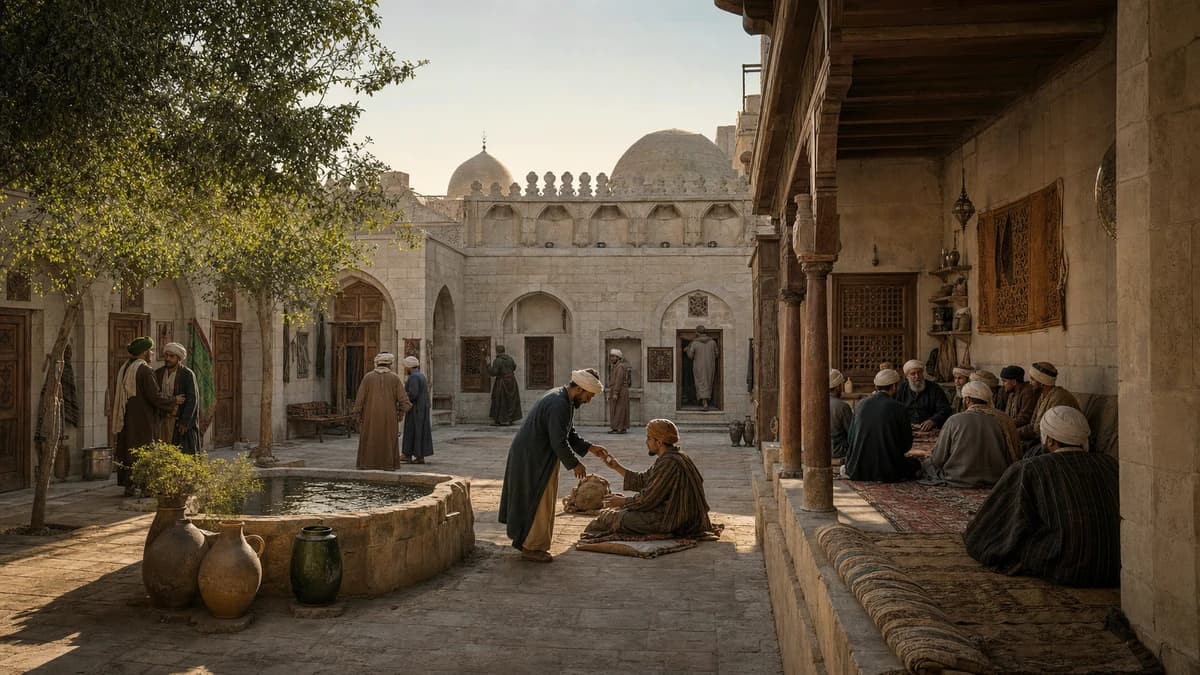
The cover image is an original AI-assisted historical reconstruction, not a photograph of a particular Sufi community or shrine.
Community needs shaped the building
A khanqah may contain cells, a communal hall, a prayer space, kitchen, courtyard and rooms for guests. A founder’s tomb can turn the site into a shrine and pilgrimage destination. Other examples are integrated with a madrasa or mosque so closely that their functions overlap.
The Mamluk complex of Sultan Barquq in Cairo was described in its waqf documentation as a madrasa-khanqah. Its residential units supported a Sufi program within a major urban foundation. The example warns against assuming that education, worship and Sufi residence always occupied separate building types.
Ardabil became a complex sacred landscape
UNESCO describes the Sheikh Safi al-Din ensemble at Ardabil as a major khanqah and shrine that developed over centuries. It incorporated a mosque, library, school, mausolea, cistern, hospital, kitchens, bakery and offices. Its ceremonial route expressed Sufi ideas while also managing crowds and institutional services.
That scale was exceptional. A modest lodge in a town or on a route might have far fewer spaces. Using Ardabil as a universal floor plan would confuse the importance of the site with the diversity of the institution.
Patronage and endowment sustained daily life
Khanqahs depended on food, fuel, repair and staff. Patrons and waqf revenue could support residents, visiting dervishes and charitable distribution. Political rulers also sponsored Sufi institutions to build alliances and public legitimacy, so devotional purpose and state patronage could coexist.
Communities changed affiliation, ritual practice and social role over time. A building might later serve as a mosque, school, museum or domestic space. Architectural evidence must be read alongside deeds, biographies and local histories.
How to read a khanqah
- Establish the local meaning of the institution’s name.
- Identify residence, communal ritual, hospitality and service spaces from evidence.
- Check whether a tomb or pilgrimage route reshaped the plan.
- Trace the endowment and later changes of community.
The khanqah is best understood as a framework for people rather than a single shape. Its architecture made sustained teaching, devotion and hospitality possible.
Sources
- UNESCO: Sheikh Safi al-Din Khānegāh and Shrine Ensemble — functions, ceremonial route and historical development.
- Archnet: Sultan Barquq Complex — a documented Mamluk madrasa-khanqah.
- The Met: Art of the Sufis — visual and institutional context for Sufi traditions.


