What Is a Qalamdan? Pen Boxes, Writing Tools and Museum Examples
A qalamdan is a Persian pen case. See how lacquer drawers and hinged brass boxes held reed pens, inkwells and other scribal tools.
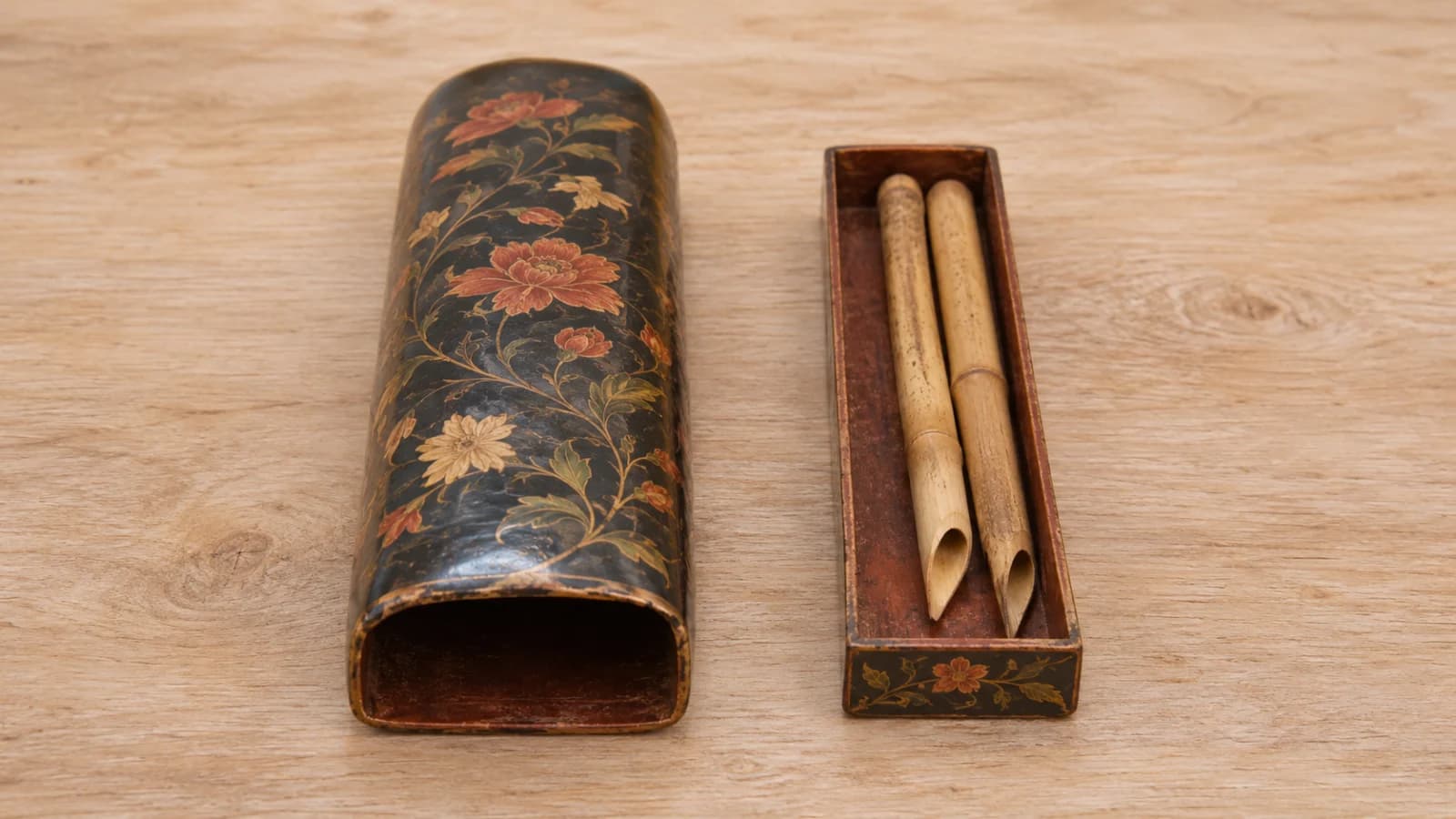
A qalamdan, also written qalamdān, is a Persian pen box or pen case. It holds the reed pens used for writing and calligraphy. Depending on its construction, it can also carry supplies such as an inkwell or a penknife. Museum examples range from inlaid brass boxes with hinged lids to lacquered cases with trays that slide out of one end.
The way a case opens tells you where the tools went. A deep compartment can keep ink apart from the pens. A narrow drawer can fit their long shafts into a case only a few centimetres wide. The lid, sides and drawer also gave artists surfaces for painting, metal inlay and inscriptions.
What a qalamdan held
A reed pen, or qalam, has a cut point that carries ink to the page. A penknife lets the writer renew the point, and a nibbing block gives the reed a firm surface during that work. McGill’s exhibition on writing and calligraphy discusses the pen case alongside those tools. Its account of the inkwell describes a wad of silk or wool at the opening that limited how much ink the pen picked up. The writer had to manage both the point and the supply of ink each time a pen was put to work. McGill University, Writing Implements, case 3b
Think of three tasks that happen around a sheet of paper. The knife and block prepare the pen. The well supplies ink. The case gathers the tools when the writer needs to put them away or carry them. For the shape of the writing tip, see the guide to the qalam reed pen. For what the well might hold, see the guide to Islamic manuscript inks.
An open box can show exactly which parts of that work it accommodated. A silver-inlaid brass example attributed to Iran in the early sixteenth century has designated spaces for a reed pen, an inkwell and a sandpot. The Met also lists a small spoon among the surviving components. The case brought together more than one kind of implement, and the openings in its interior show how much space the maker allowed for each. The Met, pen box with inscriptions, 1975.350.1a–c
How metal cases kept supplies apart
A brass box from Mosul in the British Museum, dated 1230–1250, measures 37 cm long. The long bay holds pens. Smaller vessels at one end were intended for ink, sand to blot the ink and threads to clean the reeds. Lifting the lid exposes the pens and the smaller vessels at the same time. The museum lists a height of 7.5 cm with the lid closed and 14 cm when open. Those two measurements describe the same case in different positions. British Museum, Mosul pen box, 1884,0704.85
The arrangement of ink and pens can also be seen in a late nineteenth-century Iranian brass example at Powerhouse. Its long case has a rounded end. Beside it sits an attached inkwell with its own hinged lid shaped like a scallop shell. Opening the pen compartment gives access to the shafts. Opening the smaller lid gives access to the ink. The separate closures explain the form even with the contents removed. Powerhouse Collection, brass pen box and inkwell, H7668
The Mosul case and the Powerhouse object are separated by centuries. Both use brass. They organise ink differently. On the Mosul box it sits with other supplies inside the main body. On the Powerhouse example it occupies a distinct vessel joined to the case. A picture of the end of the box can be as informative as a picture of the lid.
How a lacquer pen box slides open
The rounded sliding form developed in Iran during the seventeenth century, according to the Khalili Collections. A rigid outer shell surrounds an inner compartment that comes out through one of the ends. The end of the drawer fits the outline of the closed case. Pulling it outward reveals the writing implements along its length. A record for a silver-gilt example made in Saint Petersburg shows how that outline could travel across regions and be made in a different medium. Khalili Collections, pen box RUS 720 and discussion of the Iranian form
Lacquer describes the finish of many cases. The substrate and the decoration underneath it can have their own material descriptions. A late nineteenth-century Tehran example in The Met is 22.5 cm long. Its catalogue lists pasteboard, opaque watercolour and gold leaf beneath lacquer, along with gilt and brass. The object record thus describes both a painted paper-based body and metal in the finished piece. The Met, Tehran qalamdan, 67.206.4a, b
A case made of papier-mâché can also have a lid that lifts. A box dated about 1700 in the Khalili Collections is listed as painted and varnished, with a leather lining and a removable lid that was originally hinged. The catalogue gives its place as India or Iran, describing both Deccan painting and parallels with Iranian lacquer. The lid and the materials explain its physical form while the geographical attribution remains open. Khalili Collections, pen box LAQ 133
Flowers, birds and a case inside a case
An early nineteenth-century Iranian qalamdan in The Met is made of painted, gilded and lacquered papier-mâché and measures 23.3 cm long. The decoration places birds among flowering branches. The museum identifies the pattern as gul-u-bulbul and describes its use across pen boxes, mirror cases and book covers. When a photograph shows only the painted surface, an end view or an open view gives you better evidence for which kind of object you are looking at. The Met, bird-and-flower qalamdan, 67.206.3a, b
The same decoration can tie two different objects together. In a mid-nineteenth-century piece by Fathallah Shirazi, a small spectacle case fits inside the pen box’s sliding compartment. The matching designs in beige, gold and black carry across the two cases. The Met reads an inscription along the edges of the lid as identifying the Qajar prince Kamran Mirza as the person for whom it was made. That reading gives the paired cases a named recipient and the opening view explains where the spectacles went. The Met, pen box and spectacle case, 2018.664a–d
A court scene on the lid and stories inside
In the Aga Khan Museum’s kiyani pen box, Muhammad Isma’il Isfahani places Nasir al-Din Shah Qajar and his court at the centre of the lid. The museum identifies scenes of legendary kings from the Shahnameh alongside the royal audience. It suggests that the piece may have been made for the shah. The painted audience is evidence for that interpretation, and the museum presents the intended recipient as a possibility. Aga Khan Museum, kiyani pen box, AKM643
Draw out the compartment and the subject changes. The outer surfaces of the sliding piece show Sufi stories and figures, and its interior includes portraits of poets and Sufi personages. The museum also identifies a self-portrait of the painter with a brush and spectacles. The design therefore has an order of discovery. The court scene is visible with the box shut, while opening the compartment reveals more of the painter’s subjects. Aga Khan Museum, views and catalogue entry for AKM643
Compare the shape, size and construction
The examples below are identified by accession number because collections often use the same English title for very different objects. Length gives a sense of scale. The construction tells you where to look for the opening and for any subdivisions inside.
| Collection and object | Date and place in the record | Length | What to look for |
|---|---|---|---|
| British Museum 1884,0704.85 | 1230–1250, Mosul | 37 cm | Inlaid brass, with a long pen bay and smaller receptacles at one end |
| The Met 1975.350.1a–c | Early sixteenth century, attributed to Iran | 34.3 cm, box | Silver-inlaid brass with compartments for pens, ink and sand |
| The David Collection 13/1985 | Seventeenth or eighteenth century, Turkey | 34.5 cm | Papier-mâché and leather with embossed, partly gilded cloud bands and space for calligrapher’s tools |
| Khalili Collections LAQ 133 | About 1700, India or Iran | 30.5 cm | Painted papier-mâché with a removable lid that was once hinged |
| The Met 2018.664a–d | Mid-nineteenth century, Iran | 22 cm | Lacquer pen box with a matching spectacle case inside |
The 34.3 cm brass box attributed to Iran and the 34.5 cm Ottoman case sit within 2 mm of each other in the catalogued measurements. Their materials and decoration take different forms. The David Collection relates its raised cloud bands to similar ornament on Ottoman bookbindings. On the brass box, the calligraphy and floral ornament are worked into metal. Objects can share the proportions needed to house pens and still show distinct workshop practices. The David Collection, Ottoman kalamdan, 13/1985
What inscriptions and alterations can establish
The Met’s early sixteenth-century box records the engraver Hasan Ramadan Shahi by name. The other inscriptions include prayers and blessings, which the museum reads separately from the artist’s name. That distinction matters when you see a catalogue label with several names in it. A name can identify the person who made or inscribed the box, the recipient or a figure mentioned in the text. The script is another piece of information. This example uses bold thuluth, one of the forms illustrated in the guide to Arabic calligraphy scripts. The Met, Hasan Ramadan Shahi pen box
Even a fitted inkwell can belong to a later phase. The Met describes an inscribed brass box made in the fourteenth century whose exterior was reworked by the middle of the fifteenth. Small bird roundels inside retain traces of the earlier decoration. The inkwell and its surrounding insert were added later. In this case there are separate dates to consider for the body, the outside design and the interior fitting. The guide to tracing manuscript provenance shows how comparable distinctions between dates and ownership evidence apply to written objects. The Met, inscribed pen box, 91.1.536
Museum records and writing tools
- McGill University, Writing Implements covers reed pens, the penknife, the nibbing block and the inkwell as parts of a writing kit.
- British Museum, Mosul pen box gives open and closed dimensions and describes the smaller vessels beside the pen bay.
- Powerhouse Collection, brass pen box and inkwell documents a later Iranian metal case with a separate shell-shaped inkwell lid.
- The Met, Tehran qalamdan records the substrate, painted decoration and other materials of a lacquer case.
- Aga Khan Museum, kiyani pen box provides views of the sliding compartment and an account of the scenes on its surfaces.
- Khalili Collections, pen box LAQ 133 records a lift-off lid, evidence of its original hinge and the qualified geographical attribution.