What Is the Kaaba? Its Location, Meaning and History
The Kaaba is the sacred building at the center of Mecca’s Grand Mosque. Learn why Muslims face it, how tawaf works, and what its stone, cloth and walls tell us.
The Kaaba is the sacred, roughly cube-shaped building inside the Grand Mosque in Mecca, Saudi Arabia. It marks the qibla, the direction Muslims face in formal prayer. During Hajj and Umrah, pilgrims make seven circuits around it in a rite called tawaf. The black cloth covering the building is the kiswah.
You may see the city written as Makkah and the building as Ka‘ba, Ka‘bah or al-Kaaba. The spellings identify the same place and building. The differences that matter are between the Kaaba itself, the mosque surrounding it, the direction of prayer and the space where people make the circuits.
Where is the Kaaba in Mecca?
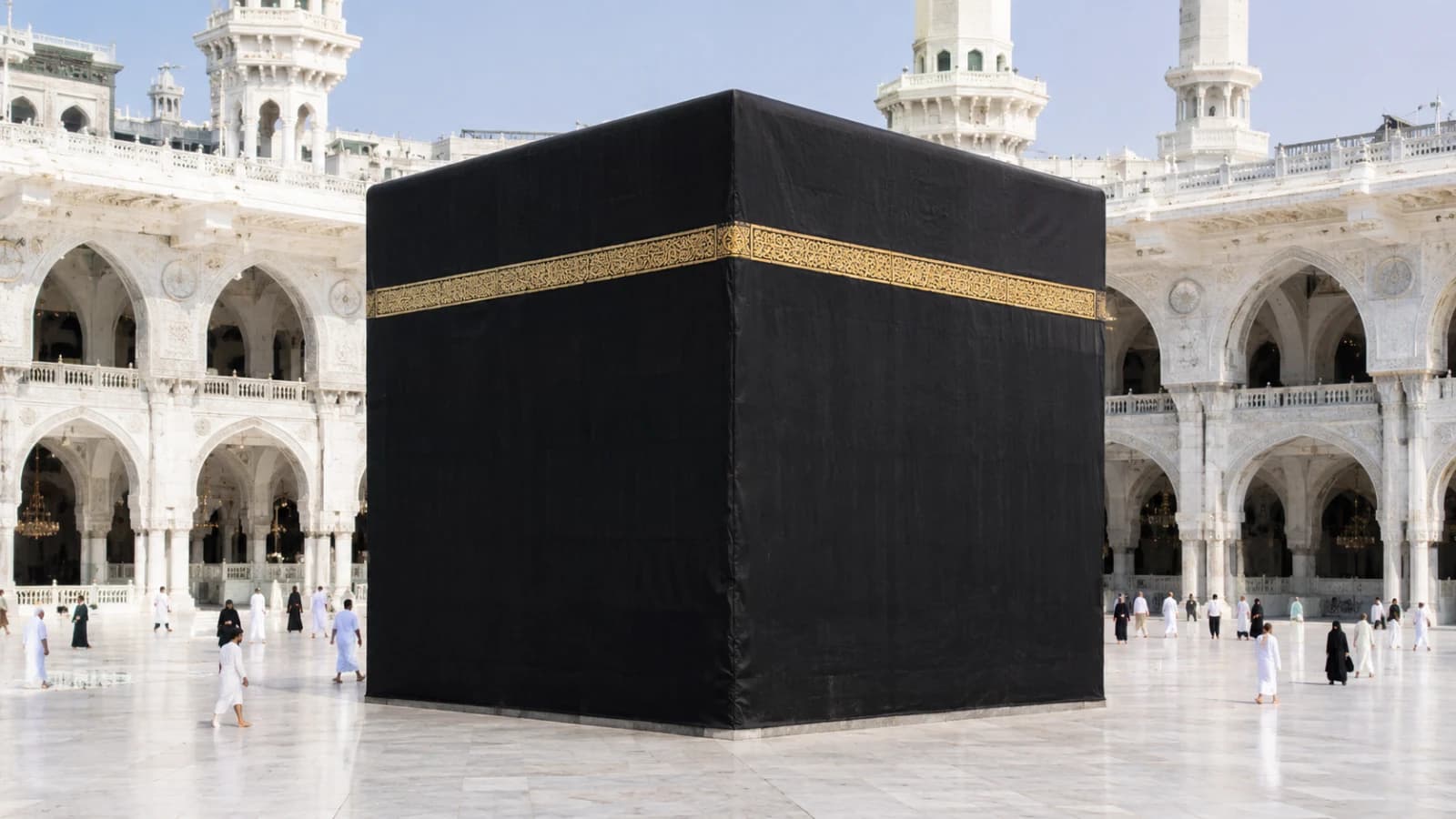
The Kaaba stands in the open central area of Masjid al-Haram, the Grand Mosque. In a photograph it is the building whose black textile forms the dark silhouette. The surrounding arcades, prayer floors and minarets belong to the mosque. The pale paved space immediately around the building is part of the mataf, the area used for tawaf. The mosque provides space for that rite on more than one level.
These names help make sense of descriptions that otherwise seem contradictory. A report about expanding the Grand Mosque may describe new floors and pathways. An account of repairs to the Kaaba concerns the much smaller building at its center. Saudipedia’s entry on the mataf records alterations to the surrounding surface and routes. Among them was the removal of a ground line aligned with the Black Stone because people gathered around it.
Why do Muslims face the Kaaba?
The qibla gives worshippers a common direction in salah, the formal daily prayer. In Qur’an 2:144, the command is to face toward the Sacred Mosque. Its practical reference is the Kaaba. Muslims worship God. The building serves as a direction shared by people praying from many places.
A person in the Grand Mosque may be able to see the building. A person in a mosque in another country usually follows the direction set by the prayer hall. Those local directions can look quite different on a flat map because each starts from a different point on Earth. A single label such as “east” cannot describe them all. Our guide to historical qibla indicators shows how some instruments combined a compass or sundial with information about a city.
The direction and the walking rite answer different questions. When a worshipper stands for salah, the qibla tells them which way to face. When a pilgrim performs tawaf, they follow a route around the building. A photograph of people walking around the Kaaba therefore shows a different practice from a photograph of people standing in rows for prayer.
How does tawaf work during Hajj and Umrah?
In tawaf, pilgrims circle the Kaaba seven times, starting in line with the Black Stone and keeping the building on their left. Seen from above, the movement is counterclockwise. The Saudi municipal Balady Atlas identifies the Black Stone corner as the start and end and describes the gesture of raising a hand toward it. The starting alignment can be recognized from a distance. Follow the crowd’s direction and the signs or staff instructions instead of pressing toward the wall.
Tawaf is part of both pilgrimages. The official Nusuk Hajj journey identifies different occasions for it within Hajj, including Tawaf al-Ifadah. Hajj also includes rites away from the Grand Mosque, including the gathering at Arafat. Umrah includes tawaf and a separate movement between Safa and Marwa called sa‘i. The step-by-step Umrah guide explains how those stages fit together. For the place of pilgrimage in Muslim practice, see the guide to the Five Pillars.
When viewing a diagram, count a circuit as a return to the starting alignment after going around the building. A shorter path past one façade does not make a circuit. The crowd may pass at different distances from the walls because the paved area is wide and the mosque has other levels. Use the signs and staff instructions in the building to find the appropriate route on the day.
What are the Black Stone, the Kiswah and the Hijr?
These features have distinct places and functions. The Black Stone is set into a corner. The kiswah covers the walls, and an embroidered curtain called a sitara covers the doorway. The Hijr is the area bounded by a low curved wall alongside the building. The following table identifies each feature by its position and use.
| Feature | Where to look | What it tells you |
|---|---|---|
| Black Stone | In a framed setting at one corner | Its alignment marks the start and end of each tawaf circuit. |
| Kiswah | Across the exterior walls | The covering is made of textiles laid over the building. |
| Sitara | Over the raised doorway | This embroidered curtain is a particular part of the exterior textile ensemble. |
| Hijr | Within the low semicircular boundary beside the Kaaba | Traditional accounts connect part of the enclosed area with an earlier building footprint. |
| Mataf | In the wider circulation area around the building | This is the space where pilgrims make the circuits. |
A report in Sahih al-Bukhari 1597 recounts Umar kissing the Black Stone because he had seen Muhammad do so, while saying that the stone itself could neither benefit nor harm him. The report explains the devotional precedent behind the gesture. The alignment with the stone still marks each circuit when pilgrims are walking farther from the wall.
Qatar Museums’ object profile shows a late Ottoman example of a door curtain from the Museum of Islamic Art’s collection. It is useful because it lets you look closely at a piece of the covering outside its original setting. Our article on Kiswah textile production explains the role of silk, embroidery and the different panels.
What do Islamic sources say about the Kaaba’s origins?
Qur’an 2:125 describes the House as a place to which people return and associates it with prayer and those who circle it. In 2:127, Ibrahim and Ismail raise its foundations. Qur’an 3:96–97 describes the House at Bakkah as a place of blessing and guidance and refers to pilgrimage for those able to undertake it.
Those verses describe the religious significance of the House and the place of Ibrahim and Ismail in Islamic tradition. They supply no calendar year for a building phase and no measurements of its masonry. The historical question of when a recorded flood damaged particular walls is answered from a different body of evidence. Reading the two kinds of source together helps explain how the site can be ancient in religious memory while the standing building has undergone documented reconstruction.
How has the building changed over time?
The Qatar National Library exhibition on the Kaaba traces several reported phases. It recounts a reconstruction by Quraysh before Muhammad’s prophetic mission, followed by changes associated with Abd Allah ibn al-Zubayr in the late seventh century. It also describes a later change under the Umayyad caliph Abd al-Malik that brought the structure back toward the configuration attributed to Quraysh.
The Ottoman rebuilding is particularly well documented. Heavy flooding damaged the building in 1039 AH, commonly discussed as the flood of 1630 in the cited historical research. Sultan Murad IV ordered reconstruction. A 2025 study of the rebuilding examines the accounts of scholars who witnessed it. It describes disagreements over which fallen stones could be reused and which parts should be removed during the work. The case shows that maintaining the same place of worship required careful decisions about what to preserve and what to rebuild.
Later work included a comprehensive renovation in 1996 under King Fahd, as recorded by Saudipedia’s Grand Mosque entry. The same entry reports measurements from the Hajj Research Center at Umm al-Qura University. The wall that contains the door, measured between the Black Stone corner and the Levantine corner, is given as 11.68 metres. The other three sides are reported as 12.04, 10.18 and 9.90 metres. The measurements concern the building’s sides, and they help explain why a shape that looks cubic in photographs has unequal wall lengths. Earlier measurements may use different reference points or units.
Reading a photograph or plan of the Kaaba
Start with the dark walls, then identify the textile, the raised door and the surrounding paved area. A close photograph of the door curtain is about the covering. A wide view of people moving around the building shows the circulation space. A plan showing a small semicircular enclosure marks the Hijr, a feature easily missed in pictures taken from ground level. If a caption refers to the qibla, it is describing the building as the reference for prayer from elsewhere.
The terms become easier to remember when paired with a single question. Which building is this? The Kaaba. Which larger complex contains it? The Grand Mosque. Which direction do worshippers face? The qibla. Which rite involves walking around the building? Tawaf. Each term names something a reader can locate or recognize in the sources below.
Sources
- Qur’an 2:144 — The verse directing worshippers toward the Sacred Mosque.
- Qur’an 2:125 — The House as a place for return, prayer and circumambulation.
- Qur’an 2:127 — Ibrahim and Ismail raising the foundations of the House.
- Qur’an 3:96–97 — The House at Bakkah and the pilgrimage obligation for those able to undertake it.
- Saudi municipal Balady Atlas, Mapping Hajj — Where circuits begin and end, their direction and the gesture toward the Black Stone.
- Nusuk Hajj journey — Where the different tawaf rites fit within the Hajj sequence.
- Sahih al-Bukhari 1597 — Umar’s explanation of his gesture at the Black Stone.
- Saudipedia, Grand Mosque — Named features, reported wall measurements and the 1996 renovation.
- Saudipedia, Mataf — The circumambulation space and changes to its surface and levels.
- Qatar National Library, The Architecture of the Holy Kaaba — Historical building phases and exhibition materials.
- Religions, study of the rebuilding under Murad IV — Research on the flood and the decisions recorded by contemporary witnesses.
- Qatar Museums, Sitara of the Ka‘ba — A collection object that illustrates the role of the door curtain.