What Is a Fez or Tarboosh? Shape, History and Museum Examples
Identify a fez or tarboosh by its crown, felt and tassel. Museum objects show how Ottoman uniform caps and regional dress differed.
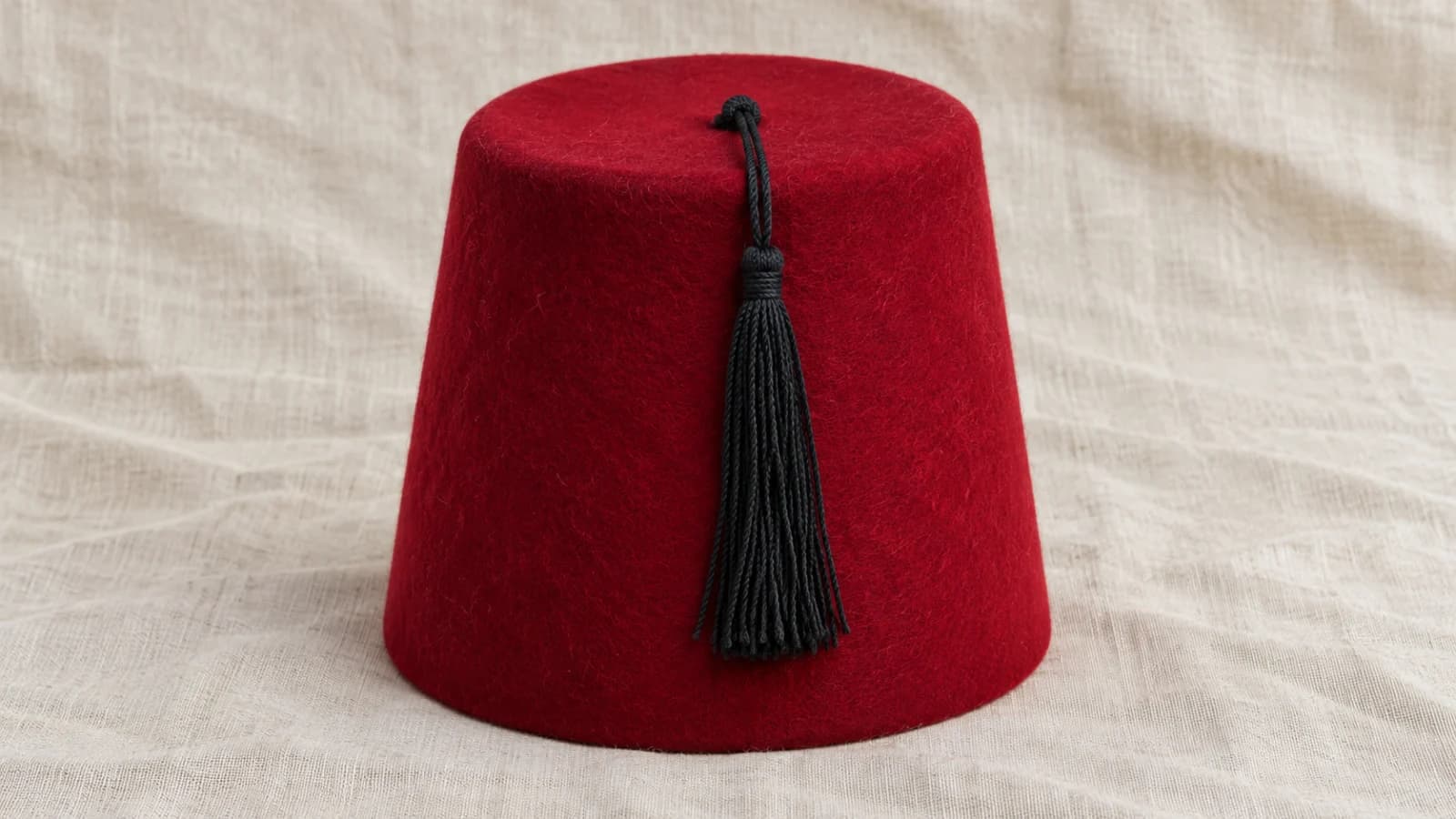
A fez, also called a tarboosh or tarbush, is a brimless cap typically made of felt. Its familiar profile has a flat top and a tassel attached at or near the centre. Red is common, and surviving hats show variation in the shade, the height of the crown, the colour of the tassel and the layers worn around the cap. Those differences become clearer when the hat is examined as part of a particular outfit.
The crown, tassel and name
Viewed from the side, a typical fez looks like a short cylinder with a slightly tapered wall. From above, its crown appears as a flat disc. The bottom edge is the opening that fits over the head. There is no projecting brim, so the outline depends on the angle of the walls and the shape held by the crown. Tassels add movement to a body intended to keep a defined shape.
English catalogues use fez, while tarboosh and tarbush are variant English spellings of a name encountered in Arabic-speaking settings. The British Museum uses both names for the same cap from Palestine, spelling the second one tarbush. The Turkish term is fes. Hülya Tezcan's entry in the TDV Encyclopaedia of Islam associates the Western name with the Moroccan city of Fez, also written Fès. That association explains a name encountered in catalogues, while each object has its own record of production and acquisition.
Caps sold or displayed under the same name can have quite different proportions. A short crown fits more easily into an outfit where the cap is partially obscured by other material. A tall cap makes the side wall a more visible feature. Even the taper can vary: the first military model described by Tezcan stood about 20 to 25 cm high and widened slightly toward the top.
Felt is shaped, and the tassel is attached
Tezcan describes a historical Ottoman process that began with wool worked into a bag-like form. Wet felting and subsequent finishing made it denser and smaller. After dyeing and further processing, a hatter shaped it on a mould and finished the surface. Forming the cap on a block established the proportions of the finished piece. An interior support could help keep the tall early model in shape. The red body and the silk tassel came from different materials and involved different work.
The same account records a trade in reshaping caps that had lost their profile. Hatters first worked with wooden forms and later used heated brass ones in places including İzmir and Istanbul. Their numbered forms offered a range of sizes and silhouettes. A smaller or more upright profile can therefore reflect a deliberate choice of mould.
The top attachment varies too. The early Ottoman model in Tezcan's account had a dark-blue or black silk tassel fixed to a projection at the centre. The long blue silk could spread out and need combing. A regulation reported for 1845 specified twisted tassels for soldiers and a thin brass disc on the crown. The small piece of hardware and the maintenance of the threads both mattered to the finished appearance.
What changed under Mahmud II
In 1829, during the reign of Sultan Mahmud II, the Ottoman government adopted the fez for its new army, the Asâkir-i Mansûre-i Muhammediyye. The move followed the dissolution of the Janissary corps in 1826, part of a broader period of Ottoman military and administrative change. An archival report and the sultan's written response, published by historian İsmail Hakkı Uzunçarşılı, describe a meeting at which officials examined samples. The report says the existing military headgear deteriorated quickly in sun, rain and moisture. Participants discussed durability, cost, existing uses of the fez elsewhere and the proposed length of the tassel.
The decision applied to a named military force. In the published record, the sultan approved the choice and called for the selected hats to be ready for issue. The journal article also reports the establishment of the Feshane workshop in Istanbul in 1830 with hatmakers brought from Tunis. The order and the workshop belong to the same history of supply. Choosing the hat made it necessary to secure finished caps and workers who could shape them. One of the Ottoman chronicle passages quoted by Uzunçarşılı records an order for 50,000 caps from Tunis. The chronicle describes an order, and the account of Feshane describes an effort to produce caps in Istanbul. Tezcan also records continued imports from abroad alongside production in Ottoman workshops. The Turkish name of a cap and the location of its production could therefore point to different places.
Ottoman fez profiles continued to change. Tezcan names a smaller style associated with Abdülmecid, a broader one associated with Abdülaziz and a more upright one associated with Abdülhamid II. These differences are useful in portrait comparisons with good documentation. The surviving examples themselves carry varying degrees of certainty. For another way to read Ottoman objects connected to a ruler and an administration, see the guide to royal monograms on Ottoman documents.
Two caps from Palestine, two settings
The British Museum's As1966,01.236 is a village man's fez from late nineteenth- or early twentieth-century historic Palestine. The body is maroon felt and the tassel is blue silk. The crown is 15 cm high excluding the tassel, and the museum lists a diameter of 19 cm. The register records that a cloth turban could be wrapped around the cap, or that the cap could be worn on its own. The wrap would change how much of the felt side remained visible.
The museum's As2000,08.60 belongs to a different outfit. The nineteenth-century cap is a boy's ceremonial fez from Palestine, identified in the collection as part of circumcision festivities. It has a red felt body, a black tassel and a fringe of stamped metal coin tokens on the front. Cotton threads and gilt-wrapped elements contribute to the decoration. It is 11 cm high excluding the black tassel, and its diameter is 18 cm.
The two measured hats are just 1 cm apart in diameter but 4 cm apart in height. The most visible addition on the boy's cap is the decorated front. That arrangement supplies a reason to look beyond the general silhouette: the crown remains recognizable as a tarbush, while the hanging ornament and museum record tie this example to a particular occasion. The measurements and decoration make the distinction clearer than the shared colour family does.
Caps, scarves and local dress
The Penn Museum catalogues a red felt fez with an embroidered scarf under object number 29-165-7. The record associates it with Turkey and assigns it to the broad period “Modern.” The scarf is documented as part of the object description. The record's possible donor and pre-1929 credit line provide collection history, with limited evidence for dating manufacture. The British Museum's description of wrapping cloth around a cap gives a separate example of how much a head covering could change depending on the accompanying textile.
The Centre of Visual Arts and Research in Cyprus catalogues cst_00803 as a nineteenth-century Turkish Cypriot fez in red felt with a black tassel. The record leaves the maker and the place unspecified. The cultural description places the cap within a tradition of dress. Its town of manufacture remains unspecified.
Compare both with the Jewish Museum of Greece's twentieth-century fez. It has dark red velvet, a tassel and yellow embroidery spelling “Pasha.” The museum files the object among costume and accessory records associated with Sephardic and Romaniote material. This individual example illustrates how the name can travel across different textiles and collection settings. The embroidery is recorded as a feature of the cap, with no named maker in the catalogue. The comparison of kaftans and abayas uses the same physical details of cut, layers and material to make sense of labels applied across regions.
What a tassel can tell you
Black is familiar in pictures of the fez, and blue is well documented. The late nineteenth- or early twentieth-century village cap in the British Museum has a blue tassel, as does an undated red felt fez at the Detroit Institute of Arts. The latter is catalogued as Turkish. It is a second blue-tassel object with a different scope of geographical and dating evidence. Matching tassel colours are a good starting point for comparison.
A tassel's arrangement can also have a meaning in a specific account. The British Museum's register for the village cap reports a convention linking the tassel's position with marital status. That information is useful alongside the record of this particular cap and local dress. On another hat, the length or arrangement may have to do with a uniform specification or a separate ornament such as the white cotton elements added to the boy's cap. Regional and institutional context explains what the details meant to the people who recorded them.
Reading a fez in an old photograph
Start with the crown. Record whether it is flat, how high the visible side is, and whether the wall tapers. Then look for the point where a tassel meets the crown and for any fabric wrapped around the base. If the photograph is monochrome, describe the tonal difference between the hat and tassel as it appears. Colour comparisons can wait for a dated caption or an object with a matching documented outfit.
Next look at the surrounding clothes and the reason the photograph was made. A documented uniform, a village portrait and an account of a family ceremony give different evidence for the same type of cap. When comparing photographs with older illustrations, check the setting in which the image was made. Ottoman illustrated chronicles offer examples of how artists used costume and placement to indicate rank. A hat in a historical image can serve that visual purpose alongside any physical resemblance to a surviving object. The image's own caption or catalogue record supplies firmer evidence for a person, date and setting. In a caption, “maroon felt fez with a blue silk tassel” tells the reader what is documented. A broader account can follow when the record identifies the place, occasion or wearer.
Museum and archival sources
- Hülya Tezcan, TDV Encyclopaedia of Islam, “Fes”
- İsmail Hakkı Uzunçarşılı, archival report and imperial response on military headwear, Belleten
- British Museum, village cap As1966,01.236
- British Museum, ceremonial cap As2000,08.60
- Penn Museum, felt fez and embroidered scarf 29-165-7
- Centre of Visual Arts and Research, fez cst_00803
- Jewish Museum of Greece, embroidered velvet fez
- Detroit Institute of Arts, red felt fez X1989.3825