Resource
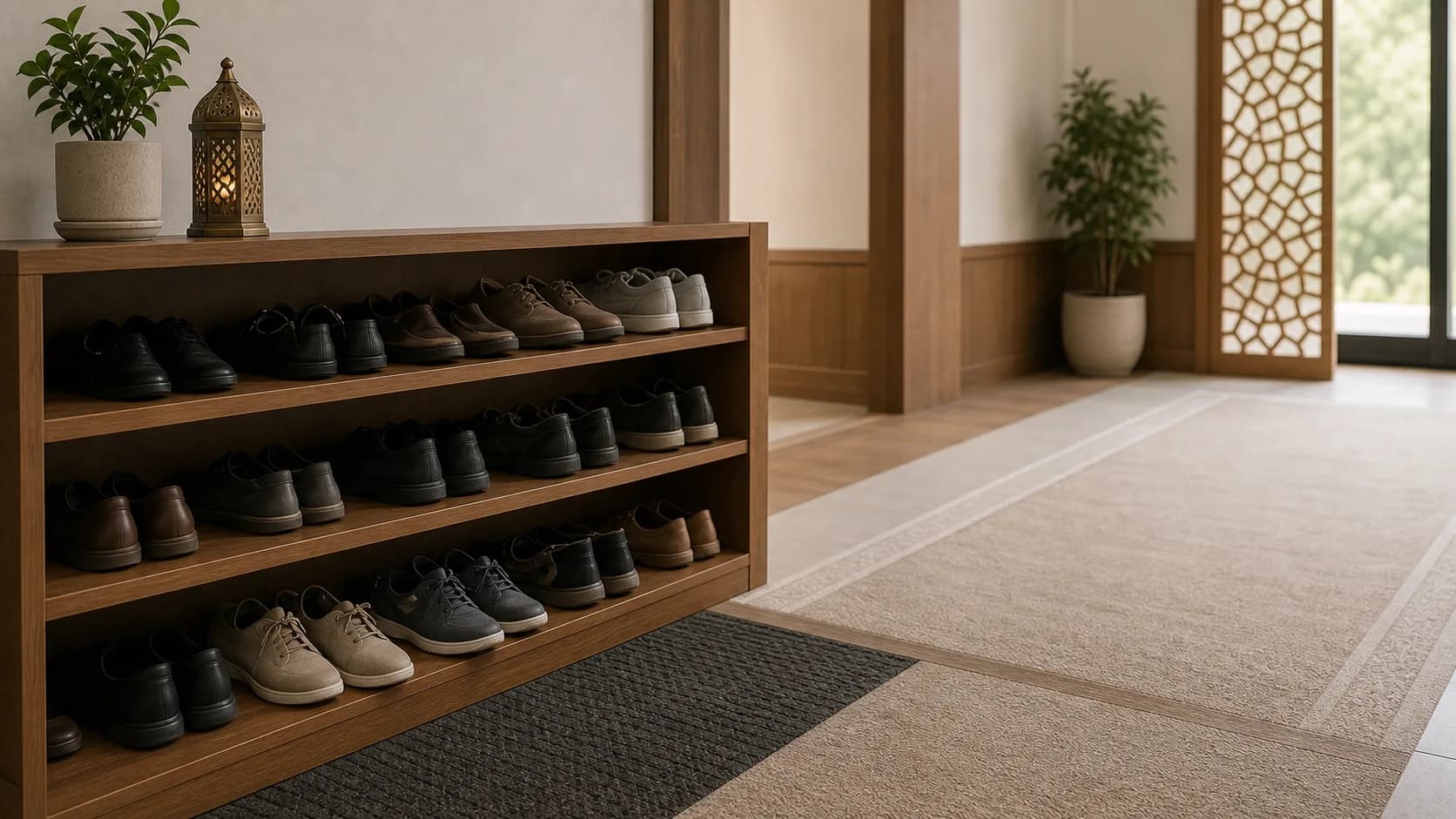
Muslim Shoe Rack Entryway Order Adab Guide
A practical Muslim guide for keeping mosque and community entryways orderly through careful shoe placement, clear paths and respectful exits.
Use case
Mosque entrances, prayer-room doors, community halls, Eid venues, classes, homes with guests and shared shoe areas
Adab focus
Clear path, neat placement, no crowding, no guessing about others' shoes, patient exit and safety awareness
Best time
When arriving, before prayer starts, during crowded exits and when an entryway becomes blocked
Boundary
Does not replace mosque policy, security rules, fire exits, accessibility requirements or local safety law
An entryway can shape the whole mood of a visit. Shoes scattered across the path, blocked doors, mixed bags and rushed exits can turn a place of worship or learning into confusion.
The Quran calls for appropriate conduct at the masjid, permission and respect around entering spaces, cooperation in righteousness, justice and not acting on guesses. At a shoe rack, those values become simple: follow the local layout, keep pathways clear, place shoes neatly, avoid moving other people's items without need and leave with patience.
This guide is educational and does not replace mosque policy, security procedures, fire exits, accessibility rules or local safety law. It helps a Muslim treat the entryway as part of shared worship adab.
Shoe Rack Entryway Order Checklist
| Entry moment | Adab question | Practical action |
|---|---|---|
| Arrival | Am I slowing the doorway? | Step aside before removing shoes, keep conversations away from the door and follow local signs. |
| Placement | Can others walk safely past my shoes? | Place shoes fully on the rack or assigned area, not in the walkway or prayer path. |
| Crowd | Am I moving someone else's belongings without right? | Ask a volunteer before shifting items, and move only what blocks safety or access. |
| Exit | Can I leave without rushing others? | Wait patiently, collect only your belongings and keep the exit path open. |
FAQ
Can I move shoes that block the door?
If safety or access is blocked, ask a responsible person when possible and move items gently only as much as needed.
What if there is no space on the rack?
Use the local overflow area or ask a volunteer. Do not create a pile in the doorway or emergency path.
Is shoe-rack order really part of adab?
Yes in practice. It protects safety, cleanliness, access and the calm of a shared worship space.
Related reading
- Mosque Etiquette First Visit Guide
Use for the broader first-visit flow before narrowing to the shoe area.
- Muslim Public Space Cleanliness Adab Guide
Use when entryway order is part of a broader public cleanliness issue.
- What Happened at Al-Aqsa and the Ibrahimi Mosque in May 2026?
A dated account of May 2026 reports from Al-Aqsa in Jerusalem and the Ibrahimi Mosque in Hebron, separating Palestinian, Jordanian and Israeli police accounts from independently documented access conditions.
Connected by mosque.
- Hypostyle Mosque Plan: Columns, Courtyard and Qibla Hall
How hypostyle mosques use repeated columns and roof bays, why the plan expanded easily, and how Kairouan and Córdoba turned repetition into monumentality.
Connected by mosque.
- Uyghur Islam: Religious Practice, Mosques and Community Life
A source-based guide to Uyghur Sunni practice, mosque life, Ramadan, shrines and the difference between lived religion, law and political claims.
Connected by mosque.
- Mosque Architecture Terms Explained by Function
A practical glossary of qibla walls, mihrabs, minbars, minarets, domes, courtyards, iwans, hypostyle halls and related mosque spaces, with regional examples and common identification errors.
Connected by mosque.
- The Maqamat of al-Hariri and al-Wasiti's Paintings
How a celebrated 1237 manuscript joins rhymed prose, social satire, calligraphy and images of travel, markets, mosques and performance in Abbasid Iraq.
Connected by mosque.
- Paris Muslim Travel Guide for Prayer Spaces Halal Food and Metro Planning
A practical Paris Muslim travel guide with mosque anchors, halal verification, RATP ticket planning, neighborhood buffers and a one-day workflow.
Connected by mosque.