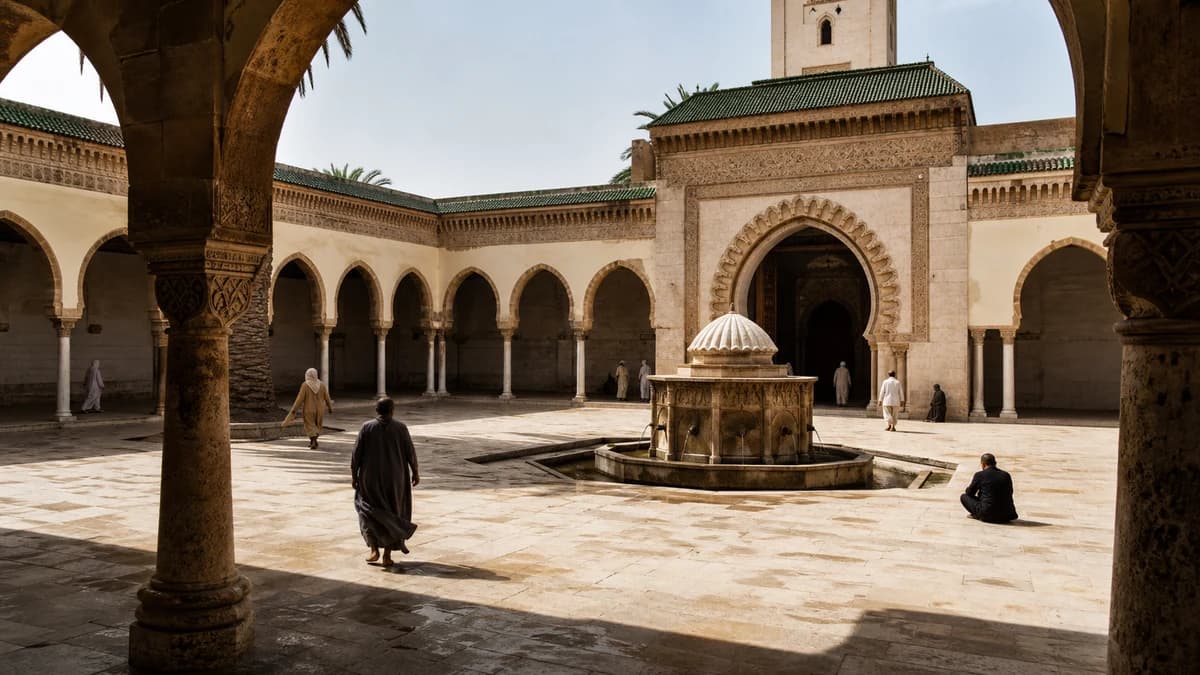
Mosque Sahn: Courtyard, Arcades and Ablution Fountain
What a mosque courtyard does for circulation, overflow prayer, light and climate—and why the central fountain is common but not a universal rule.
The sahn is a courtyard, and in mosque architecture it often forms the open center or forecourt of a congregational complex. It can organize circulation, admit light, provide overflow prayer space and connect entrances with the covered prayer hall. Its shape and use vary with climate, region and building history.
The cover image is an original AI-assisted architectural reconstruction, not a photograph of a named mosque courtyard.
An open space can organize a large congregation
Friday prayer brings many people through gates within a limited time. A courtyard distributes that movement before worshippers enter the roofed hall. In favorable weather it can extend usable prayer space, but the presence of a courtyard does not mean every part was permanently assigned to prayer.
Arcades create shade and a transition between open and enclosed zones. Their bays can continue the structural rhythm of a hypostyle hall or frame a different centralized composition. Doors, minarets and monumental portals may align with a main axis, although inherited streets or irregular sites can shift the geometry.
The fountain is functional and symbolic—but not automatic
Many courtyards contain a fountain or pavilion connected with ablution. Worshippers need water for ritual washing, but facilities may stand elsewhere in the complex or outside the main court. A decorative basin is not proof that every ablution occurred at that exact spot.
Water also cools, reflects light and provides sound, yet climate claims require care. A small fountain cannot air-condition a vast courtyard. Shade, masonry mass, ventilation and patterns of use all contribute to comfort.
Kairouan, Córdoba and Ottoman courts
In hypostyle mosques such as Kairouan and Córdoba, the courtyard works with a columned hall and repeated arcades. Ottoman imperial mosques often pair a domed prayer hall with a porticoed forecourt of more regular bays. Chinese, West African and Southeast Asian mosques can follow very different courtyard traditions or omit the type.
The courtyard therefore helps compare plans without ranking them against one supposed ideal. Regional building cultures shaped mosques as strongly as shared ritual needs.
How to read a sahn
- Trace routes from each gate to the prayer hall and service areas.
- Identify shade, drainage and changes in paving or level.
- Verify the date and function of fountains or ablution structures.
- Check whether later enclosure, roofing or landscaping changed the original open space.
A sahn is active space, not empty space. Its architecture manages arrival, orientation, climate and the changing size of a congregation.
Sources
- Smarthistory: Mosque Architecture, an Introduction — sahn, fountain and common mosque elements.
- Smarthistory: Common Types of Mosque Architecture — courtyard relationships across major plan types.
- Smarthistory: The Great Mosque of Córdoba — courtyard and hypostyle hall in a changing monument.


