What the Mahmal Was in the Cairo Hajj Caravan
A source-critical history of the mahmal’s frame, embroidered cover, Cairo and Damascus processions, relationship to the kiswah and surre, political meaning, 1926 rupture and surviving museum objects.
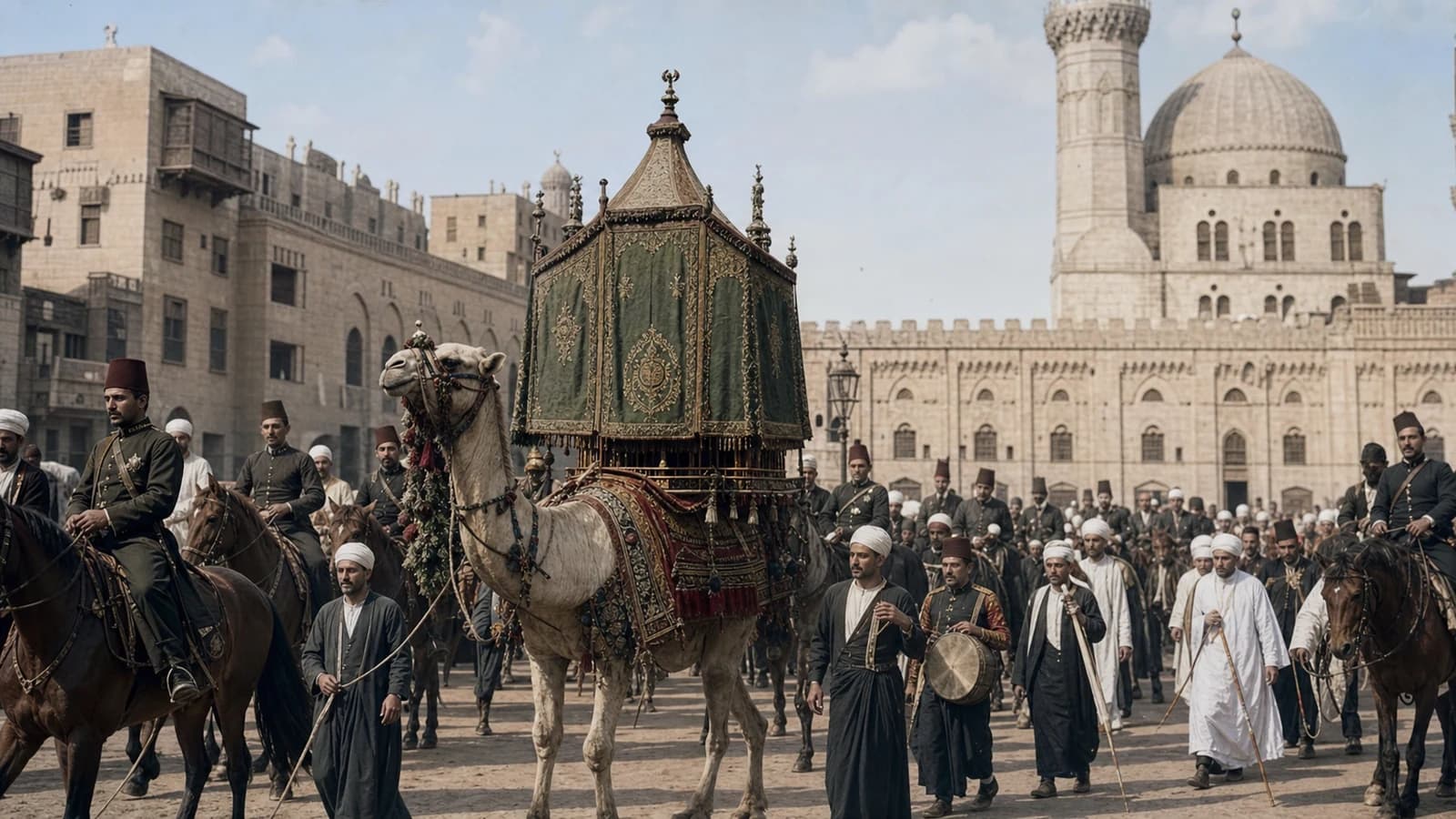
It is often described as empty or passengerless, and it certainly did not carry a ruler. Some object records and later Egyptian accounts say that Qur’ans or small ceremonial items could be placed inside on particular occasions. The careful definition is therefore functional: the mahmal was a symbolic litter rather than a passenger vehicle or the transport chest for the entire kiswah.
The short answer at a glance
| Question | Evidence-based answer |
|---|---|
| What was it? | A pyramidal or tent-like wooden frame with an embroidered textile cover, finials and banners, mounted on a camel. |
| Did it carry the sultan? | No. It represented the absent ruler’s authority and patronage. |
| Was it the kiswah? | No. The mahmal cover and the Kaaba’s kiswah were distinct textiles, although they traveled and appeared in processions together. |
| Where did it leave from? | Most famously Cairo and Damascus; mahmals were also associated with Yemen and other sponsors in some periods. |
| Who led the caravan? | The amir al-hajj commanded and administered the official caravan; the mahmal was its ceremonial focus. |
| When did the Egyptian mahmal stop reaching Makkah? | After the violent 1926 incident in the Hijaz; Cairo ceremonies had a separate, later afterlife. |
Mahmal, kiswah and surre were three different things
The mahmal was the ceremonial frame and its own fitted cover. The kiswah was the set of textiles made to cover the Kaaba, including separately shaped components. The surre was money and gifts sent under imperial or state patronage to people and institutions in Makkah and Medina. They could travel in the same official caravan without becoming one object.
Confusion persists because city processions displayed the mahmal beside the textiles and gifts before departure. Illustrations compress a long procession into one scene, while captions use “holy carpet” loosely. The site’s guides to the making of the kiswah and the Ottoman surre follow each material system separately.
What the physical object looked like
A mahmal used a square wooden base and a high pyramidal or tent-like upper frame. A fitted sitr, or cover, enveloped the structure. Appliqué, embroidered inscriptions, colored silk, metal-wrapped thread, banners, tassels and finials turned the frame into a highly visible object above the crowd.
The Khalili Collections’ Egyptian mahmal TXT 442, dated 1867–1876, stands about four metres high when assembled. Its red silk cover has green and gold-colored silk appliqué and embroidery in silver and silver-gilt wire over padded cotton thread. The dimensions and materials come from a surviving object record, not from an artist’s estimate.
The mahmal camel was part of the ceremony
The structure was mounted on a camel selected for appearance and strength and fitted with elaborate tack. The Metropolitan Museum of Art’s ceremonial camel shaffron is cataloged as equipment that may have adorned an animal in the Cairo pilgrimage caravan. Its object history helps reconstruct the ensemble beyond the textile-covered frame.
The camel carrying the mahmal was not an ordinary pack animal hidden among baggage. Processional position, ornament, handling and public attention made animal and frame into one ceremonial display. This is why museum interpretation should not isolate a cover from the body, movement and sound that once gave it meaning.
Was the mahmal really empty
Many museum and library descriptions call it empty, passengerless or a substitute for the absent sultan. That wording correctly rejects the common idea that a ruler, pilgrim or relic was transported inside. The Khalili overview explicitly describes Ottoman mahmals as empty palanquins.
Evidence is not perfectly uniform about small contents. The Met notes that a mahmal is sometimes described as empty and sometimes as containing a Qur’an or another religious text. The Cairo governorate’s history describes two small Qur’ans in silver-gilt boxes. It is safer to say that symbolic representation, not carrying a person or the complete kiswah, defined the object; contents could vary by account and period.
The origin story is less certain than a single founder claim
Modern summaries often state that the Mamluk sultan Baybars began sending the mahmal from Cairo in the thirteenth century. The Khalili catalog says Baybars is reported to have been the first. Other traditions connect the custom to Shajar al-Durr and a royal woman’s pilgrimage.
Doris Behrens-Abouseif’s study of the “mahmal legend” shows why the female-founder story must be tested rather than repeated as fact. The secure conclusion is that the institution became a prominent feature of Mamluk state pilgrimage in the later thirteenth century. An exact first procession, motive and passenger cannot be reconstructed merely from later legend.
Cairo turned departure into a civic spectacle
Before the caravan left, the mahmal and Kaaba textiles were paraded through Cairo. State officials, soldiers, religious figures, craftspeople, musicians, pilgrims and spectators participated at different moments. The ruler or representative formally entrusted the caravan to the amir al-hajj.
The procession made distant pilgrimage visible to people who would not travel. It also displayed the workshops, money, security and organization claimed by the state. Cairo sources distinguish more than one annual ceremony, including an earlier procession announcing the approaching season and the later departure. A single print labeled “the mahmal procession” may therefore show a city circuit rather than the caravan already beginning the desert journey.
The amir al-hajj commanded the caravan
The amir al-hajj, or commander of the pilgrimage, held responsibility for an organized moving community. Protection, water, provisioning, pace, camps, disputes and relations with authorities along the route required administration as well as ceremony. Armed escort was a practical claim that the sponsor could secure pilgrimage.
The mahmal did not lead by itself. Its privileged visual position represented the authority behind the caravan, while commanders, soldiers, guides, animal handlers and service workers kept people moving. Europeana aptly describes historic caravans as “cities on the move”; the phrase should direct attention to labor and logistics, not only spectacle.
The Cairo and Damascus mahmals represented connected routes
After the Ottoman conquest of Egypt and Syria in 1516–1517, mahmals traveled with both the Egyptian caravan from Cairo and the Syrian caravan from Damascus, each representing Ottoman sovereignty. The Damascus route gathered pilgrims from Anatolia and other regions, while Cairo served Egypt and arrivals from farther west and south.
Khalili records also mention occasional mahmals from Yemen, and other rulers used comparable displays in different periods. They could compete for precedence near the holy places because processional order signaled rank. It is misleading to treat the Cairo mahmal as the only historical example, even though Egyptian visual and museum evidence is especially abundant.
The mahmal made political authority visible
The ruler was usually absent, but the mahmal stood in for his presence. Funding the caravan, guards, water, gifts and textiles presented him as a protector and benefactor of pilgrims and the Two Holy Sanctuaries. Qur’anic inscriptions, dynastic emblems and the ruler’s name joined devotion to sovereignty on the fabric itself.
This symbolism did not mean the sponsor controlled every event on the road or in the Hijaz. It was a public claim that could be accepted, negotiated or challenged. The political meaning became especially clear when rival authorities disputed who could send the mahmal, how it should be received and what honors accompanied it.
Popular devotion was not identical to the state message
Spectators could seek blessing by touching the mahmal or objects associated with its return. Music, banners, animals and crowds gave the procession emotional force beyond official protocol. For families who did not perform the Hajj, seeing the caravan depart and return connected the city to the sacred journey.
Religious scholars did not agree uniformly about these practices. Critics regarded honoring the mahmal, music or blessing-seeking as innovations without a basis in early Islamic ritual. Supporters and participants treated the ceremony as pious custom and public celebration. The object’s meaning was therefore contested within Muslim societies, not simply admired by all or condemned by all.
The cover was reused rather than replaced every year
The mahmal’s own cover should not be confused with the annually renewed Kaaba textile. Khalili mahmal TXT 469 was first used during the reign of Mahmud II and later renovated under Khedive Isma‘il. Its inscriptions record both stages, while the catalog explains that mahmal covers returned to the Cairo textile workshop for repair and storage.
Reuse changes how a museum textile should be dated. One cover can have an original commission, later repair, replaced banners and a surviving wooden frame assembled or conserved at another time. A single year printed in a caption may describe an inscription or restoration rather than every physical component.
Inscriptions identify patronage and production layers
Mahmal textiles can carry Qur’anic passages, blessings, rulers’ names, titles, tughras and dates. These are not merely decoration. They can distinguish an Egyptian from Syrian cover, identify a commissioner, reveal reuse and connect a fragment to a specific part of the pyramidal structure.
Researchers compare script, textile technique, dimensions, seams and attachment points with cataloged complete examples. A rectangular embroidered panel with sacred text is not automatically from a mahmal; it may belong to the Kaaba, the Prophet’s Mosque, Maqam Ibrahim, a banner or another ceremonial furnishing.
Photographs and prints capture performance but require source criticism
The British Museum’s print of a procession departing for Makkah provides visual evidence of how European audiences saw the Cairo caravan. Johns Hopkins preserves a postcard depicting a Damascus mahmal. Photographs, postcards, travel prints and paintings can show crowds, routes, costume and the structure’s scale.
They also select and stage. A publisher may crop the crowd, color a monochrome image, repeat an old caption or present an urban parade as the Hajj route itself. Record creator, production date, medium, caption and viewpoint before treating an image as eyewitness evidence. Our guide to Hajj certificates and pilgrimage records offers a parallel method for separating journey evidence from devotional representation.
The 1926 incident ended the Egyptian mahmal’s journey to Makkah
Political and religious conflict sharpened after Ibn Saud took control of the Hijaz. In 1926, an encounter near Makkah between the Egyptian mahmal escort and Saudi Ikhwan involved stone throwing and gunfire, causing deaths and a diplomatic rupture. Details and casualty figures vary by source and should not be inflated without a specific record.
The decisive institutional result is clearer: the Egyptian mahmal was no longer sent to Makkah after 1926. The dispute concerned sovereignty, military escort, music and religious objections to the ceremony. It cannot be explained simply as transport becoming obsolete.
Cairo processions continued after the pilgrimage dispatch stopped
The end of travel to the Hijaz was not immediately the end of every Egyptian ceremony. Library and scholarly summaries report that mahmal processions continued or were revived within Cairo into the early 1950s. The object could survive as civic memory and royal spectacle after losing its place in the international pilgrimage caravan.
This produces two different end dates: 1926 for the Egyptian mahmal reaching Makkah, and the early 1950s for the final Cairo ceremonial afterlife. Statements that the tradition “ended in 1926” need to specify which practice ended.
How to identify a mahmal in a museum
- Look for a tall square-based, pyramidal frame rather than a flat Kaaba panel.
- Check whether the textile is cataloged as a sitr for an Egyptian or Syrian mahmal.
- Record dimensions; complete assembled structures are several metres high.
- Read inscriptions for ruler, date, place and renovation.
- Distinguish original frame, cover, finials and later conservation supports.
- Ask whether the object was reused over multiple pilgrimage seasons.
- Compare a photograph or print with a cataloged object before claiming they are the same mahmal.
Frequently asked questions
Did the mahmal carry the kiswah? It accompanied the kiswah and appeared with it in Cairo ceremonies, but the mahmal cover and the textiles for the Kaaba were different objects. Do not describe the mahmal itself as the Kaaba’s covering.
Was anyone inside? It did not transport a ruler or passenger. Many sources call it empty, while some accounts mention a Qur’an or small ceremonial contents. Its defining role was symbolic representation.
Who started the tradition? Baybars is often reported as the first Mamluk sponsor, but exact origin stories are uncertain and later legends about Shajar al-Durr should not be treated as settled fact.
Why were there mahmals from Cairo and Damascus? They accompanied major official pilgrimage routes and represented sovereign sponsorship over different caravan networks.
Why did it stop? The 1926 confrontation in the Hijaz crystallized Saudi religious objections and Egyptian-Saudi political conflict. Cairo display had a later afterlife even after dispatch to Makkah ended.
Related Hajj history guides
- The kiswah and Kaaba textiles — separates the Kaaba covering, door curtain, inscriptions and workshop production.
- The Ottoman surre — follows the money, gifts and administrative procession sent to Makkah and Medina.
- Hajj certificates and pilgrimage records — distinguishes journey documentation, proxy pilgrimage and devotional imagery.
- The Darb Zubaydah Hajj road — examines stations, water and route infrastructure behind premodern pilgrimage.
- Mansa Musa’s Hajj through Cairo — shows how caravan history is reconstructed from dated narrative sources.
Related Muslim Post guides
- The Five Pillars of Islam, Their Meaning and Who Performs Them
- Eid al-Fitr vs Eid al-Adha: Dates, Meaning and Traditions
- Zamzam Well: Sacred History and Water Infrastructure
Sources
- Khalili Collections — Egyptian mahmal TXT 442 — Used for object dimensions, materials, reported Baybars origin, Cairo and Damascus processions, sovereign symbolism and the distinction between mahmal and kiswah textiles.
- Khalili Collections — Egyptian mahmal TXT 469 — Used for evidence that a cover could be repaired, stored, renovated and reused under more than one ruler.
- Metropolitan Museum of Art — Ceremonial camel shaffron — Used for the decorated camel ensemble, procession, surre and kiswah context, and the catalog’s qualified description of possible mahmal contents.
- British Museum — Procession departing for Makkah — Used as a cataloged visual source for the Cairo mahmal and the need to distinguish print representation from the physical object.
- University of Chicago — The Mahmal Legend and the Pilgrimage of the Ladies of the Mamluk Court — Used to test later origin stories and distinguish the institutional mahmal from legends of royal women’s pilgrimage.
- Europeana — Hajj and the remarkable story of the mahmal — Used for caravan administration, public procession, popular participation and the mahmal’s role as a symbol of sovereignty.
- Johns Hopkins University Libraries — Damascus mahmal postcard collection — Used for a dated photographic artifact and for the distinction between the 1926 end of dispatch to Makkah and later Cairo ceremonies.
- Cairo Governorate — The holy mahmal and its journey — Used as an Egyptian institutional account of frame, cover, ceremonial route, small Qur’an boxes and the local distinction among mahmal, kiswah and surre; contested origin and end-date claims were not accepted from this source alone.


