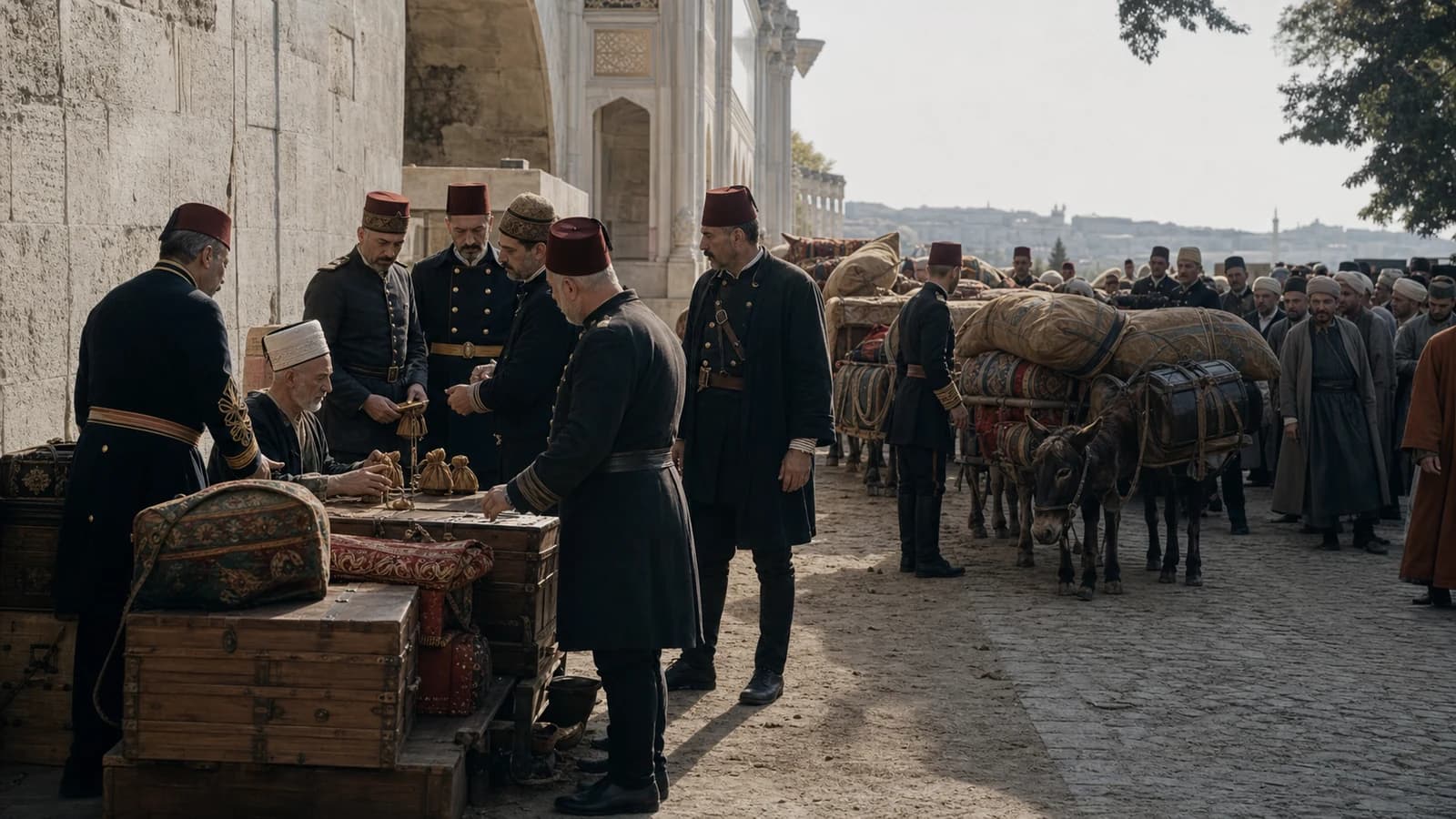
The Ottoman Surre: Gifts Sent to Mecca and Medina
How purses, registers, textiles and public ceremony turned annual support for the Holy Cities into a carefully recorded act of Ottoman rule and devotion.
The Ottoman Surre was an annual imperial convoy that transported money, luxury textiles, and provisions from Istanbul to the holy cities of Mecca and Medina under state patronage.
The Surre Procession and Imperial Legitimacy
The departure of the Surre from Istanbul was marked by a grand public ceremony centered around the surre emini, the high-ranking official appointed by the sultan to oversee the safe transport of the treasury. This procession featured decorated camels, military escorts, and state officials parading through the capital. This public display was a powerful tool for projecting the sultan's religious devotion, administrative capacity, and claim to the caliphate, demonstrating his role as the protector of the Holy Sanctuaries.
The cargo consisted of sealed leather purses and heavy wooden chests containing gold coins, grain allocations, and exquisite textiles destined for the Kaaba and the Prophet's Mosque. These gifts were distributed to local residents, religious scholars, and tribal leaders along the route, securing their loyalty and ensuring the safety of the pilgrimage corridors.
Caravans, Routes, and Regional Variations
While the initial dispatch of the Surre occurred in Istanbul, the journey to the Hijaz was not a single, continuous march. The convoy merged with larger regional caravans in major administrative hubs such as Damascus and Cairo. These regional caravans carried their own ceremonial objects, such as the mahmal (a ceremonial palanquin), and were led by local military commanders who managed the complex logistics of desert travel.
The routes and transport technologies used for the Surre evolved over time. For centuries, the convoy relied on overland camel routes, which were vulnerable to weather, disease, and raids. In the nineteenth century, the Ottoman administration integrated steamships and eventually the Hejaz Railway into the transport system, significantly reducing travel time and altering the ceremonial stops along the route.
Analyzing Surre Registers and Material Culture
Historians reconstruct the scale and impact of the Surre by cross-referencing administrative documents with surviving material objects.
- Translate the detailed recipient registers (surre defterleri) to identify the specific individuals, institutions, and tribes slated to receive stipends.
- Examine the construction, metal hardware, and wax seals of surviving surre chests to verify their administrative origin and security features.
- Analyze the calligraphic styles and imperial tughras embroidered on surre banners to date the specific convoy to which they belonged.
- Compare the financial allocations recorded in Istanbul's central ledgers with local court records in Mecca to verify if the funds arrived intact.
Interpretive Caution and Historical Realities
When interpreting the Surre, museums must maintain historical accuracy by avoiding common misconceptions. It is a frequent error to assume that the Ottoman sultan personally accompanied the Surre convoy on the Hajj; in reality, the sultans remained in the capital, delegating the physical journey to the surre emini and regional governors. The registers themselves must also be read critically, as they document intended distributions that did not always match the realities of theft, corruption, or political disruption on the road.
Furthermore, while the Surre was a highly visible tool of imperial representation, its function cannot be reduced to mere political propaganda. It was a vital economic lifeline for the populations of Mecca and Medina, supporting schools, hospitals, and public kitchens. Understanding the Surre requires balancing its symbolic role in imperial court culture with its practical economic impact on the daily lives of the inhabitants of the Hijaz.
The cover image is an original AI-assisted reconstruction of an Ottoman surre departure, not a photograph or recreation of one documented procession.
Sources
- Türkiye Directorate of Communications: Sacred Path Exhibition — surre objects, procession and exhibition evidence.
- Khalili Collections: Surrah Purse — material evidence for official donations.
- TDV Encyclopaedia of Islam: Surre — terminology, chronology and administration.


