Hajj Certificates: How Pilgrimage Was Documented
How illustrated scrolls and printed forms recorded completed or proxy pilgrimage, named participants and turned sacred geography into portable evidence.
Hajj certificates are historical documents that record the completion of the pilgrimage to Mecca, verify a pilgrimage performed by proxy on behalf of another individual, or serve as devotional commemorations of the sacred journey.
Forms and Material Formats
The physical formats of these documents evolved significantly over several centuries. Early examples typically survive as long manuscript scrolls made of joined sheets of paper, while later periods saw the introduction of single-sheet documents and eventually printed templates with spaces left blank for handwritten names, dates, and witness signatures. The choice of material, from heavy handmade papers to thin imported sheets, often reflects the regional origin and economic status of the pilgrim or the commissioning patron.
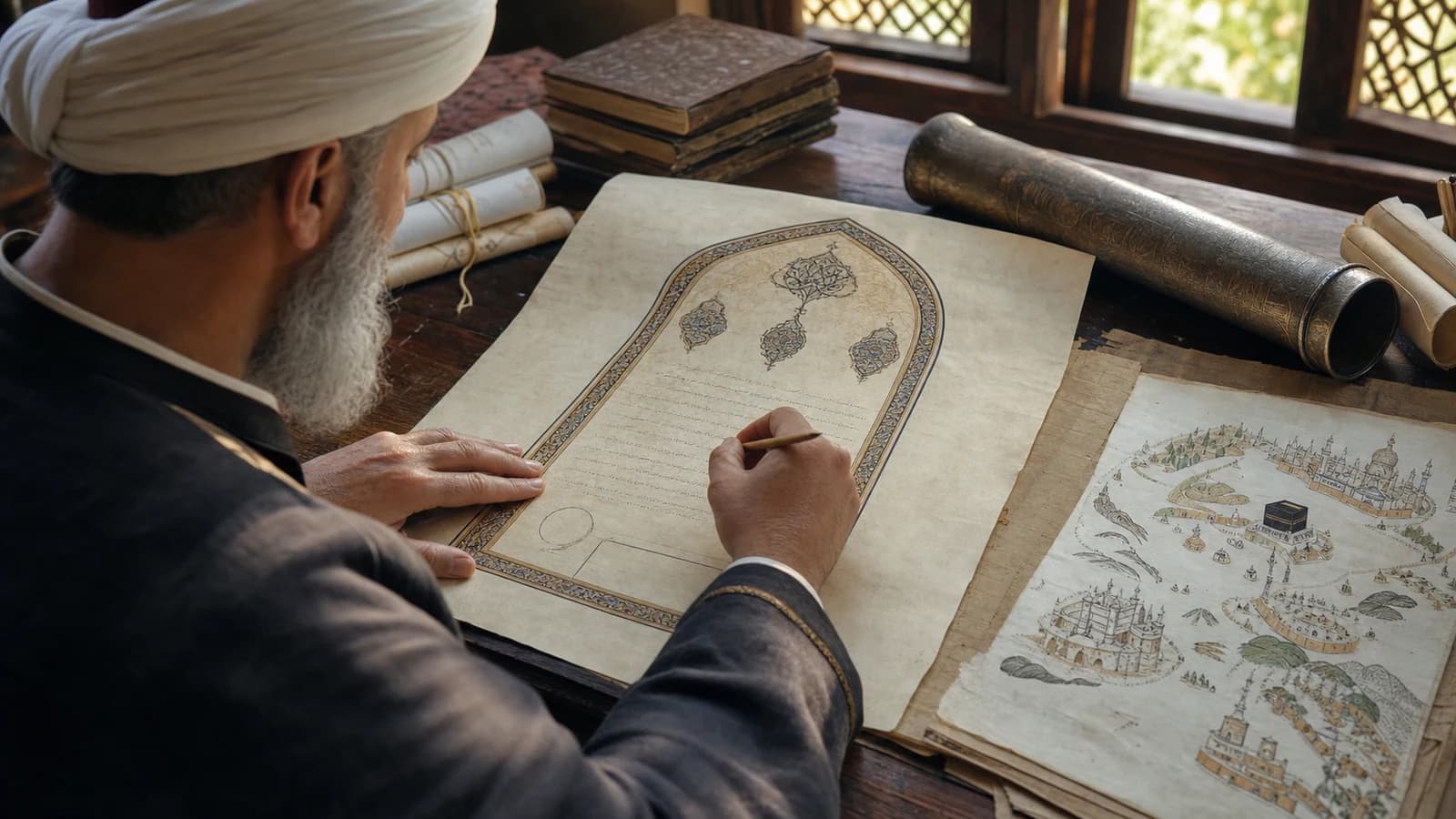
Visual elements on these documents are highly distinctive, featuring schematic representations of the Kaaba, the Prophet's Mosque in Medina, and various ritual stations such as Arafat and Muzdalifah. Rather than functioning as measured, cartographic maps, these illustrations served as mnemonic devices and evidentiary images. They visually anchored the text, allowing the viewer to mentally retrace the sacred geography of the pilgrimage and verify the completion of specific ritual steps.
The Legal and Devotional Practice of Proxy Hajj
A significant portion of surviving certificates documents the practice of proxy Hajj, where an individual performed the pilgrimage on behalf of a deceased, ill, or otherwise incapacitated person. This was not a casual arrangement or simple tourism by delegation; it was a formal legal and devotional contract governed by specific jurisprudential conditions. The proxy was required to state clearly that the rituals were performed for the named beneficiary, and the certificate served as legal proof that this obligation had been fulfilled.
To establish the validity of a proxy Hajj, the document had to be witnessed and signed by individuals who could attest to the proxy's character and the successful completion of the rites. These legal requirements transformed the certificate from a personal souvenir into a formal instrument of Islamic contract law, which was often preserved in family archives or religious endowments to settle estate obligations.
Methodology for Reading Pilgrimage Scrolls
Analyzing these documents requires a holistic approach that goes beyond merely reading the primary text. Historians must examine the entire material and textual assemblage to reconstruct the document's life cycle and verify its authenticity.
- Examine the paper type, watermarks, and scroll joins to determine the approximate production date and geographical origin of the writing material.
- Analyze the calligraphic styles, ink composition, and the placement of official seals or signatures to identify the scribal tradition and administrative context.
- Inspect the container, storage creases, and wear patterns to understand how the document was preserved, transported, and displayed by its owners.
- Cross-reference the named individuals and dates with local biographical dictionaries or court records to verify the historical identities of the pilgrim, proxy, and witnesses.
Interpretive Limits and Provenance
Modern museum interpretation must navigate several evidentiary limits when displaying these scrolls. It is historically inaccurate to assume that every illustrated pilgrimage scroll was a legally binding certificate; some were created purely as commemorative art or educational tools. Furthermore, the possession of a certificate by a family does not provide absolute proof that the named individual personally visited every site depicted on the scroll, as some illustrations represented idealized itineraries rather than personal routes.
Provenance research often reveals complex histories of ownership, restoration, and remounting. A scroll may have been altered in later centuries to replace damaged sections or to add prestigious names, meaning that researchers must carefully separate the original fifteenth-century core from later Ottoman or modern conservation interventions to avoid misattribution.
The cover image is an original AI-assisted reconstruction of a pilgrimage document workshop, not a replica of a named certificate or legible historical text.
Sources
- Khalili Collections: Printed Hajj Certificate — printed form, proxy language and container.
- Khalili Collections: Certificate of Pilgrimage by Proxy — named proxy pilgrimage evidence.
- Khalili Collections: Early Pilgrimage Scroll Sections — manuscript imagery and format.
Related reading
- How Futuh al-Haramayn guided pilgrims
- How the Mahmal shaped caravan ceremony


