Zamzam Well: Sacred History and Water Infrastructure
How Muslim tradition, custodial work, pumps, treatment and scientific monitoring belong to different layers of Zamzam's long history in Mecca.
The Zamzam Well is a historic water source located within the Grand Mosque in Mecca, possessing profound sacred significance in Islamic tradition alongside a complex history of architectural and engineering interventions.
Sacred Tradition and Material Evidence
In Islamic belief, the origin of the Zamzam Well is intimately tied to Hajar and her infant son Ismail, who were provided with water in the barren valley of Mecca through divine intervention. While respecting this sacred narrative, historians and archaeologists analyze Zamzam through the lens of material, administrative, and architectural evidence, documenting how the physical well-face and its surrounding infrastructure have been managed across different historical eras.
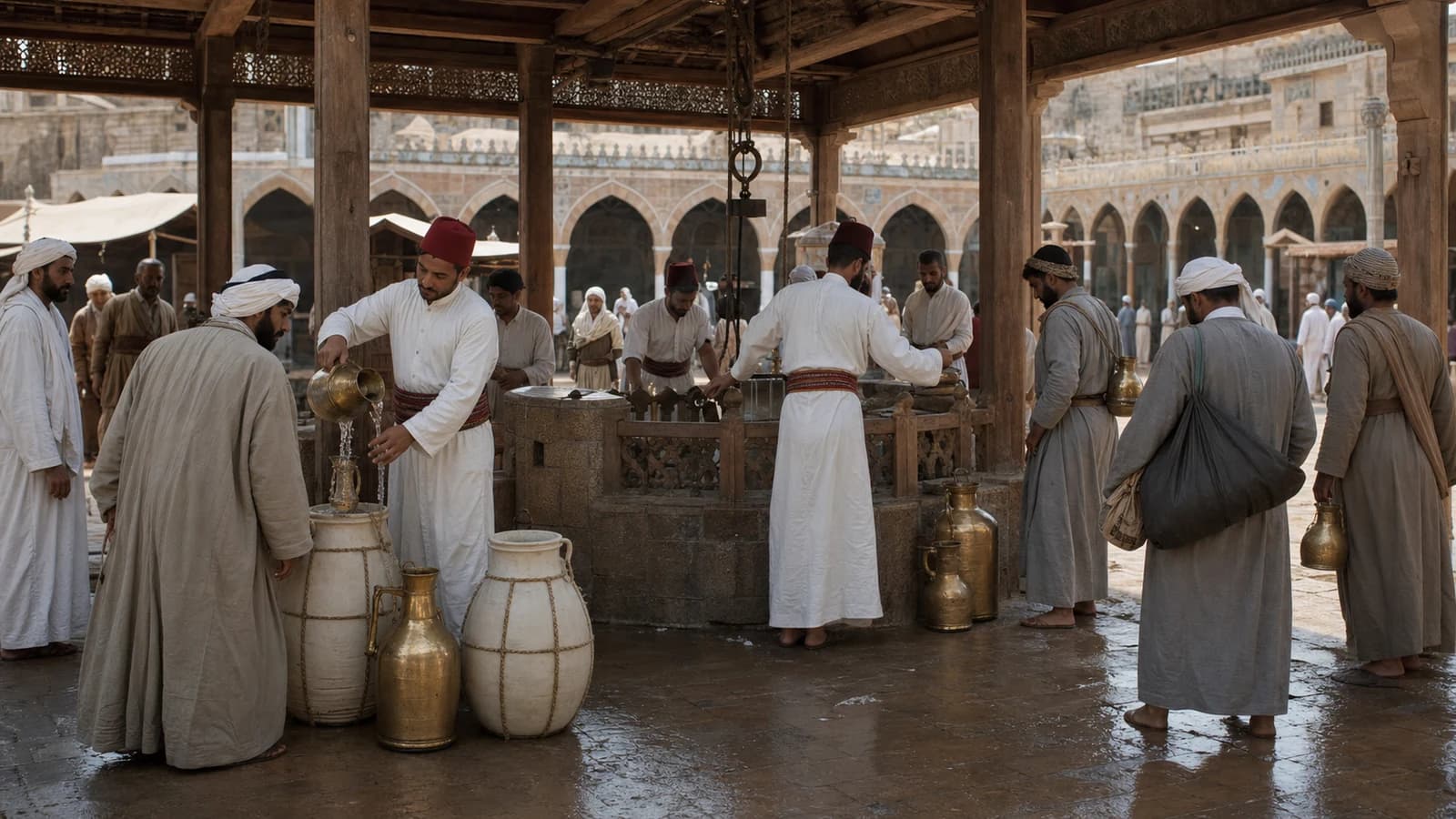
For centuries, water was drawn manually using ropes and leather buckets, a task managed by a specialized guild of local distributors known as the al-zamazima. This group held hereditary rights to draw, store, and distribute the water to arriving pilgrims, utilizing distinctive clay jars to keep the water cool. This manual system coexisted with various architectural enclosures that protected the wellhead from contamination and flooding.
Modern Engineering, Pumping, and Monitoring
In the twentieth and twenty-first centuries, the infrastructure of Zamzam underwent a complete technological transformation. The traditional manual drawing of water was replaced by high-capacity electric pumps, and a sophisticated network of stainless steel pipes was installed to transport the water to modern treatment, cooling, and distribution facilities. Today, the water is subjected to continuous ultraviolet sterilization and microfiltration to ensure safety for millions of users.
Modern management also involves real-time digital monitoring of the well's water level, temperature, and pH balance. These technical operations are designed to manage the aquifer sustainably, preventing depletion while meeting the massive demand during peak pilgrimage seasons. Museum displays of this system focus on these engineering achievements without making medical claims or using scientific data to validate or invalidate religious beliefs.
A Checklist for Documenting Zamzam's Material History
To reconstruct the physical evolution of the Zamzam Well, researchers must consult a variety of historical media and architectural surveys.
- Analyze historic photographs and architectural drawings from the nineteenth and early twentieth centuries to map the changing footprint of the wellhouse.
- Examine surviving clay water jars (dawariq) and metal buckets in museum collections to identify maker marks and regional distribution styles.
- Study the administrative decrees and ledger books of the al-zamazima guild to understand the historical regulation of water distribution.
- Review modern geological and hydrological reports of the Mecca basin to understand the physical characteristics of the alluvial aquifer.
Architectural Evolution and Spatial Changes
The spatial relationship between the Zamzam Well and the surrounding courtyard of the Grand Mosque has changed dramatically due to successive expansions. Historic photographs show a free-standing wellhouse building (the Kabah-adjacent Zamzam building) that pilgrims could enter. In the mid-twentieth century, this structure was demolished to clear the path for pilgrims performing the circumambulation (tawaf), and the well access was moved to an underground chamber.
In subsequent renovations, this underground access was also closed to the public to maximize the surface area of the courtyard, shifting the visitor experience entirely to modern tap stations and portable containers. Consequently, historic representations of Zamzam must be interpreted as time-specific snapshots of a constantly evolving architectural landscape rather than static depictions of the sanctuary.
The cover image is an original AI-assisted historical reconstruction of water service in Mecca, not a view inside the current Zamzam facilities or a depiction of a sacred narrative.
Sources
- Saudipedia: Zamzam Well — location, history and modern infrastructure.
- Saudipedia: Zamzam Studies and Research Center — monitoring and institutional research.
- Saudipedia: Al-Zamazmah Profession — historical water service and custodial practice.
Related reading
- How Ayn Zubaydah carried water toward Mecca
- How historic Hajj caravans managed water


