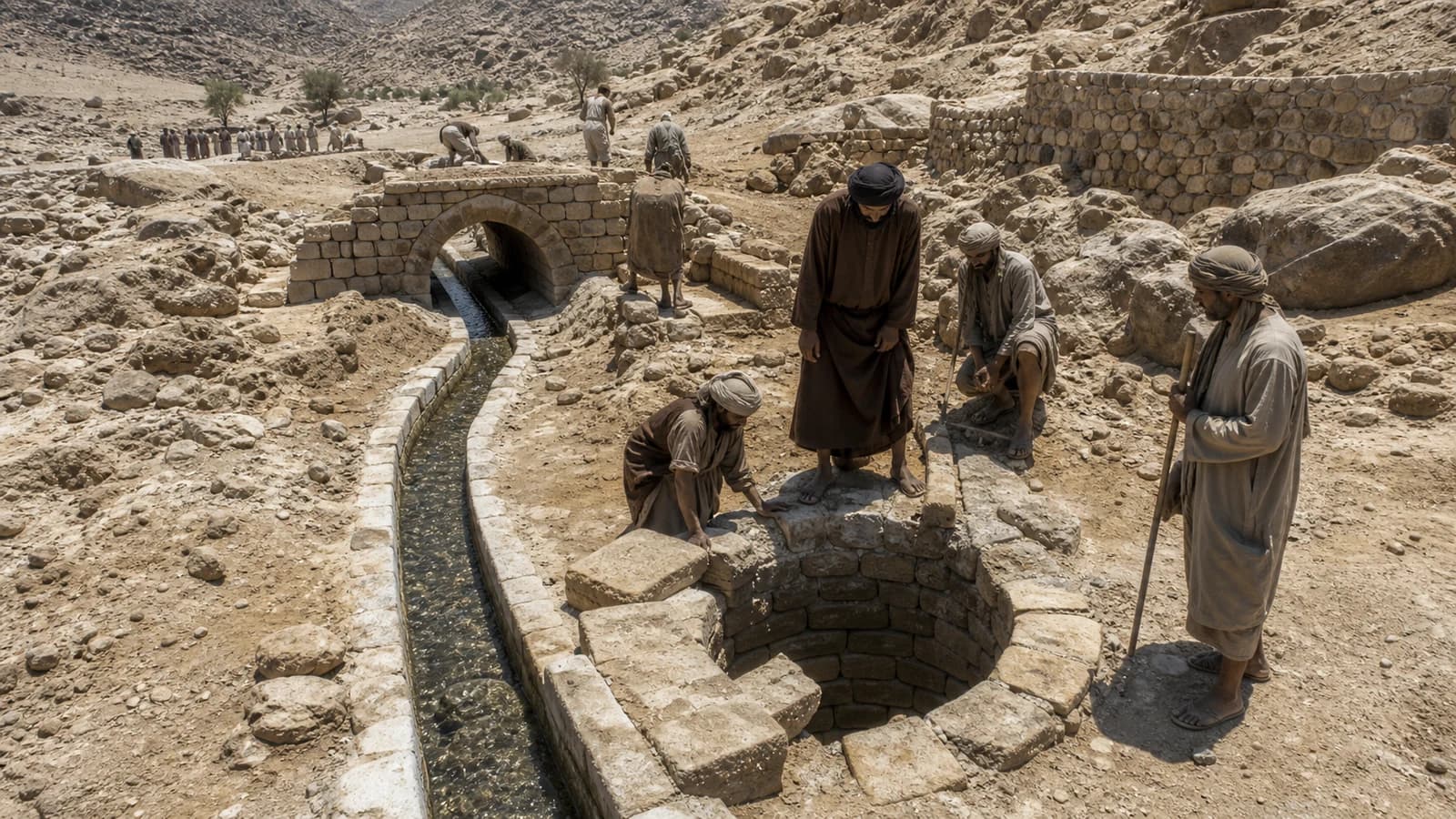
Ayn Zubaydah: The Water System Built for Pilgrims
How channels, tunnels, inspection shafts and catchments carried water toward Arafat and Mecca—and why this system is distinct from the Darb Zubaydah road.
Ayn Zubaydah is an extensive Abbasid-era aqueduct and water management system designed to secure a reliable water supply for the city of Mecca and the surrounding pilgrimage sites.
The Historical Context of the Aqueduct
Associated with Zubaydah bint Jafar, the wife of the Abbasid caliph Harun al-Rashid, this infrastructure project addressed the critical water scarcity that threatened the safety of pilgrims during the annual Hajj. It is historically vital to distinguish Ayn Zubaydah, the physical water canal system in the vicinity of Mecca, from the Darb Zubaydah, which is the overland pilgrimage road stretching from Iraq to Mecca that features its own distinct network of wells, reservoirs, and stations.
The construction of the aqueduct was a monumental engineering feat that captured water from the natural springs of Wadi Numan and other nearby mountain sources. By utilizing gravity-fed channels, the system directed water across difficult terrain, ensuring a continuous flow to the dry valleys where pilgrims gathered in large numbers.
Engineering and Architectural Components
The infrastructure of Ayn Zubaydah relied on a sophisticated combination of surface and subterranean engineering. Gravity-fed channels were carefully graded to maintain water flow without causing erosion, while deep tunnels were excavated through solid rock to protect the water from evaporation and contamination. Stone dams were constructed to manage seasonal torrents and divert water into settling pools where sediment could drop out before the water entered the main conduits.
A key feature of the system was the network of vertical access shafts, similar to those found in qanat systems. These shafts served a dual purpose: they provided essential ventilation during construction and allowed maintenance crews to descend into the subterranean channels to clear blockages, repair stone linings, and monitor water flow over successive generations.
Investigating Water Infrastructure History
Analyzing the physical remains and historical records of Ayn Zubaydah requires separating legendary accounts from material evidence.
- Locate the physical junctions where gravity-fed channels meet subterranean tunnels to map the hydraulic gradient of the system.
- Examine the stone masonry, mortar composition, and plaster linings of the channels to identify different historical construction and repair phases.
- Review local endowment documents (waqfiyyat) to trace the legal ownership of water rights and the funding mechanisms for maintenance.
- Compare archaeological survey data with early Arabic geographical texts to verify the locations of historic settling pools and distribution basins.
Dating, Maintenance, and Legal Endowments
Dating the construction of Ayn Zubaydah presents challenges for historians. While Islamic tradition and modern official descriptions frequently cite the year 194 AH (809-10 CE) as a major construction phase, this date cannot be applied universally to every surviving segment. The system underwent repeated repairs, expansions, and reconstructions over the centuries under Mamluk, Ottoman, and modern administrations, leaving a complex stratigraphic record.
The long-term survival of the aqueduct was made possible through the institution of the waqf (charitable endowment). These legal instruments secured water rights and dedicated agricultural revenues to fund continuous maintenance. Rather than relying on romanticized historical tales of unlimited wealth, modern research focuses on these practical administrative and legal frameworks that kept the water flowing to Mecca's pilgrims for centuries.
The cover image is an original AI-assisted reconstruction of the Ayn Zubaydah waterworks, not a survey image or exact restoration of a surviving channel.
Sources
- Royal Commission for Makkah: Ayn Zubaydah — official site history and location.
- General Authority for Awqaf: Zubaydah Endowment — endowment and channel construction.
- Saudi Press Agency: Historic Engineering Heritage — route, shafts, channels and later maintenance.
Related reading
- How Darb Zubaydah supplied the Iraqi Hajj route
- How qanat underground channels work


