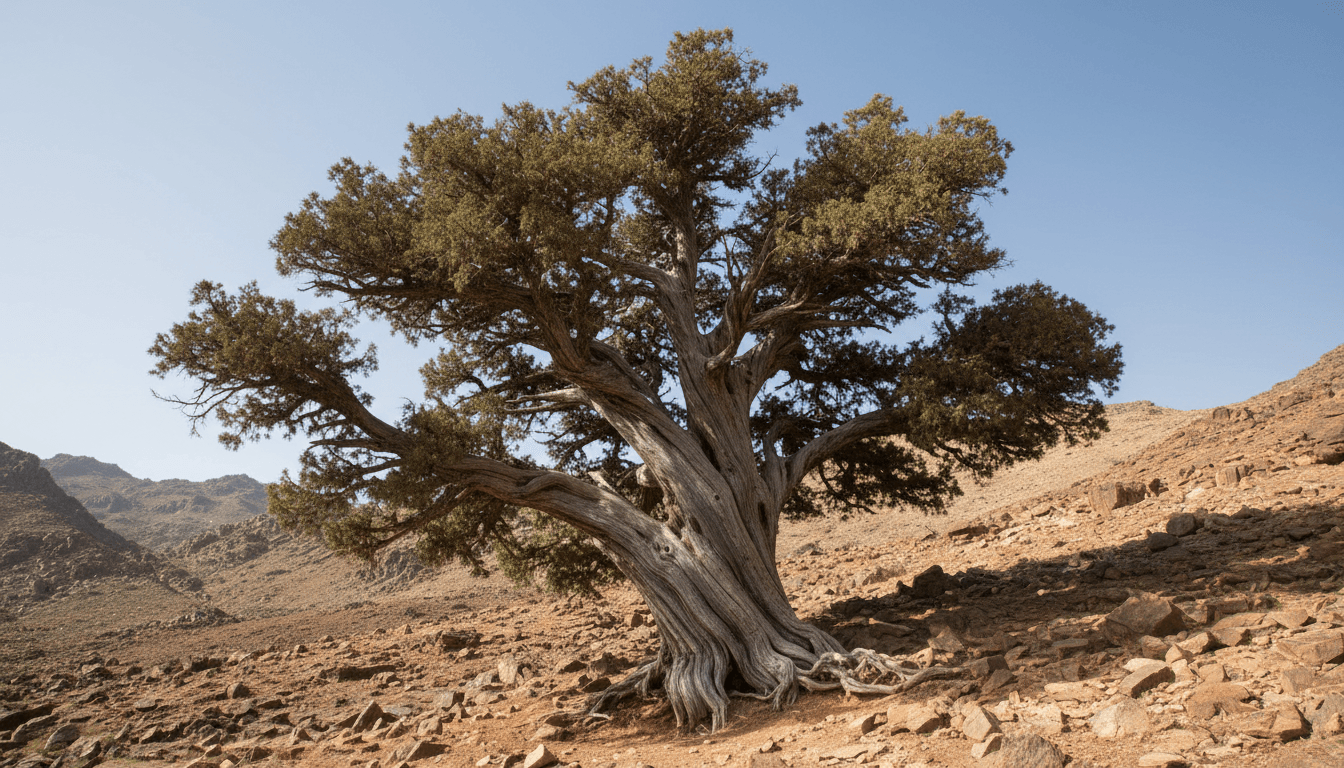
Ziarat, Pakistan: Juniper Forest, Heritage Status and Ecology
A documented guide to Ziarat in Balochistan, its juniper forest, highland ecology, UNESCO Tentative List status, biosphere context and careful interpretation of tree-age claims.
Ziarat is a highland district and town associated with cool summers, the Quaid-e-Azam Residency and an extensive juniper forest. The forest appears on Pakistan's UNESCO Tentative List, but it is not an inscribed World Heritage property. The submitting state's text describes a proposed area of about 110,000 hectares and very old trees; such superlative age estimates should be attributed and not treated as measurements for every individual. This guide focuses on the forest as a living, slow-growing ecosystem shaped by water stress, grazing, fuel use, regeneration and community stewardship, while distinguishing the town, district, forest landscape, biosphere designation and heritage proposal.
Key points
- Ziarat Juniper Forest is on Pakistan's UNESCO Tentative List, not the World Heritage List.
- Tree-age claims describe estimates or exceptional specimens and should not be generalized to every tree.
- Slow growth makes regeneration, soil, water and disturbance central to conservation.
- The town, district, proposed heritage area and biosphere landscape use different boundaries.
Ziarat town, district and forest are not one boundary
Ziarat is used for a town, an administrative district and the surrounding highland destination. The juniper ecosystem extends beyond an urban boundary, while conservation and heritage proposals may use still different polygons. A map should label which boundary it depicts. Population figures for Ziarat district cannot be attached automatically to the town or forest communities.
Elevation creates a cooler environment than much of lowland Pakistan, but highland weather remains variable. Snow, road conditions and forest access change seasonally. Tourism descriptions that call Ziarat permanently pleasant hide winter hazard and water stress; current travel information should be verified close to departure.
Juniper ecology and slow regeneration
Junipers survive in dry mountain environments through slow growth and adaptations to limited moisture. A forest of scattered old trees is not empty land: canopy, roots, soil, fungi, birds, mammals and human use form a connected system. Conservation must consider grazing pressure, fuelwood, cutting, erosion, fire, pests and changing precipitation.
Old trees attract attention, but regeneration determines the forest's future. Seed production, germination, browsing and safe microsites can limit young trees. A photograph of a large trunk cannot establish age without a method, and coring a tree is not a casual visitor activity. Report age ranges with the study or institution that estimated them.
What the UNESCO Tentative List means
Pakistan submitted the Ziarat Juniper Forest to UNESCO's Tentative List. The entry describes the site's values, a large proposed area and claims made by the submitting state. UNESCO publishes that national submission with a disclaimer; publication is not a Committee endorsement of every sentence and is not World Heritage inscription.
A Tentative List is the stage from which a state may later develop a nomination. Inscription would require a defined property and buffer zone, comparative analysis, integrity, protection and management assessment. Until such a process succeeds, articles should use the exact phrase UNESCO Tentative List and link to the entry.
Biosphere and protected-landscape terminology
UNESCO's Ziarat submission also references biosphere-reserve recognition. Biosphere reserves and World Heritage properties belong to different UNESCO programmes with different purposes and boundaries. One does not automatically confer the other. A site can support conservation, research and community livelihoods without being a World Heritage property.
Protected-area names can likewise overlap with forest administration and customary use. Record the legal instrument, managing body and date before describing protection. A tourism sign or promotional logo is not enough to establish the exact regulatory boundary.
Community use and responsible visitation
People live in and around the landscape and depend on land, water, livestock and forest resources. Conservation accounts should include local knowledge and costs rather than portraying residents as outside threats. At the same time, cultural importance does not remove ecological limits. Site-specific research is needed to evaluate particular practices.
Visitors should remain on permitted routes, avoid cutting wood, lighting fires or damaging bark, and remove waste. Roads, accommodation, snow and security can change; confirm locally. Do not publish exact locations of vulnerable trees merely to create a photo destination.
Researching Ziarat with dated evidence
Begin with the UNESCO entry for the proposal and disclaimer, then consult provincial statistics and environmental policy for current administrative and water context. For tree age or regeneration, seek studies that identify sampling, species, site and method. Keep promotional descriptions separate from measured ecological evidence.
Direct links to the Balochistan, Quetta and Hanna guides place Ziarat within provincial highland geography without treating their ecosystems as identical. Mehrgarh provides a contrasting heritage case: both are tentative-list entries, but one concerns an archaeological sequence and the other a living forest landscape.
How to read the evidence
Official statistics, government plans, UNESCO submissions, museum records and tourism pages answer different questions. Keep each source's geography, reference date, institutional role and uncertainty visible. Current access, weather, transport and security conditions must be checked close to the intended date.
Related Balochistan reading
- Balochistan Province: Map, Districts, Population and Geography
- Quetta City: History, Geography, Population and Culture
- Hanna Lake, Quetta: History, Water Conditions and Visitor Context
- Mehrgarh: Archaeological Site, Neolithic History and UNESCO Status
Sources
These sources are linked for verification. A UNESCO Tentative List entry is not a World Heritage inscription, a budget line is not proof of completion, and an institutional plan is not an observed outcome.
- UNESCO World Heritage Centre — Ziarat Juniper Forest — Pakistan's Tentative List submission describing the forest and proposed boundaries; superlative age claims belong to the submitting state text.
- UNESCO World Heritage Centre — Pakistan state party page — Authoritative list of Pakistan's inscribed properties and tentative-list entries.
- Government of Balochistan — Provincial portal — Official provincial overview and government information, including the province's area and administrative context.
- Balochistan Bureau of Statistics — Statistics and district profiles — Official statistics hub with district profiles and provincial indicators; administrative listings may post-date the 2023 census reference date.
- Pakistan Bureau of Statistics — Provincial Census Report 2023: Balochistan — Official provincial report describing census geography, population and settlement patterns at the reference date.
- Government of Balochistan — Balochistan Water Policy 2024 — Provincial policy evidence on aridity, water management and wetlands, including Hanna Lake.


