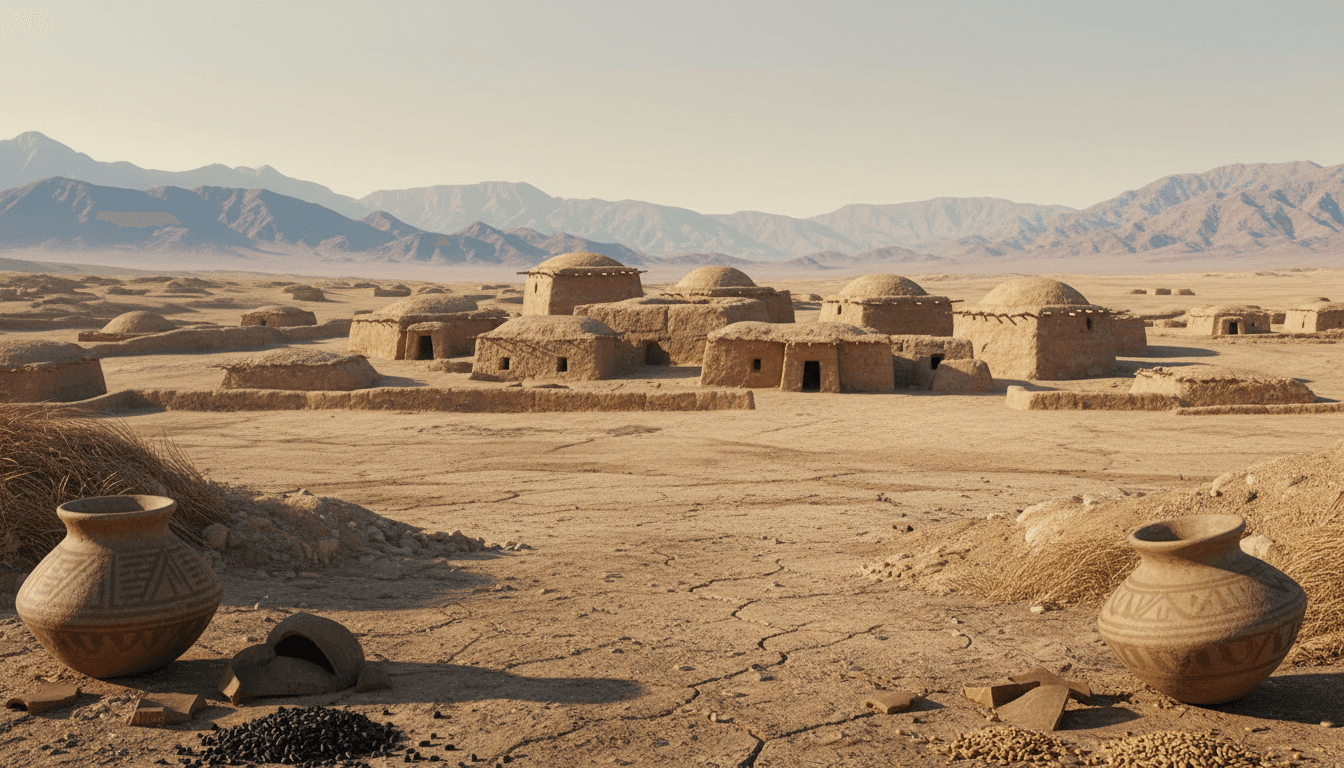
How Mehrgarh Changes the Story of Early Farming in South Asia
An evidence-led guide to Mehrgarh, its 2025 radiocarbon redating, farming and craft evidence, drilled teeth, Indus connections and UNESCO Tentative List status.
Mehrgarh is one of South Asia's most important early farming and settlement sites, located on the Kachhi plain near the Bolan Pass. UNESCO's Tentative List entry describes a sequence from the seventh to the third millennium BCE and an archaeological area of about 250 hectares. Search results often call it a UNESCO World Heritage Site, but that is incorrect: Mehrgarh remains on Pakistan's Tentative List and is not inscribed on the World Heritage List. This guide explains what archaeology can show about changing settlement, crops, herding, craft and exchange, while avoiding the myth of a single sudden civilization or a direct ethnic label for people who lived thousands of years before modern identities.
Key points
- Mehrgarh is on Pakistan's UNESCO Tentative List, not the World Heritage List.
- Its long sequence records changing settlement, subsistence and craft practices rather than one uniform Neolithic moment.
- The site's position near the Bolan corridor helps frame exchange, but movement must be demonstrated through materials and context.
- Modern ethnic, national or religious identities should not be projected directly onto prehistoric communities.
Location on the Kachhi plain
Mehrgarh lies in Balochistan's Kachhi plain close to approaches through the Bolan Pass. The setting links upland routes with plains leading toward the Indus system. That geography makes movement and exchange plausible, but archaeology must establish particular connections through stratified objects, materials, plant remains, animals and technologies. A map arrow alone cannot prove a migration or trade network.
The UNESCO Tentative List submission gives an area of roughly 250 hectares and situates the site in a wider archaeological landscape. Site boundaries, excavated trenches and the full ancient settlement are not identical. Visitors and writers should not assume that visible mounds represent every occupation phase or that an unexcavated area is empty.
A sequence from the seventh to third millennium BCE
UNESCO's site description places Mehrgarh's sequence broadly between the seventh and third millennia BCE. Archaeologists divide that span into periods based on architecture, burial practice, ceramics, tools and other material changes. Period labels are analytical tools; they do not mean that every household changed at the same moment or that one population simply replaced another.
Early levels are frequently described as aceramic Neolithic because pottery was absent from the documented assemblage while settled life, cultivation and herding were present. Later phases contain pottery and increasingly varied craft evidence. The words early, first and oldest should always specify the region, evidence and dating method instead of turning the site into a competitive superlative.
Farming, herding and household life
Plant and animal remains support research into cultivation and herding, while mud-brick buildings, storage and burials help reconstruct settlement organization. These materials show practices over time, not a single invention event. Domestication itself is a long biological and social process, and the presence of a species does not reveal who controlled production without further context.
Burials and ornaments can document care, craft and difference, but they do not translate automatically into modern ranks, religions or gender roles. Interpretation should identify the sample, preservation and comparison. Human remains require ethical handling, clear collection history and attention to the responsibilities of museums and archaeological authorities.
Craft, dentistry and claims of innovation
Mehrgarh is known for evidence of bead making, ceramics, metallurgy in later phases and drilled human teeth discussed in archaeological research. Such findings are often rewritten online as the invention of dentistry. A responsible description names the excavated specimens, dates, tool marks and scholarly interpretation. It does not claim a modern profession existed in identical form.
Craft materials can reveal technical skill and exchange when their geological or botanical origins are established. Similar-looking beads are not proof that two distant sites traded directly; materials may pass through several communities. Publication context, stratigraphy and laboratory analysis matter more than a viral image of an isolated object.
Excavation history and preservation
The UNESCO submission records major excavation campaigns from 1974 to 1986 and renewed work from 1996. Archaeological knowledge therefore comes from specific teams, methods and publication histories. Older field records may use different coordinates, chronologies or conservation standards from current work. A good summary identifies the excavation rather than presenting every claim as timeless consensus.
Erosion, looting, construction and inadequate storage can separate objects from the context that gives them meaning. Preservation includes the site, field notes, photographs, samples and collections. Public interest should not encourage collecting pottery or entering restricted areas. Context lost through souvenir removal cannot be recreated.
Understanding the UNESCO status
Pakistan placed Mehrgarh on its Tentative List, a preliminary national inventory used before a possible World Heritage nomination. UNESCO's Pakistan page and Committee decision records show that the site is not currently inscribed. A Tentative List entry is important evidence of recognized potential, but it is not a World Heritage designation or a guarantee of later inscription.
Use direct links to the Bolan guide for corridor geography and to the Balochistan page for current administration. Keep the prehistoric site separate from the modern province's ethnic and political categories. That distinction protects both archaeological accuracy and the living identities of communities in Balochistan today.
What the new tooth-enamel dates actually measured
The 2025 project targeted carbonate in human tooth enamel because enamel can preserve a datable carbon signal when bone collagen is poorly preserved. The researchers used accelerator mass spectrometry and compared results from vertically ordered graves. They excluded or treated problematic measurements with care, including samples that did not fit the stratigraphic sequence. The dates were then modelled together rather than reduced to a single isolated number. This combination of laboratory measurement, burial position and Bayesian modelling is why the paper changes the chronological argument.
Direct does not mean infallible. Carbon incorporated into teeth can be influenced by diet, and the authors discuss possible reservoir effects. Different teeth also form during different parts of childhood, so their measurements refer to people rather than to the exact day a grave was dug. The model produces probability ranges, not a precise foundation year for Mehrgarh. Reporting the ranges preserves what the method can support and prevents a scientific revision from becoming a new false certainty.
Farming evidence without an origin myth
Mehrgarh has long been central to arguments about how cultivation and herding developed east of the Iranian plateau. Botanical and faunal remains, storage, mud-brick architecture and changing settlement practices all contribute, but no single seed or animal bone can explain the process by itself. Identification, stratigraphic context and signs of morphological change matter. The presence of wheat, barley or managed animals can show food-producing practices without proving that every species was domesticated locally or that an entire economic system arrived in one migration.
The 2025 chronology strengthens the need to compare Mehrgarh with neighbouring regions rather than naming it the first farm in South Asia by default. If its securely dated early community belongs mainly to the early fifth millennium BCE, some older diffusion timelines require re-evaluation. That does not make the site unimportant. It makes Mehrgarh more valuable as a test case for how farming packages were selected, adapted and reorganized across highland and plain environments. A later date changes the historical question from an isolated beginning to the timing and mechanism of regional interaction.
Drilled teeth show intervention but not modern dentistry
A 2006 Nature report identified 11 drilled molar crowns belonging to nine adults from the Neolithic cemetery. Microscopic wear around some cavities indicated that the drilling occurred while the individuals were alive. Experimental work showed that a bow-driven flint point could make comparable holes quickly. The finds are strong evidence of deliberate work on human teeth and of technical knowledge derived from drilling beads or other small materials.
They do not reveal a dental profession, anaesthesia, a theory of decay or a standard therapeutic procedure. Some drilled teeth showed decay, while the purpose of every intervention remains uncertain. The report used the term “proto-dentistry” to describe an early practice, not to claim institutional continuity with a present-day clinic. Because the teeth came from burial contexts assigned under the older Mehrgarh chronology, their absolute dating should also be read alongside the 2025 redating instead of copied from older summaries without qualification.
Cotton in a copper bead and the problem of legacy dates
A mineralized fibre bundle preserved inside a copper bead from a Mehrgarh burial was identified as cotton in a 2002 Journal of Archaeological Science paper. Reflected-light microscopy and scanning electron microscopy allowed the researchers to examine fibre structure even though the organic material had been mineralized. The find is important evidence for very early cotton use and for a composite object in which fibre, copper and bead-making knowledge came together.
The paper described the burial as sixth millennium BCE under the chronology available at the time. The 2025 redating means that this absolute age should now be reassessed against the exact grave's position and any new model assignment. The fibre identification and the old calendar estimate are separate claims: a changed chronology does not make the cotton disappear, but it can alter where the object sits in regional history. The study also could not determine whether the fibre came from a domesticated cotton species. “Cotton was present” is better supported than “Mehrgarh invented cotton cultivation.”
Beads, glaze and exchange require contextual proof
Studies of glazed steatite beads from Mehrgarh and nearby Nausharo use microscopy, chemistry and manufacturing traces to ask how small objects were shaped, fired and coated. A bead is therefore more than decoration: its raw material, surface treatment and production debris can reveal a technical sequence. Similar techniques across sites may indicate shared knowledge, movement of specialists or exchange, but resemblance alone cannot identify a direct trading partner.
Mehrgarh's position near the Bolan corridor makes connections between uplands and plains plausible. Archaeological proof still depends on dated contexts, geological sourcing and repeated patterns. Maps that draw an uninterrupted arrow from western Asia to the Indus valley compress centuries of local decisions into a single route. The more defensible account distinguishes the movement of material, the transfer of a technique and the movement of people, because those processes can occur together or independently.
How Mehrgarh relates to the later Indus tradition
Mehrgarh predates the urban Indus or Harappan phase, and later levels participate in wider traditions of ceramics, ornaments, metallurgy and settlement across the region. This long record helps archaeologists study change before cities such as Mohenjo-daro and Harappa reached their mature urban form. It does not establish a straight evolutionary ladder in which one village inevitably became one civilization. Occupations shifted, regional centres changed and communities adopted practices unevenly.
The safest relationship is historical rather than genealogical: Mehrgarh supplies evidence for prehistoric lifeways and technologies in a region that later supported Indus urbanism. Specific continuities have to be demonstrated feature by feature. Modern national, ethnic and religious identities cannot be projected onto unnamed prehistoric inhabitants, and archaeological importance does not give any present community exclusive descent or ownership. That boundary keeps the site informative without turning it into a modern origin claim.
UNESCO Tentative List status explained
Pakistan added the Archaeological Site of Mehrgarh to its Tentative List in 2004. A Tentative List is a state's inventory of places it may consider nominating in the future. It is a prerequisite for a normal World Heritage nomination, but it is not inscription, does not create a World Heritage property and does not guarantee that a nomination will be submitted or accepted. UNESCO's current Pakistan page lists Mehrgarh among tentative sites, while Pakistan's inscribed properties appear separately.
The status matters for search accuracy because many summaries collapse “listed by UNESCO” into “UNESCO World Heritage Site.” For Mehrgarh, the exact phrase is “on Pakistan's UNESCO Tentative List.” The official entry is still useful for location, site extent, excavation history and the rationale proposed by the state party. Its older chronology should be labelled as the submission's framework, not used to override later scientific dating.
How to read the evidence
Official statistics, government plans, UNESCO submissions, museum records and tourism pages answer different questions. Keep each source's geography, reference date, institutional role and uncertainty visible. Current access, weather, transport and security conditions must be checked close to the intended date.
Related Balochistan reading
- Balochistan Province: Map, Districts, Population and Geography
- Bolan Pass: Geography, History and the Route to Quetta
- Quetta City: History, Geography, Population and Culture
- Ziarat, Pakistan: Juniper Forest, Heritage Status and Ecology
Sources
- UNESCO World Heritage Centre, Archaeological Site of Mehrgarh — Pakistan's 2004 Tentative List submission provides the official status, proposed site area, excavation history and the older seventh-to-third-millennium chronological framework.
- UNESCO World Heritage Centre, Pakistan state party profile — The live country inventory separates inscribed World Heritage properties from tentative sites and confirms that Mehrgarh is not currently inscribed.
- Scientific Reports, New radiocarbon dates of human tooth enamel reveal a late appearance of farming life in the Indus Valley — The 2025 peer-reviewed study reports 23 burial dates, stratigraphic modelling, probability ranges and the revised Period I chronology of about 5250–4650 calibrated BCE.
- Muséum national d'Histoire naturelle, study revising Mehrgarh's Neolithic chronology — The research institution explains the samples, enamel-dating approach and historical implications of the 2025 chronology in accessible form.
- Nature, Early Neolithic tradition of dentistry — This archaeological report documents 11 drilled molars from nine adults, microscopic evidence of drilling during life and experimental comparison with flint tools.
- Journal of Archaeological Science, First evidence of cotton at Neolithic Mehrgarh, Pakistan — The paper identifies mineralized cotton fibres inside a copper bead, describes the microscopy and states the limits on species-level domestication claims.
- Materials Research Society proceedings, Glazed steatite beads from Mehrgarh and Nausharo — The materials study supports the discussion of manufacturing sequence, glaze technology and the need to distinguish technical evidence from assumed direct trade.
- Syria review of Mehrgarh Field Reports 1974–1985 — This bibliographic record situates the major excavation publications and helps readers trace the field reports behind the site's established periodization.


