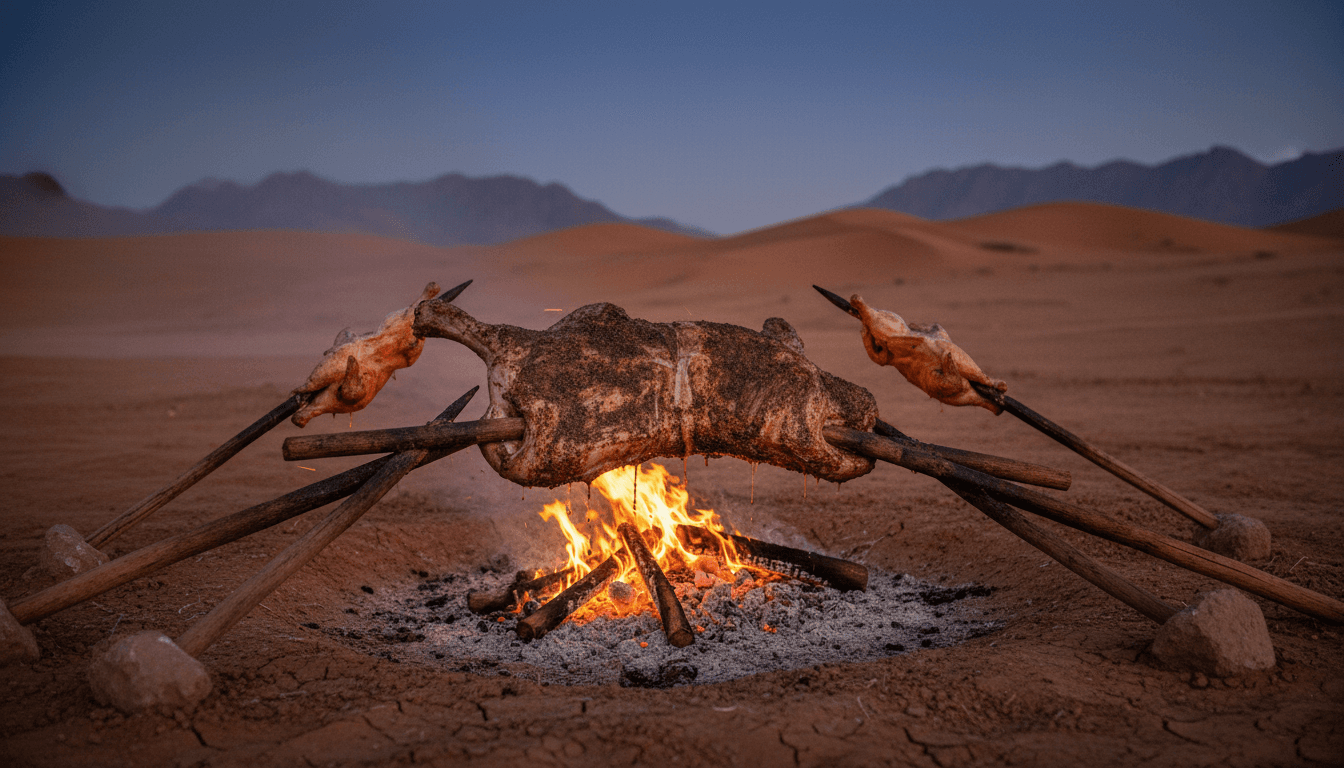
Sajji: Balochistan Food, Preparation, History and Regional Variations
A documented guide to Sajji from Balochistan, explaining whole-lamb or chicken preparation, salt, coal roasting, rice and bread accompaniments, urban variations and food-safety principles.
Sajji is strongly associated with Balochistan and appears in Pakistan's National Register of Intangible Cultural Heritage. The register describes whole lamb or chicken roasted on skewers over coals, usually seasoned simply with salt, sometimes prepared with green papaya, and served with rice or breads such as kaak, rot or naan. That institutional description is a useful baseline, not one compulsory recipe. Household, pastoral, restaurant and city versions differ in meat, stuffing, seasoning, equipment and desired doneness. This guide explains the method and cultural context while refusing two common errors: calling every spiced roast Sajji and treating one restaurant version as the only authentic form.
Key points
- Pakistan's national intangible-heritage register identifies Sajji with Balochistan and documents a core coal-roasting method.
- Lamb and chicken versions, stuffing, papaya, seasoning and finishing practices vary by place and cook.
- Authenticity is best documented through named cooks, communities, occasions and techniques rather than a universal ingredient list.
- Whole-animal and poultry cooking require calibrated temperature checks and safe handling, regardless of customary timing cues.
What the national heritage register documents
Pakistan's national register places Sajji in the traditional-cuisine domain and associates it with Balochistan. Its entry describes a whole lamb or chicken placed on skewers, salted, sometimes treated with green papaya, stuffed with rice and roasted over coals. It also names breads served alongside and notes urban regional variations. These details provide a cited institutional description.
A register entry does not freeze living food. It selects features for national documentation and may compress differences among Baloch, Brahui, Pashtun, urban and other cooks. Use it as a reference point, then record the person, place, occasion and method for a particular meal.
Meat, salt, heat and time
The visual signature of Sajji is meat cooked around radiant heat rather than chopped pieces buried under a heavy sauce. Salt-forward seasoning lets meat and smoke remain prominent in many versions. Green papaya contains enzymes that can tenderize meat, but quantity and time affect texture. Its presence should be described as a variation where documented, not a universal requirement.
Traditional cooks judge heat, distance and doneness through experience with animal size and equipment. A written recipe must add measurable food-safety checks. Poultry and whole-animal interiors can heat unevenly; use a calibrated thermometer at the appropriate thickest points, avoid cross-contamination and follow current public-health guidance for safe internal temperatures.
Rice, kaak and the structure of the meal
Some Sajji preparations include rice inside the carcass, while others serve rice separately or emphasize bread. The national register names kaak, rot and naan as accompaniments. Those terms can cover local forms and spellings. A recipe should explain the specific bread used rather than translating every one as generic flatbread.
Serving method also carries social meaning: meat may be cut by a cook, shared from platters or presented restaurant-style. Hospitality, celebration and group eating cannot be reconstructed from ingredients alone. Photographs should identify whether they show a family occasion, commercial service or staged demonstration.
Balochistan origin and national spread
Sajji is now sold widely across Pakistan. City restaurants often use chicken, add lemon or spice after roasting, or adapt equipment to a compact kitchen. That spread demonstrates popularity and change. It does not erase the dish's association with Balochistan, but neither does the name guarantee that a restaurant follows a particular provincial method.
Food-history claims should be modest unless supported by dated menus, household records, travel accounts or oral histories. Origin can refer to a broad regional association rather than one inventor or exact year. Ask older cooks how they learned the method and preserve variation instead of editing testimony into a single origin legend.
How to document a Sajji recipe responsibly
Record meat type and weight, cut or whole form, salt quantity, tenderizer, stuffing, fuel, skewer position, heat distance, cooking time, target temperature, resting and accompaniments. Credit the cook and obtain consent before publishing family techniques or faces. If a step is inferred from video, label it as an observation rather than the cook's explanation.
Translation matters. Retain local dish and bread names on first use, then add a description. Do not replace them with a globally familiar food that only looks similar. Ingredient availability and halal sourcing should be explained for the intended audience without suggesting that one certification system defines every community's practice.
Food as part of the Balochistan topic centre
Direct links to Balochistan and Quetta give geographic and urban context; the dress page offers a parallel example of a living practice that varies across makers and regions. The Kund Malir–Hingol guide connects food travel writing with the realities of remote facilities, where visitors should not assume a meal or water will be available.
Sources in this article have different roles. The heritage register documents an official element, the census report supplies a dated provincial description, and current government and tourism pages show institutional framing. None replaces interviewing cooks or testing a recipe safely. Keeping those roles separate produces useful search content without manufacturing certainty.
How to read the evidence
Official statistics, government plans, UNESCO submissions, museum records and tourism pages answer different questions. Keep each source's geography, reference date, institutional role and uncertainty visible. Current access, weather, transport and security conditions must be checked close to the intended date.
Related Balochistan reading
- Balochistan Province: Map, Districts, Population and Geography
- Quetta City: History, Geography, Population and Culture
- Balochi Traditional Dress: Embroidery, Pashk and Cultural Context
- Kund Malir and Hingol: Makran Coast, National Park and Pilgrimage Landscape
Sources
These sources are linked for verification. A UNESCO Tentative List entry is not a World Heritage inscription, a budget line is not proof of completion, and an institutional plan is not an observed outcome.
- Pakistan National Heritage and Culture Division — National Register of Intangible Cultural Heritage — National register entry identifying Sajji as Balochistan traditional cuisine and describing its core preparation and regional variants.
- Pakistan Bureau of Statistics — Provincial Census Report Balochistan 2017 — Official provincial reference with brief descriptions of local cuisine and dress; use as a dated institutional description, not a complete ethnography.
- Government of Balochistan — Provincial portal — Official provincial overview and government information, including the province's area and administrative context.
- Balochistan Bureau of Statistics — Statistics and district profiles — Official statistics hub with district profiles and provincial indicators; administrative listings may post-date the 2023 census reference date.
- National Tourism Portal — Tourist attractions in Pakistan — Official national attraction directory with Balochistan entries including Hingol and Gwadar.
- Pakistan Bureau of Statistics — Provincial Census Report 2023: Balochistan — Official provincial report describing census geography, population and settlement patterns at the reference date.


