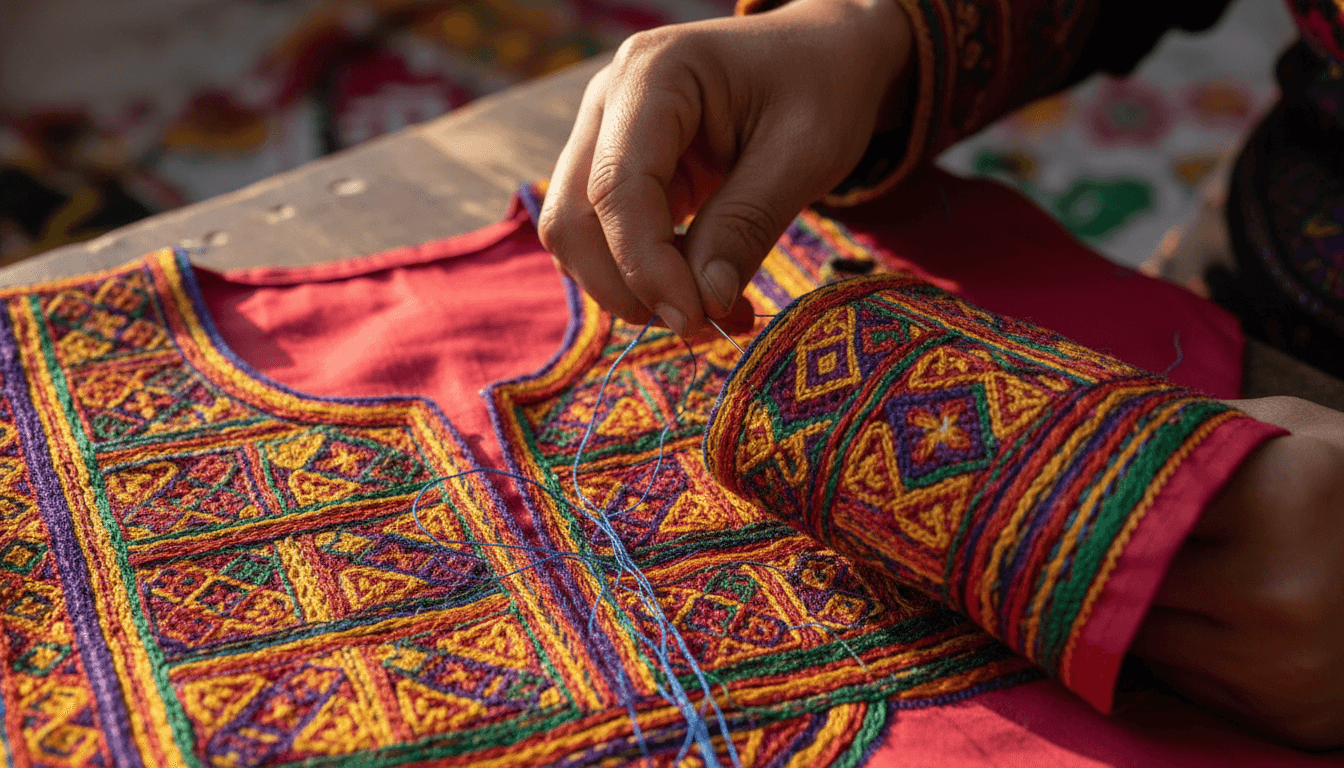
Balochi Traditional Dress: Embroidery, Pashk and Cultural Context
A museum- and textile-based guide to Balochi dress, including the embroidered pashk, panel placement, men's clothing, regional variation, maker credit and the wider Baluch cultural geography.
Balochi dress is recognized for generous silhouettes and highly worked embroidery, especially on women's garments, yet there is no single timeless outfit worn identically across Baloch communities. The Horniman Museum records a specific Balochistan pashk with embroidered front and cuff panels; the Textile Research Centre describes named panel positions; Encyclopaedia Iranica documents related traditions across the broader Baluch region spanning parts of Pakistan, Iran and Afghanistan. These sources show why a garment needs maker, owner, place, date, material and use. This guide treats embroidery as skilled knowledge and labour, not as a pattern that can be detached from women artisans without credit.
Key points
- Pashk and other clothing terms should be retained with regional spelling and an explanation rather than forced into one English category.
- Embroidered chest, cuff and pocket panels have identifiable construction roles, but designs vary by maker, region and period.
- Baloch cultural geography crosses modern borders; evidence from Iran or Afghanistan must not be mislabeled as Pakistan's province.
- Cataloguing should credit makers and distinguish hand embroidery, machine work, repair, commercial adaptation and contemporary design.
The pashk as a documented garment
The Horniman Museum's item record describes a woman's pashk from Balochistan made of shot silk, with coloured-silk embroidery, long sleeves, gussets, braid and geometric panels. This is strong object-level evidence because it records a specific garment and museum number. It is not a complete template for every Balochi woman's clothing.
Names vary in spelling across Balochi dialects, neighbouring languages and English catalogues. Preserve the source spelling, local pronunciation if documented and the garment's component names. Translating pashk only as dress can help a general reader but loses a searchable cultural term, so both should appear together.
Embroidery panels, stitches and construction
The Textile Research Centre describes a characteristic arrangement of embroidery on the chest or yoke, central strip, sleeve cuffs and a long pocket panel. Museum garments let readers verify placement and construction. Those structural similarities do not make every motif universal; colours, density, mirror work, thread and geometry can vary widely.
A close photograph should be linked to the whole garment, reverse where available, scale, material and repair history. Motif meanings are often assigned confidently by sellers. Record the artisan or community who supplied an interpretation and avoid inventing symbolism from geometric resemblance.
Men's clothing and the danger of one costume image
Official provincial descriptions note loose shalwar, long shirts and turbans among men's clothing, with variation among Baloch, Brahui and Pashtun communities. Cut, volume, cloth, headwear and occasion change with place and fashion. A festival group photograph may show coordinated presentation rather than daily clothing.
Women's embroidery receives more visual attention, which can make men's dress seem uniform and can hide the labour of female makers. A balanced record asks who cut, sewed, embroidered, purchased and wore each piece. Clothing is an economy and relationship as well as an identity symbol.
A cultural region larger than one province
Baluch communities live across parts of Pakistan, Iran and Afghanistan and in diaspora settings. Encyclopaedia Iranica and the Textile Research Centre document this wider geography. Their objects and terminology should not be relabelled automatically as products of the Pakistani province of Balochistan. Modern borders, museum provenance and cultural affiliation are different fields.
Within Pakistan, Quetta markets and institutions can bring together Baloch, Brahui, Pashtun and urban fashions. A design purchased in Quetta may have been made elsewhere. Record maker location separately from purchase location and wearer's identity; collapsing them creates false regional maps.
Contemporary design, markets and artisan credit
BUITEMS' textile exhibition in Quetta documents students and faculty working with traditional Balochi embroidery and contemporary design. Such projects show continuity through adaptation rather than a choice between authentic past and modern fashion. The relevant questions are who participated, how motifs were sourced and whether artisan knowledge was credited and compensated.
Commercial demand can support livelihoods while encouraging copied patterns, machine imitation and anonymous labour. Product descriptions should disclose hand and machine processes, materials, production location, custom work and lead time. Cultural respect is not guaranteed by adding the word traditional to a mass-produced item.
A responsible garment record
Catalog maker, wearer or owner, local name, place made, place acquired, date, fibers, weave, cut, seams, panels, stitches, mirrors or beads, dimensions, condition, repairs, occasion, consent and image rights. If provenance is uncertain, say so. Do not publish a vulnerable family's location merely to make an object history appear complete.
Link directly to the Balochistan and Quetta guides for geographic context, and to Sajji for another living tradition whose regional association does not erase variation. Ziarat adds a highland setting but should not be used to assign a forest district's identity to every garment. Object-level evidence keeps the cluster explanatory rather than decorative.
How to read the evidence
Official statistics, government plans, UNESCO submissions, museum records and tourism pages answer different questions. Keep each source's geography, reference date, institutional role and uncertainty visible. Current access, weather, transport and security conditions must be checked close to the intended date.
Related Balochistan reading
- Balochistan Province: Map, Districts, Population and Geography
- Quetta City: History, Geography, Population and Culture
- Sajji: Balochistan Food, Preparation, History and Regional Variations
- Ziarat, Pakistan: Juniper Forest, Heritage Status and Ecology
Sources
These sources are linked for verification. A UNESCO Tentative List entry is not a World Heritage inscription, a budget line is not proof of completion, and an institutional plan is not an observed outcome.
- Horniman Museum and Gardens — Woman's dress from Balochistan — Item-level museum record documenting construction, silk, embroidered panels and geometric designs on a specific pashk.
- Textile Research Centre Leiden — Baluch embroidery — Textile reference explaining named embroidered panels and the wider geographic range of Baluch clothing traditions.
- Encyclopaedia Iranica — Clothing of the Baluch — Scholarly reference on clothing and embroidery across the broader historical Baluch region, not only Pakistan's province.
- BUITEMS — Textile Exhibition Weaves Tradition with Modern Design — Quetta university record of student and faculty work involving Balochi embroidery and contemporary textile design.
- Pakistan Bureau of Statistics — Provincial Census Report Balochistan 2017 — Official provincial reference with brief descriptions of local cuisine and dress; use as a dated institutional description, not a complete ethnography.
- Government of Balochistan — Provincial portal — Official provincial overview and government information, including the province's area and administrative context.


