How the Great Mosque of Kairouan Took Shape
Trace the Great Mosque of Kairouan from its early foundation through Aghlabid rebuilding, and read its courtyard, minaret, mihrab and minbar as evidence from different centuries.
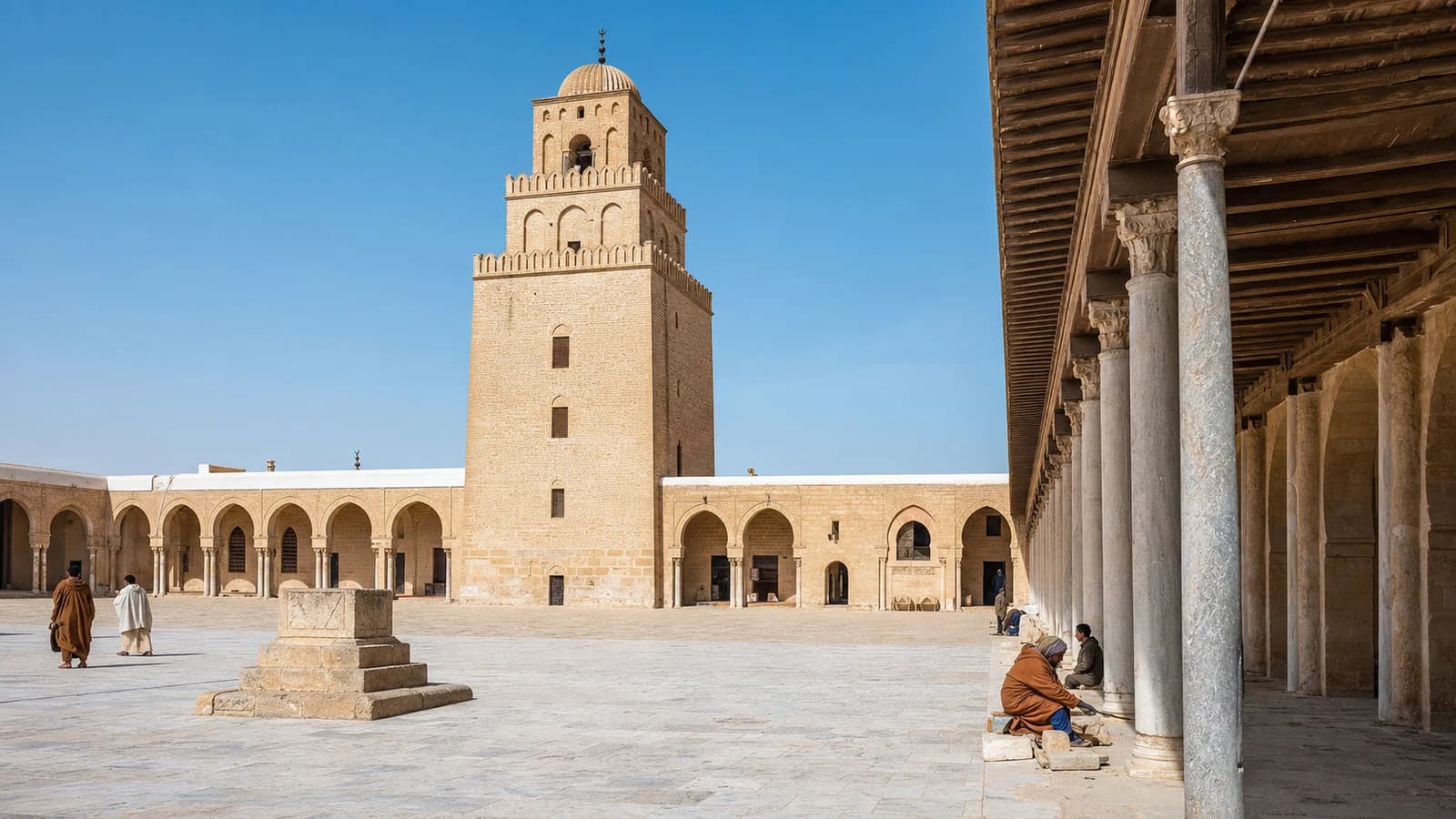
The city of Kairouan and its monuments are inscribed on UNESCO’s World Heritage List. Its heritage description calls the Great Mosque, rebuilt in the ninth century, a major monument and identifies the flagstone courtyard, porticoes, marble and porphyry columns, and three-storey minaret. The image above this article is an educational architectural reconstruction, not a photograph of the mosque or a measured reconstruction of any single construction phase.
Was the mosque founded in 670 or built in 836?
Both dates appear because they refer to different things. The Museum With No Frontiers monument record, prepared by Mohamed Béji Ben Mami, associates the site’s first Muslim prayer place with ʿUqba ibn Nāfiʿ in 670. It then describes renovations and enlargements in the eighth century before a major rebuilding commissioned by the Aghlabid ruler Ziyādat Allāh I in 836. The record states that the rebuilt mosque assumed dimensions close to the present monument’s footprint.
“Founded in 670” therefore speaks to the site’s remembered beginning. “Rebuilt in 836” speaks to the medieval fabric and plan that dominate what a visitor encounters. Neither phrase proves that the existing minaret, roof beam, carved panel and tile have survived unchanged from one of those dates. The ICOMOS evaluation supplied through UNESCO likewise describes the Great Mosque as rebuilt in the ninth century. It evaluates Kairouan as a city with several monuments, so the World Heritage inscription should not be presented as a certificate dating each part of the mosque to 836.
The site was maintained and repaired after the Aghlabid period. That matters because a standing monument is a record of use, repair and replacement as well as initial design. A reader looking for the “original mosque” cannot simply peel back one later decorative layer and expect the 670 prayer place to appear intact. The sounder question is which dated source and physical feature support a claim about a particular phase.
How do courtyard and prayer hall organize the building?
The northern court is a large open space bordered by porticoes, with the square minaret facing the prayer hall across it. The hall is a hypostyle space: a roof is carried by rows of columns and arches rather than by one uninterrupted span. UNESCO notes its marble and porphyry columns; the Museum With No Frontiers record describes many reused ancient columns and capitals in the hall and galleries. Reuse is visible evidence of material history, but a column’s ancient origin does not by itself identify the exact building from which it was taken.
The arrangement is easier to read as a route than as a list of famous features. From the courtyard a worshipper approaches the hall, moves through its repeated bays and reaches the wall oriented for prayer. The middle aisle and the bay along that wall emphasize the zone before the mihrab, the prayer niche. The Museum With No Frontiers description records this meeting of axes and a dome above the niche area. Our hypostyle mosque plan guide explains the general plan; Kairouan is one named, dated example of how that plan was built.
The source’s English measurements of the monument and hall do not agree neatly with one another, so this article does not use them to calculate an exact area or congregation size. The physical reading—court, porticoes, aisles and niche—does not require a questionable number. If precise dimensions matter, they should come from a consistent survey that states what was measured and whether later walls were included.
What can the minaret tell us?
The minaret stands opposite the prayer hall on the courtyard’s northern side. UNESCO describes it as a massive square, three-storey tower that interrupts the portico line. The Museum With No Frontiers record also notes its three stages and heavy proportions. This placement makes the tower a strong marker in the approach to the mosque and in Kairouan’s skyline.
Architectural historians compare its form with later towers in North Africa, but “influenced every western minaret” would go further than these sources prove. A later tower may share a square base or stepped silhouette for more than one reason; a documented chain of designers and buildings is stronger evidence of direct borrowing than shape alone. The tower’s visible masonry also should not be labeled defensive brickwork without a structural study of this particular building. The old text on this page used that claim without a supporting source.
Visitors often see minarets as the most recognizable part of a mosque, yet the tower cannot explain the hall’s liturgical arrangement on its own. Our guide to mosque architecture terms distinguishes minaret from mihrab, minbar and qibla wall. Keeping the terms separate lets a reader ask the right chronological question for each component.
Why is the mihrab more than one kind of evidence?
The mihrab marks the direction of prayer in the hall. Its present ornament includes carved marble, a painted wooden half-dome and lustre tiles around the niche. The Museum With No Frontiers monument record assigns the decorated mihrab to the period of the Aghlabid prince Abū Ibrāhīm Aḥmad, around 862, after the 836 rebuilding. That sequence is central: the large plan and the decorated niche are related parts of the building, but their recorded dates differ.
The tiles are an unusually useful test of the relationship between style and place of manufacture. A metallic lustre surface can look different in diffuse light and reflection. The 2003 Archaeometry study by O. Bobin and colleagues analyzed eight Kairouan tile samples and four Mesopotamian comparison pieces. Its conclusion is probabilistic: the tested Kairouan tiles probably came from a major Mesopotamian production centre, with Baghdad, Samarra or Basra possible. The analysis does not identify one certain workshop for every tile in the surround.
The Qantara cultural heritage entry on the mihrab documents the niche as an object of study in its own right. Read together, the monument record, the specialist entry and the chemical comparison show why “Aghlabid decoration” and “all materials manufactured locally” are not equivalent claims. Patronage, installation, artistic choices and the origin of a ceramic surface can involve different places.
What survives of the ninth-century minbar?
The minbar is the pulpit associated with preaching, placed near the mihrab. The Museum With No Frontiers monument record describes Kairouan’s carved wooden minbar as a remarkable ninth-century survival. A separate Raqqada Museum carved-wood fragment record ties a particular piece to that pulpit and assigns it to the time of Abū Ibrāhīm Aḥmad. The fragment’s vegetal carving is direct material evidence; the catalog’s proposed cultural influences are an interpretation of its forms.
That object record also warns against a neat origin story. It says historical suggestions that the pulpit was made in Baghdad are unclear, and proposes that Ifriqiyan craftsmen may have carved imported teak, subject to the wood’s origin being established. A timber species, a route of supply and a place of carving are three different questions. Calling the whole pulpit “made in Baghdad” or “certainly made in Kairouan” skips the catalog’s stated uncertainty.
The fragment’s modern history matters as well. The Raqqada record says pieces were removed during work on the pulpit around 1920 and later kept with the mosque’s relics before museum display. An object now in a museum can be evidence for a building still standing elsewhere, but its present location is not its original setting. Readers can compare the museum’s accession account with the monument description rather than relying on a single decorative photograph.
Which details belong to later centuries?
The Museum With No Frontiers record dates the richly lettered wooden maqṣūra, a screened enclosure beside the minbar, to the Zirid ruler al-Muʿizz ibn Bādīs in the eleventh century. It is part of the mosque’s historical ensemble, but not evidence that every surviving wooden furnishing was installed in 836. Later roof repairs and restorations likewise mean that age should be assigned to documented components rather than to all visible timber at once.
This is why an apparently unified interior can hold several chronologies. A column may be older than Islam, the current plan may be rooted in the ninth-century rebuilding, the mihrab decoration may be associated with the 860s, and the maqṣūra may belong to the eleventh century. Those dates do not contradict one another; they answer questions about different objects. What would be misleading is a caption that gives the entire scene a single construction year without qualification.
The same principle applies across Tunisia. Our account of the Zaytuna Mosque in Tunis concerns another institution with its own building and teaching history. Comparing the two can help readers ask what a mosque contributed to urban life, but it cannot transfer Kairouan’s mihrab tiles, minbar date or restoration sequence to Tunis.
How should a visitor read an image of the mosque?
First identify the view. A courtyard image shows porticoes, paving and the tower; it cannot display the mihrab’s material in detail. An interior image can show columns and the niche but may not reveal which capitals are reused or when a roof was repaired. A close-up of one tile can show glaze and decoration but not prove the date of every surrounding wall. The guide to mosque courtyards supplies vocabulary for the sahn without substituting a generic courtyard description for Kairouan’s own records.
Second check whether the image is an actual photograph, a drawing, a modern reconstruction or a museum object removed from the site. The header image used here is an original educational reconstruction; it cannot certify a precise ninth-century façade, an original arrangement of every vessel or the condition of the monument today. A dated institutional photograph or measured plan should carry those claims.
Finally, tie a statement to the source that could actually establish it. UNESCO supports the site’s heritage designation and major spatial features. The Museum With No Frontiers catalog provides a component-by-component chronology. The Raqqada fragment provides direct evidence for a piece of carved wood. Bobin and colleagues provide an analytical inference about sampled tiles. A careful account of the Great Mosque of Kairouan keeps those evidence types together without pretending they are identical.
Sources
- UNESCO World Heritage Centre, Kairouan — inscription and site description for the ninth-century rebuilding, courtyard, porticoes, columns and three-storey minaret; World Heritage status does not independently date every component.
- ICOMOS, Kairouan advisory evaluation, hosted by UNESCO — heritage assessment of the city and its monuments, including the Great Mosque’s ninth-century rebuilding; counted with UNESCO as one institutional source.
- Mohamed Béji Ben Mami, “Great Mosque of Kairouan,” Museum With No Frontiers — monument catalog for successive construction, courtyard and hall arrangement, mihrab, minbar and later maqṣūra. Conflicting English dimension figures are not repeated.
- Mourad Rammah, carved-wood fragment from the Kairouan minbar, Raqqada Museum / Museum With No Frontiers — object record for a surviving pulpit fragment, its removal and display history, and the limits of proposed wood and workshop origins.
- O. Bobin and colleagues, “Where Did the Lustre Tiles of the Sidi Oqba Mosque in Kairouan Come From?”, Archaeometry 45, 2003 — original physicochemical comparison of eight Kairouan and four Mesopotamian samples; supports a probable Mesopotamian origin, not one proven workshop.
- Qantara Mediterranean Heritage, mihrab of the Great Mosque of Kairouan — object-focused record for the decorated prayer niche, used to separate its material evidence from the date of the whole building.
- Khan Academy, “The Great Mosque of Kairouan” — art-history teaching overview with site photography and plan vocabulary; used for orientation, not as a substitute for the monument and object records.


