Zaytuna Mosque: Architecture, Teaching and Tunis
How Zaytuna Mosque grew through successive building phases, anchored the medina of Tunis and supported teaching without resembling a modern campus.
The Zaytuna Mosque, situated at the heart of the medina of Tunis, is a historic congregational mosque that served as a vital hub for architectural development and Islamic scholarship in North Africa.
Foundation and Aghlabid Reconstruction
Traditional accounts attribute the foundation of the Zaytuna Mosque to the early Islamic period. However, the physical fabric of the mosque today is largely defined by a major reconstruction carried out in the ninth century under the Aghlabid dynasty. This rebuilding established the core layout of the mosque, including its rectangular courtyard and its hypostyle prayer hall, aligning it with regional architectural styles.
The mosque’s prayer hall features rows of reused columns, which were salvaged from older structures. These columns support arches that divide the hall into multiple aisles. Over the centuries, the building underwent significant modifications under successive Hafsid, Ottoman, and modern interventions, making the modern structure a complex composite of different historical eras rather than a single-period monument.
The Medina Context and Urban Fabric
Unlike isolated monumental complexes, the Zaytuna Mosque is deeply integrated into the dense urban fabric of the Tunis medina. The outer walls of the mosque are directly bordered by the street and market fabric of the medina, which specialize in various trades. This close physical proximity reflects the historical connection between religious authority, education, and commercial life in the city.
The mosque’s entrances open directly onto these narrow market streets, making it an accessible sanctuary for merchants, shoppers, and travelers. The integration with the surrounding markets ensured that the mosque remained the physical anchor of Tunis for centuries, with the building physically embedded within the daily commerce of the surrounding souks.
The System of Learning and Scholarship
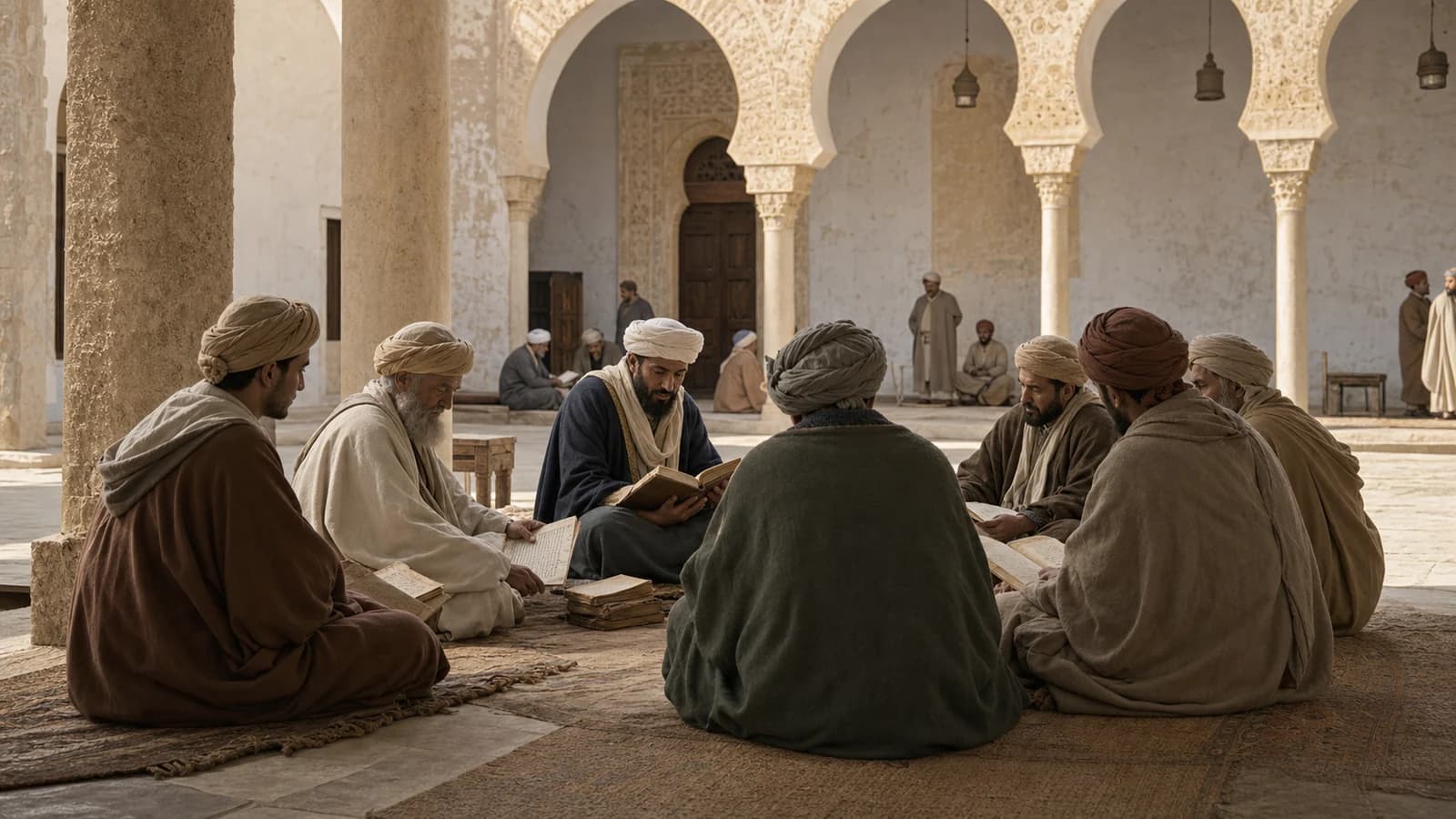
The Zaytuna Mosque is famous for its historical role in education, though it is inaccurate to describe it as an uninterrupted modern university from one founding date. Instead, learning at the Zaytuna took place through informal teaching circles, where scholars gathered around specific pillars in the prayer hall to lecture on theology, law, and grammar. Students traveled from across the region to attend these sessions.
This educational system relied on the transmission of authoritative texts. Rather than receiving a modern degree from a centralized faculty system, a student earned an authorization directly from an individual teacher, certifying their competence to teach a specific text. This personalized, text-based system of learning was deeply embedded in the daily religious life of the mosque, utilizing its spaces for study, lessons, and copying.
Hafsid, Ottoman, and Modern Interventions
The architectural history of the Zaytuna is further complicated by major interventions under subsequent dynasties. During the Hafsid period, rulers added to the complex, reinforcing the mosque's status as an intellectual center. In the Ottoman era, builders modified the structure, introducing new decorative styles that contrasted with the older Aghlabid elements.
In the modern era, restoration campaigns have attempted to stabilize the building while balancing the needs of a living place of worship with historical preservation. These successive interventions complicate any one-period reconstruction. Consequently, modern visitors and historians must carefully analyze the physical fabric to distinguish between genuine medieval masonry, later additions, and modern reconstructions.
Evidence-Reading Checklist
- Locate the physical boundaries where the mosque walls meet the surrounding market streets.
- Examine the reused columns in the hypostyle prayer hall to identify signs of older craftsmanship.
- Analyze the architectural differences resulting from successive Hafsid, Ottoman, and modern interventions.
- Identify how the physical layout supported teaching circles and textual transmission rather than a modern faculty system.
In conclusion, the Zaytuna Mosque remains a vital monument of Tunis, illustrating how religious architecture, urban commerce, and traditional systems of learning evolved together over many centuries.
The cover image is an original AI-assisted historical reconstruction, not a photograph of a specific Zaytuna lesson or a measured reconstruction of one building phase.
Sources
- Tunisia Heritage Agency: Az-Zaytuna Mosque — official architectural history.
- UNESCO World Heritage Centre: Medina of Tunis — urban and heritage context.
- Tunis Afrique Presse: Zaytuna Heritage Register — living institution and recent documentation.
Related reading
- The Great Mosque of Kairouan explained
- How ijaza documented scholarly transmission


