Why the Baptistère de Saint Louis Is a Mamluk Basin
What the Louvre basin signed by Muhammad ibn al-Zayn reveals about Mamluk metalwork, its debated patron and function, and its later use in French royal baptisms.
The answer in one evidence table
| Question | What the evidence supports | What remains uncertain |
|---|---|---|
| What is it? | A large Mamluk copper-alloy or brass basin with precious-metal inlay | The exact name used for it by its first owner |
| When was it made? | Usually dated about 1320–1340 | A single workshop year is not inscribed |
| Where was it made? | Egypt or Syria under Mamluk rule | No secure city or excavated workshop is known |
| Who made it? | Muhammad ibn al-Zayn, named in repeated signatures | How his workshop was organized and who assisted him |
| Who ordered it? | Probably an elite patron in a courtly setting | No unambiguous owner or patron is named |
| Was it Saint Louis’s? | No; the basin postdates Louis IX | Its route from the Mamluk world to France is incomplete |
What the Louvre object physically is
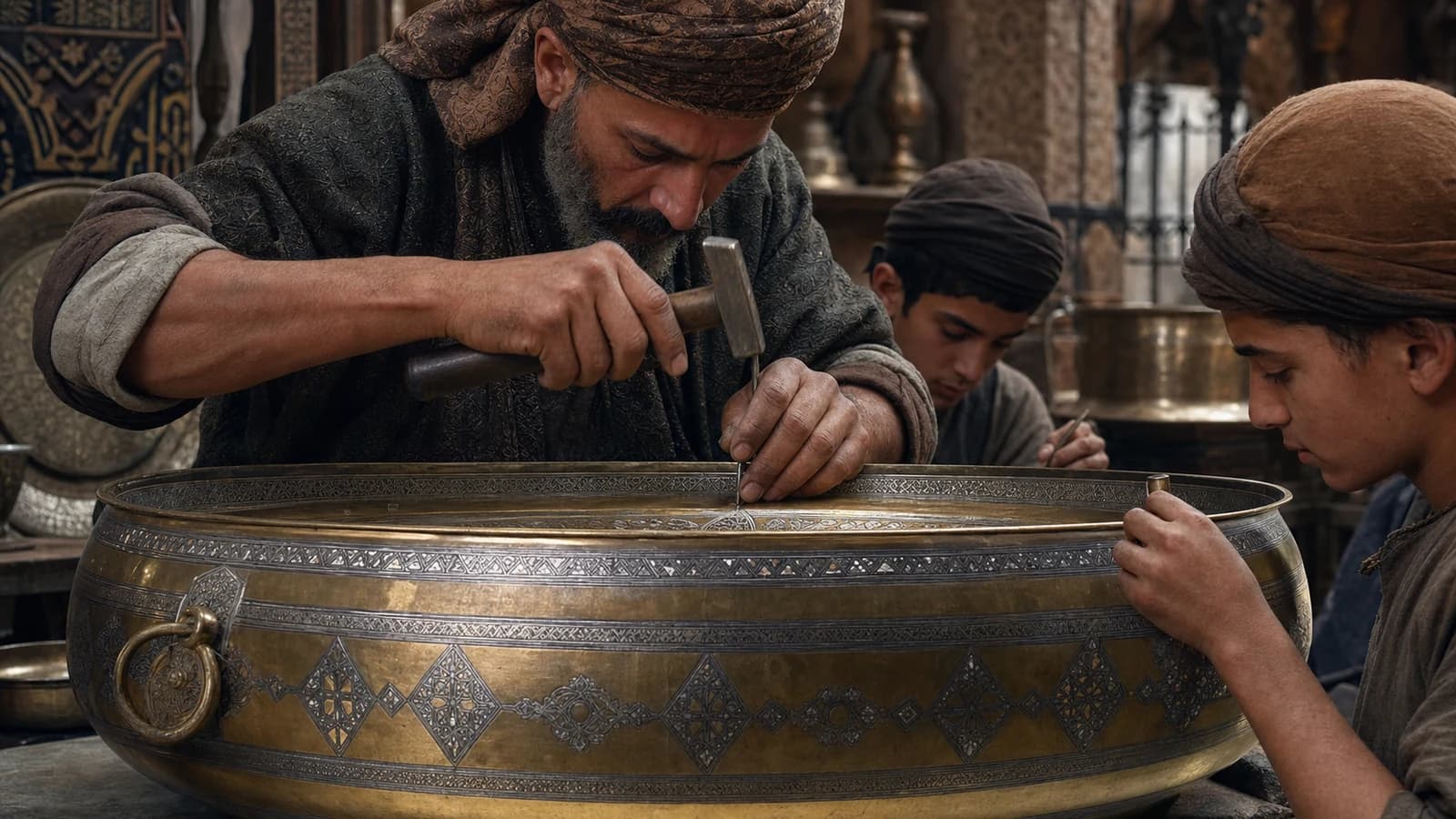
The Louvre catalogues the vessel at roughly half a metre across and a little over twenty centimetres high. It was raised or hammered from metal and then densely engraved. Recesses in the brass received sheets or wires of precious metal, while a black material sharpened the contrast around figures, animals, inscriptions and plant forms. The result was not a solid gold or silver bowl. It was an engineered surface in which colour, line and reflected light made base metal look exceptionally rich.
Material vocabulary needs care. Older descriptions may call the object bronze, while museum records describe a copper alloy or brass. Dark inlay has also been labelled niello, bitumen or black compound in different publications. Those terms do not all name the same recipe. The safest description follows the current object record and distinguishes what can be seen from what would require scientific identification of surviving material.
Muhammad ibn al-Zayn and the repeated signatures
The strongest evidence for authorship is on the basin itself. In several places, an Arabic signature identifies the work of the master Muhammad ibn al-Zayn. This is more secure than assigning the vessel to an anonymous national “school” from style alone. The word translated as master indicates claimed professional standing, but the signature does not provide a biography, a city of birth or a complete list of workshop members.
Scholars have connected Muhammad ibn al-Zayn with another signed bowl and have debated whether similarly named work in other materials belongs to the same person. Such comparisons are useful, yet a repeated name is not automatically proof that every object came from one hand. For this basin, the signatures securely anchor the maker’s name; the wider career remains a reconstruction from a small surviving corpus.
How Mamluk brass inlay was made
Mamluk metalworkers inherited and transformed techniques that had flourished in northern Iraq, Syria and Egypt. A vessel was shaped, its design was cut into the surface, and precious metal was inserted and burnished into prepared channels or recesses. Chasing could add texture and sharpen contours. Because silver and gold could later be removed, surviving vessels often preserve only traces of their original brilliance. The Baptistère retains enough to show why such work ranked among the most prestigious courtly objects.
Comparable early-fourteenth-century basins in the British Museum and the Metropolitan Museum of Art show that this was a recognizable luxury category rather than an isolated technical miracle. Large basins combined inscriptions, medallions, floral patterns, animals and water-related imagery. Comparison helps identify a Mamluk visual and material context, but it does not prove that two vessels had the same patron, workshop or function.
What the exterior scenes show
The exterior is organized in bands and medallions filled with riders, armed figures, attendants, animals and courtly activity. Clothing, weapons and emblems have encouraged attempts to identify specific offices, ethnic groups or historical events. The imagery certainly participates in a world of elite hunting, ceremony and military display. It turns the basin into a statement about organized power as well as a useful container.
Identifying every figure is much harder. No surviving caption names a battle or a complete cast. Scholars have proposed readings involving Mamluk officers, Mongols, Crusaders and particular patrons, but visual resemblance alone cannot close the question. A responsible description first records pose, dress, equipment and placement, then labels any historical identification as an interpretation rather than an inscriptional fact.
Fish, water and the view inside the basin
The interior includes aquatic imagery that would interact with water placed in the vessel. Fish and other creatures form part of a larger decorative program, while figures and animals continue around the inner surface. The location matters: a motif at the bottom changes as water reflects light or as the level rises and falls. The basin was designed to be viewed from above as well as from the side.
Aquatic decoration supports a water-related use, but it does not by itself identify one ceremony. A comparable Mamluk basin in the British Museum is described as a prestigious washing vessel, and contemporary evidence also permits other occasional uses for large basins. The safest conclusion is that this object belonged to elite service and display; “hand-washing basin” is plausible, while a uniquely specified original ritual is not securely documented.
Why the original patron is still debated
Many Mamluk luxury objects praise or name a ruler and display blazons associated with offices. This basin is lavish enough for an exceptionally high-status commission, yet it does not preserve a straightforward dedicatory statement naming its owner. That absence has driven competing patronage theories. Scholars compare costumes, heraldic signs, inscriptions, stylistic groups and the political careers of possible patrons.
The method is cumulative rather than decisive. A blazon may indicate rank without identifying one person; an image can evoke a social group without functioning as a portrait; a date range can overlap several reigns. The best catalogue answer therefore keeps “Egypt or Syria, about 1320–1340” separate from more specific hypotheses. Uncertainty is not a failure of research. It is the accurate result when a signed maker and an unsigned patron occupy different evidentiary positions.
Why it cannot have belonged to Saint Louis
Louis IX of France, later canonized as Saint Louis, died in 1270. The Louvre basin is normally dated at least half a century later. That chronological mismatch is enough to reject the idea that it was made for him or used at his own baptism. The traditional label describes a later French association, not the original object.
This correction matters because names steer interpretation. Calling the vessel a baptistery can make the Christian afterlife seem original and the Mamluk manufacture secondary. Calling it first a basin signed by Muhammad ibn al-Zayn reverses that distortion. The common name may still be retained so readers can find the object, provided the article immediately explains why it is historically misleading.
How the basin entered French royal ritual
The route from a fourteenth-century Mamluk workshop to France is not fully recorded. The object later appeared in the treasury of the Sainte-Chapelle at Vincennes and acquired a role in royal baptisms. Smarthistory notes that French monarchs used it intermittently as a baptismal font through the nineteenth century before it entered permanent museum display. This is reuse, not evidence of its first purpose.
Objects often cross religious and political settings without keeping their initial names. A courtly Islamic vessel could be valued for precious material, workmanship, exotic prestige or an association invented after arrival. Its French use is an important part of the biography, but it should be dated as a later layer. The related guide to Mosul inlaid metalwork and its mobile style shows how techniques and vessels moved well beyond a single city.
What Christian reuse does and does not prove
Later baptismal use proves that the basin was physically present and meaningful in a Christian royal context. It does not prove that its figures were designed as Christian images, that its Arabic inscriptions were understood by every French custodian or that its original owner intended export. Likewise, preservation in a treasury is not a transparent record of how it arrived there. Gifts, trade, diplomatic exchange, booty and collecting are different mechanisms and require different evidence.
The larger history of Mamluk metalwork makes European circulation unsurprising. The Met documents trade in inlaid vessels between Mamluk lands and Venice, including pieces made for export or later installed in European elite and church collections. That general pattern establishes possibility, not the exact journey of this basin. A route should not be filled with an attractive story where the documentation is silent.
How to read the basin without overclaiming
- Start with the inventory record. Record the Louvre number, dimensions, material and current date range.
- Separate inscription from interpretation. The maker’s signatures are textual evidence; an identification of a rider is a scholarly proposal.
- Compare objects by feature. Material, construction, inlay, form and motif are stronger than a vague claim that two pieces “look Islamic.”
- Date each biography layer. Mamluk manufacture, movement to France, treasury use, royal baptism and museum display did not happen at once.
- Do not convert absence into certainty. An unnamed patron is not permission to select whichever ruler best fits a dramatic narrative.
- Use the image as evidence carefully. Lighting, restored inlay, camera angle and digital contrast affect what viewers think they see.
Why this object matters for Mamluk history
The basin preserves the name of a Muslim artisan, a sophisticated metalworking process and an unusually dense figurative program from the Mamluk world. It also demonstrates that elite Islamic art cannot be reduced to a prohibition on images. Courtly figures, hunters, animals, inscriptions and ornament could coexist on a prestigious vessel, while their meaning depended on location, patronage and use.
Its later history shows why provenance and naming are part of interpretation. The object was not frozen when it left Egypt or Syria. It entered new institutions, served another ritual and received a name that displaced its chronology. Reading both lives together gives a stronger history than claiming the basin exclusively for either a Mamluk court or French monarchy. For the political setting of the period, see the documented account of the Battle of Ain Jalut and the early Mamluk Sultanate.
Related reading
- Mosul inlaid metalwork — how brass, silver and workshop styles travelled across regions.
- Mamluk mosque lamps — another material tradition best read through construction, inscription and use.
- The Battle of Ain Jalut — political chronology for the rise of Mamluk power.
- Islamic history timeline — place the basin’s date within a broader regional chronology.
Related Muslim Post guides
- People and Animals in Islamic Art: What Museum Objects Show
- Arabesque Art Explained: Leaves, Scrolls and Repeating Patterns
- Islamic Geometric Patterns: Compass, Grids and Star Polygons
Sources
Each source is annotated for the claim it supports. The Louvre record controls object-specific facts; comparative museum objects establish the wider Mamluk metalwork category; academic studies document interpretive debates; and the reframing essay separates original manufacture from later European use.
- Louvre Collections — Basin Called the Baptistère de Saint Louis — primary museum record for inventory identity, date range, materials, dimensions, signatures, bibliography and exhibition history.
- Musée du Louvre — Une icône ambiguë — current curatorial account of the basin as an ambiguous icon, including attribution, technique and the limits of patron identification.
- Musée du Louvre — Mamluks educational dossier — used for the metal-inlay process, visual program, Mamluk context and the object’s later French biography.
- Bulletin of SOAS — The Blazons of the “Baptistere de Saint Louis” — foundational scholarly analysis of signatures, blazons, court scenes and the problem of an unnamed owner.
- Smarthistory — Framing Islamic Art — supports the chronology that excludes Louis IX and explains the basin’s later intermittent use in French royal baptisms.
- Metropolitan Museum of Art — Early-fourteenth-century Mamluk basin — comparative object for basin form, brass and silver inlay, inscriptions, medallions and elite production.
- British Museum — Basin made for Sultan al-Nasir Muhammad — comparative evidence for prestigious large Mamluk basins, precious-metal inlay, washing and other documented uses.
- Metropolitan Museum of Art — Venice’s Muslim trading partners — establishes the wider Mediterranean circulation and European reuse of Mamluk inlaid metalwork without claiming a specific route for this basin.


