Mamluk Mosque Lamps: How Enameled Glass Held and Shaped Light
How Mamluk glassmakers blew, enameled, gilded and suspended mosque lamps—and how an inner oil-and-water vessel with a floating wick produced light.
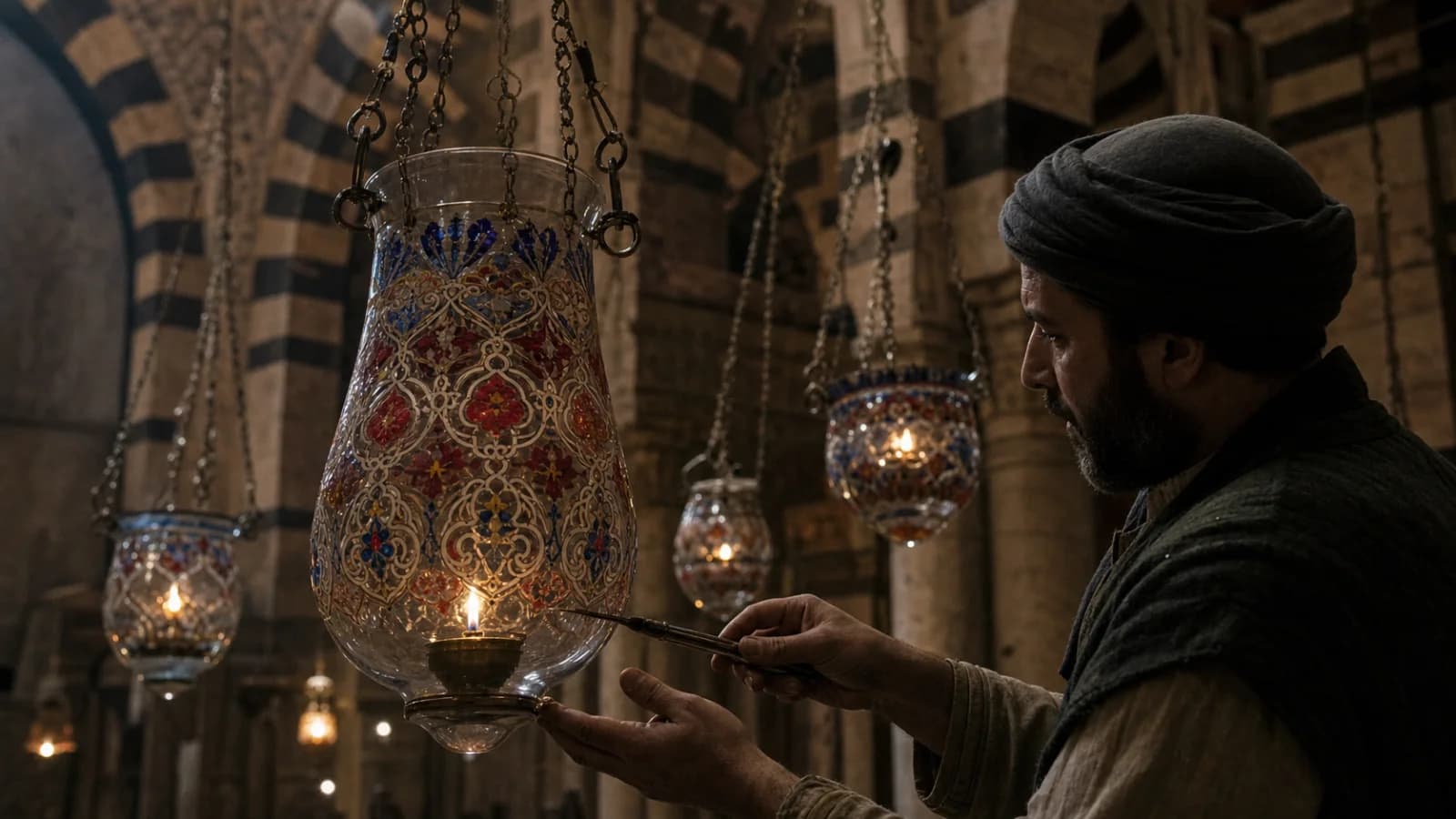
Rows of suspended glass vessels once gave Mamluk mosques, madrasas and mausoleums a field of small, flickering lights. The finest fourteenth-century examples from Egypt and Syria have a bulbous body, flaring neck, foot and applied handles for chains. Their enamel and gilding carried inscriptions, heraldic emblems and vegetal decoration. Although museums call the entire object a mosque lamp, the decorated outer vessel often functioned as a luminous holder for a smaller oil lamp.
This article uses an original AI-assisted visual reconstruction for educational context. It is not a photograph of a specific mosque interior or surviving Mamluk lamp.
From furnace to suspended vessel
A glassmaker gathered molten glass, blew the main body and shaped the neck and foot. Handles were applied while the material remained hot. After cooling, painters added colored glass enamels and gold with a brush or reed pen. Refiring fused the enamel to the surface, but colors matured at different temperatures, so an ambitious scheme required precise control and could demand repeated heating.
Chains attached through the glass loops and often to a metal suspension ring. Within the large shade sat a smaller saucer or container holding oil, water and a floating cotton wick. The wick drew oil at the surface; when the oil was consumed, water could help extinguish the flame. This arrangement protected the decorated outer glass from serving as a full fuel reservoir and located the light where it could make gold and enamel shimmer.
Light, patronage and inscription
Many lamps bear Qur’anic text associated with light, dedicatory inscriptions, a ruler’s or amir’s titles, and emblems connected with court office. Such content tied a practical furnishing to piety, patronage and public memory. A donor who endowed a religious complex could order groups of related lamps, turning repeated names and symbols into an architectural ensemble.
The light level should not be romanticized as modern brightness. Each wick produced a modest flame and needed fuel, cleaning and trimming. Many lamps together made circulation and recitation possible after dark while creating atmosphere. Soot, broken suspension parts and thermal stress were constant maintenance concerns. Their fragility helps explain why complete groups rarely survive in place.
Original, restoration or revival?
Mamluk glass became highly fashionable among nineteenth-century European collectors, and workshops made convincing copies and interpretations. Some museum lamps combine older and later components or have been heavily restored. Date cannot be decided from an “Islamic-looking” inscription alone. Curators compare glass composition, enamels, handle construction, wear, old repairs and documented ownership.
Look through the vessel rather than only at its painted surface. The foot, chain loops and interior fittings reveal how it worked; the enamel reveals how flame would activate the design. A mosque lamp is therefore both furnishing and image: a carefully engineered support that made material light participate in a larger religious space.


