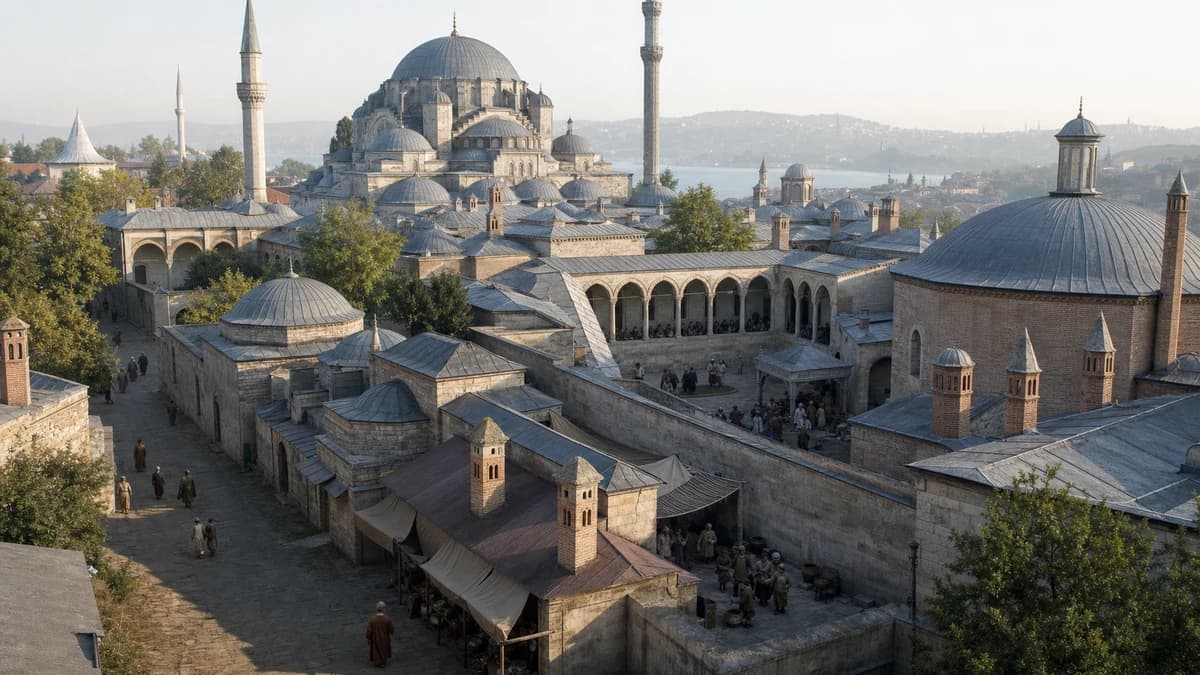
Ottoman Külliye: Mosque, School, Hospital and Soup Kitchen
What an Ottoman külliye contained, how endowment income linked worship to education and welfare, and why every complex had a different program.
An Ottoman külliye is a group of buildings organized around a major religious foundation, often but not always centered on a mosque. A complex might join worship with teaching, food distribution, health care, lodging, bathing, water supply and commercial income. The term names an institutional ensemble, not one fixed checklist.
The cover image is an original AI-assisted urban reconstruction, not a photograph or measured plan of a specific külliye.
A mosque could anchor a wider public institution
The Süleymaniye complex in Istanbul is the best-known imperial example. Around Sinan’s monumental mosque stood madrasas, a hospital, soup kitchen, hospice, bath and other facilities. Atik Valide combined a mosque with advanced teaching, a hospital, a Sufi lodge, an imaret and traveler accommodation. Bayezid II’s complex at Amasya had its own program, including a madrasa, soup kitchen, library and timekeeper’s room.
These differences matter. A small provincial foundation should not be described as if it contained every service found at an imperial capital. Surviving buildings may also represent only part of the original ensemble.
Endowment turned buildings into an operating system
A waqf could dedicate shops, farms, baths or other revenue-producing property to salaries, food, fuel, water, repair and teaching. Architecture alone did not feed students or maintain a hospital. Income, staff, legal administration and routine provisioning made the complex function.
The arrangement also shaped the city. Shops and caravanserais could face busy streets; quieter courts served study or residence; kitchens needed service access; the mosque claimed a prominent skyline. Topography and existing neighborhoods often forced an irregular plan even when individual buildings were strongly symmetrical.
Patronage, memory and public benefit
Sultans, royal women, officials and other patrons used külliyes to provide services and express political legitimacy. Tombs tied a founder’s memory to continuing prayer and charity. Monumentality therefore had several audiences: worshippers, students, travelers, employees, recipients of food and residents who encountered the complex daily.
Calling the külliye a modern “campus” is useful only as a rough comparison. Its legal basis, devotional purpose, household patronage and integration with premodern urban economy were different from a contemporary university or civic center.
How to read a külliye
- Identify which buildings survive and which are known only from records.
- Map public, residential, service and revenue-producing zones.
- Read the waqf deed when available to connect rooms with staff and budgets.
- Trace rebuilding, demolition and new uses before assuming the present plan is original.
The külliye’s real achievement was coordination. It joined architecture, finance and daily service so that a foundation could remain active beyond the lifetime of its patron.
Sources
- Archnet: Süleymaniye Külliyesi — the imperial complex and its institutional program.
- Archnet: Atik Valide Külliyesi — teaching, health, lodging and food-service buildings.
- Archnet: II. Bayezid Külliyesi, Amasya — a distinct provincial arrangement and building list.


