Who Ate at Ottoman Imarets and How Waqf Kitchens Worked
How Ottoman imarets turned waqf income into meals, who received food, what surviving deeds and registers reveal, and why one kitchen's menu cannot stand for all.
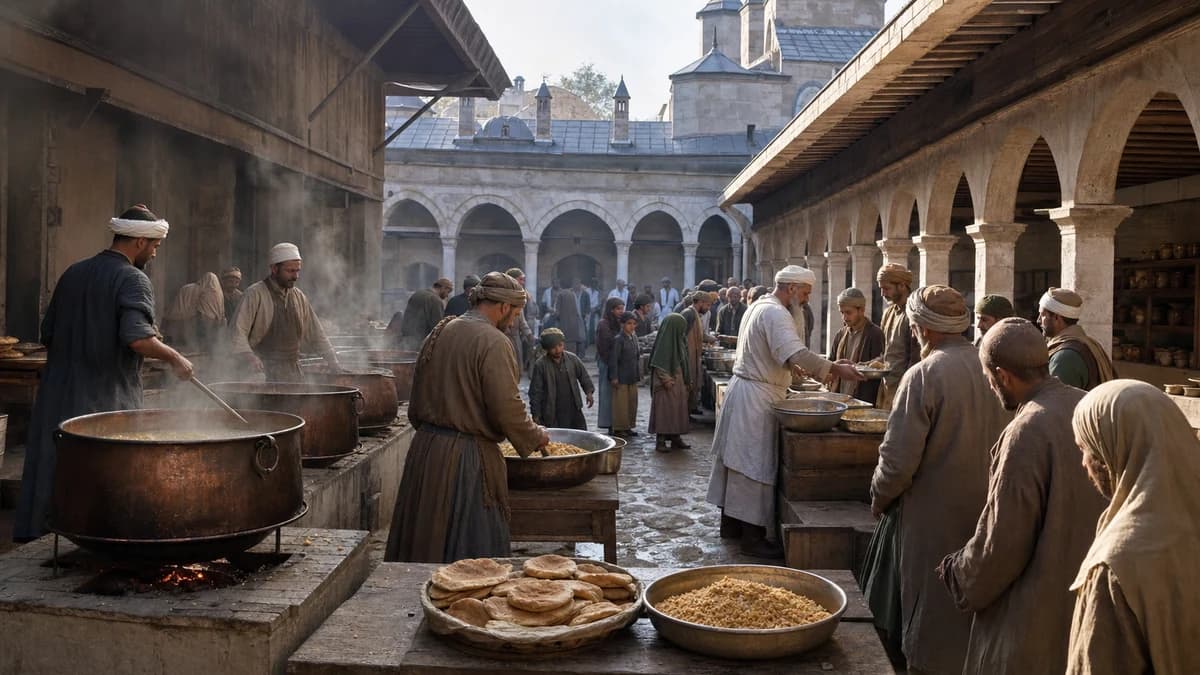
The most useful evidence is specific. A foundation deed tells us what a patron ordered; a recipient register records named beneficiaries at a later date; a surviving building shows how service was arranged in space. None of these alone proves that every Ottoman imaret served the same food to everyone. The cover image on this page is an educational historical reconstruction, not a photograph of an identified imaret or a record of its menu.
What did “imaret” mean in an Ottoman source?
The word has more than one historical use. Zeynep Tarım Ertuğ’s TDV İslâm Ansiklopedisi entry explains that an inscription or administrative record may use imaret for a charitable building or even a group of buildings, while another text uses it specifically for the place where meals were cooked and handed out. A traveler reading of an “imaret” therefore needs to ask whether the source describes a building group, an individual kitchen or its feeding service.
The narrower sense became closely associated with public kitchens in Ottoman towns. “Soup kitchen” is a practical translation, but it should not imply that all meals were soup or that every recipient was destitute. The same endowed site could include a mosque, madrasa, hospice and rooms for travelers. Our guide to the Ottoman külliye describes that larger architectural arrangement; here the question is how one part of it turned resources into repeated meals.
This distinction protects against a common category error. A donor might endow an impressive mosque and its adjacent buildings, but their construction date, architectural plan and later use do not themselves tell us the daily number of meals. For that we need the foundation’s rules and, if they survive, records of food purchases and distribution. The meaning of the word, the purpose of the building and the evidence for daily operation are related questions, not interchangeable answers.
How did a waqf keep a kitchen running?
A large cooking room was only the visible part of the institution. Grain, meat, fuel, wages, utensils and repairs required recurring income. The Turkish Directorate General of Foundations’ historical account describes shops, markets, gardens, fields and other income-bearing property assigned to charitable services. A founder could specify in a vakfiye or waqf deed which activities the revenue should support and who would administer them. Our separate waqfiyya guide explains how a deed joins property to obligations.
Hatice Büşra Kürk’s 2024 Middle East Technical University thesis compares the imaret provisions of 32 published endowment deeds dating from the fourteenth century through Mehmed II’s reign. It studies intended recipients, ingredient quantities and menus. That corpus is especially valuable because it tests whether the provisions of one famous royal kitchen were typical of other foundations. Its limit is equally important: a founding deed is a plan for service, not a continuous diary proving that each purchase and serving happened exactly as ordered decades later.
Managers had to buy food, receive deliveries, supervise staff and keep the endowed property productive. A failed harvest, a price change or a dispute over income could affect service, even if the founding rule stayed on paper. The economic chain was therefore more than “a wealthy patron gave away bread”: designated property produced income, administrators directed that income, workers prepared meals, and eligible people received them. Each step may leave a different kind of historical record.
What work happened between storehouse and serving place?
Cooking for a stream of students and travelers required storage, ovens or hearths, water, vessels, fuel access and people to prepare and carry food. The Archnet record for the Atik Valide Külliyesi in Istanbul describes a kitchen with an associated hospice and caravanserai as part of a much larger site that also held educational and medical buildings. It is a specific architectural example, commissioned for Nurbanu Sultan under Selim II and completed under Murad III, rather than a universal floor plan for all imarets.
An architectural record can reveal how different activities were placed in relation to one another. It cannot show what every guest actually ate on an ordinary Tuesday. Conversely, a food account can record ingredients without telling us whether a building’s visible stonework belonged to its first phase or a later repair. A careful reconstruction uses both kinds of evidence and keeps their limits visible.
The TDV imaret entry cites the Fatih foundation’s records for a detailed staff list: cooks and bakers worked alongside a steward, storekeeper, grain cleaners, porters, cleaners and other workers. Even if one does not reproduce every historical job title, this list makes a material point. The service depended on purchasing, storing, preparing, baking, washing and distribution. It was a labor system supported by endowed revenue, not a ceremonial pot placed beside a mosque.
What food does the Fatih foundation actually document?
The same TDV entry presents the Fatih kitchen as a concrete menu case. It describes twice-daily food, typically rice soup in the morning and a wheat preparation in the evening, with meat among the provisions. It also records different offerings on Fridays and other occasions, including rice dishes and sweet preparations. These details are drawn from named Fatih foundation material and related historical scholarship, not from a generic claim about “Ottoman cuisine.”
The distinctions within that account matter. An ingredient specified for a day is not automatically an ingredient in every recipient’s bowl. The presence of honey, dried fruit or meat in a purchase list does not license a claim that each guest received an identical feast. Daily staples and special-day dishes should be described separately. A menu from one Istanbul kitchen cannot be projected onto a smaller one in Anatolia or a foundation in Jerusalem.
The translated label “soup kitchen” can therefore hide how varied the food was. It is useful for the institution’s function—providing prepared food—while the actual dishes need a site and document. To test a menu claim, a reader should ask: which foundation, which year, which deed or account, which meal, and which recipient group? If those details are missing, a colorful description may be a modern reconstruction rather than a record.
Who was entitled to eat?
The answer depended on the founder’s rules and the institution’s purpose. Students and teachers attached to a madrasa, employees of an endowed site, guests and travelers, dervishes, and local people in need could all appear among beneficiaries. Amy Singer’s study of Hürrem Sultan’s imperial kitchen in Jerusalem identifies travelers, scholars, pious mystics and local indigents as different groups served by an imaret. A Jerusalem foundation was also part of Ottoman provisioning policy and of the relationship between imperial patrons and local people.
Those groups should not be collapsed into a modern image of an undifferentiated queue of the poorest residents. A student might receive food as part of an endowed educational place; a worker might be fed while carrying out duties; a traveler might be entitled to hospitality for a limited stay; a person without income might be supported because the deed named that category. Historical charity could meet material needs and express a patron’s authority at the same time.
The social setting was neither uniform nor static. A royal foundation, a provincial institution and a small independent kitchen had different resources and constituencies. Even within one institution, recorded rules might distinguish kinds or amounts of food. That variation is a reason to identify the named kitchen before claiming who “the Ottomans” fed. It also makes the sources more useful: they let us ask how a rule was applied in a particular place instead of repeating a pleasing generality.
What changed when a 1538 recipient register survived?
Mehmet İnbaşı’s 2026 study of a 1538 Yavuz Sultan Selim foundation register offers a different sort of evidence from a founding deed. The document records people who benefited from meals at the imaret attached to Selim’s memorial foundation in Istanbul. The article reports widows, their daughters and orphans among them, alongside dervishes, religious figures, poets and people who obtained meals through the intercession of officials. It specifically names the poets Zâti and Basirî.
A register of named recipients is powerful because it shows more than the categories a founder intended. It still has boundaries: it describes the people and arrangement captured by that particular surviving document, not everyone who ever ate at every Ottoman kitchen. The author’s analysis also separates those visibly in need from others who gained access through social connections. That mixture makes “only the poor ate there” inaccurate for this recorded case.
The register also shows why women should not disappear from an account of the institution. Widows and daughters are visible in this source as recipients, rather than being inferred from a general statement about family charity. Where the document does not give a complete biography or household budget, we should not invent one. Its contribution is the presence and named relationship of beneficiaries at a known date.
Why did rulers and households sponsor imarets?
Endowing a kitchen could relieve hunger, supply a school or pilgrimage setting, honor a deceased relative and make a patron’s care visible in a city. İnbaşı explains the memorial purpose of the Yavuz Sultan Selim foundation built by his son Süleyman. Singer’s Jerusalem case centers Hürrem Sultan, Süleyman’s wife, and shows how a woman of the dynasty could sponsor a lasting institution that linked imperial and local economies. These are documented cases, not a claim that every donor acted from one motive.
An endowment was also a commitment to continuing administration. Patrons named property and service obligations; later staff and managers had to translate them into food. The resulting meals could both help recipients and display status. Historical evidence does not force a choice between benevolence and politics. It asks us to identify who paid, who governed, who ate and who benefited from the public reputation of feeding others.
The question connects to a wider issue in Ottoman history: institutions changed as revenues, urban populations and state priorities changed. Our article on Ottoman transformation after Süleyman cautions against treating a later alteration as proof that every sixteenth-century foundation immediately “declined.” An imaret should be followed across dated records rather than assigned a single rise-and-fall story from its first deed.
How can a reader check a claim about one imaret?
Start with a named place and a dated source. A foundation deed establishes a prescribed service; a recipient register identifies people recorded at a particular moment; accounts can reveal purchases and costs; an architectural survey describes physical space. None is interchangeable with a picture of a modern kitchen. Compare at least two types where possible, and record whose interpretation connects them.
For example, a statement that the Fatih kitchen served a particular dish should point to its specific deed or a scholarly treatment of that record. A statement that widows received meals at the Yavuz Sultan Selim foundation should point to the 1538 register study. A statement about the Atik Valide building’s relation to a hospice should point to the architectural record. A statement about Hürrem Sultan’s Jerusalem foundation should not silently migrate to a different city.
It also helps to distinguish an imaret from another endowed service. The al-Mansuri hospital in Cairo shows how a waqf could support medical care in a different time and region. The comparison illuminates the funding mechanism; it does not make a hospital and an Ottoman feeding kitchen the same institution. The most trustworthy history preserves both the shared tool and the local differences.
Does the word describe today’s kitchens too?
Yes, but modern use is a separate question. Türkiye’s Directorate General of Foundations describes its present-day soup-kitchen service, including current eligibility and application procedures. This demonstrates that the language and charitable service continue in an administrative setting. Its present rules are not evidence of who qualified under a sixteenth-century deed, what a Fatih guest ate, or how Hürrem Sultan’s Jerusalem kitchen was staffed.
The surviving historical record supports a precise answer. Ottoman imarets were funded feeding institutions whose users and meals were set by particular foundations and shaped by actual administration. Their buildings, deeds, menus and registers each reveal a different part of the system. The strongest account names the site and document before describing the meal.
Sources
- Zeynep Tarım Ertuğ, “İmaret,” TDV İslâm Ansiklopedisi — explains the word’s broad and narrow historical uses and reproduces details from Fatih and other foundation material on staff, meal times and dishes. Its examples are site-specific.
- Hatice Büşra Kürk, Imarets in the Ottoman Empire from the 14th Century to the End of the Fatih Era Based on Waqfiyyas, METU, 2024 — comparative study of 32 endowment deeds; supports discussion of founders’ stipulated recipients and menus, not a claim that all rules were always fulfilled.
- Mehmet İnbaşı, “The Imaret Notebook of the Yavuz Sultan Selim Foundation, Dated 1538,” 2026 — archival analysis of a named recipient register; supports the examples of widows, children, poets, dervishes and mediated access at that institution.
- Archnet, Atik Valide Külliyesi — architectural and historical record for the relation of kitchen, hospice and caravanserai within a particular Istanbul site; it is not a menu record.
- Amy Singer, Constructing Ottoman Beneficence, listed by Princeton University — research summary of Hürrem Sultan’s Jerusalem waqf, its beneficiaries, and its imperial and local setting; the page summarizes a book rather than reproducing every underlying ledger.
- T.R. Directorate General of Foundations, “Foundations in History” — institutional account of income-bearing endowed property and continuing charitable services; historical claims above are also checked against the specialist sources.
- T.R. Directorate General of Foundations, “Soup Kitchen Service” — current administrative service only, included to distinguish modern eligibility from Ottoman historical practice.


