Maqam Ibrahim at the Kaaba and the Prayer After Tawaf
What is Maqam Ibrahim, where is it, and why do pilgrims pray after tawaf? Read the Quran passages, Jabir's report and guidance for crowded visits.
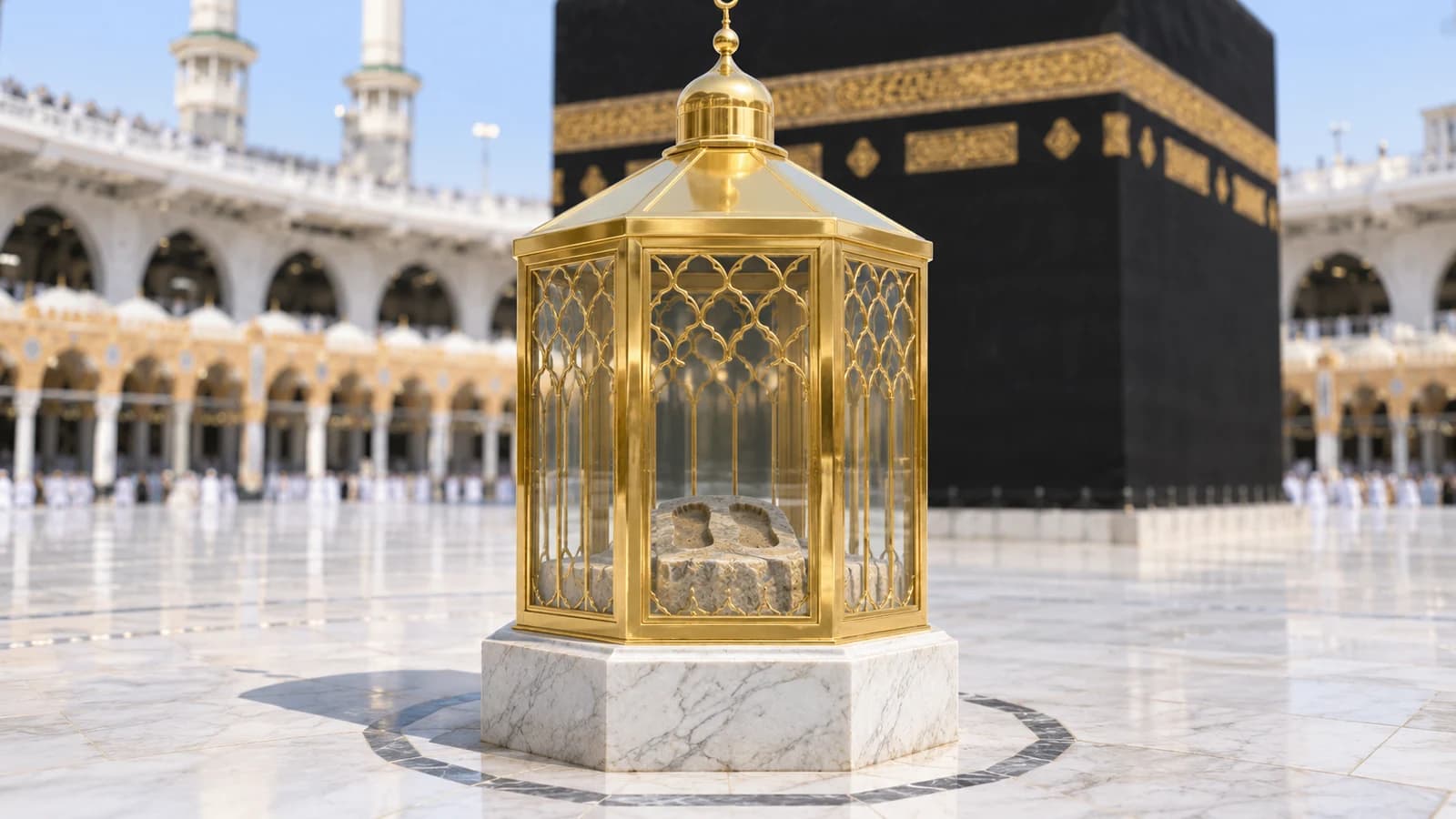
Maqam Ibrahim, or the Station of Abraham, is the stone near the Kaaba on which Ibrahim is reported to have stood while building the Sacred House with his son Ismail. It is protected by a transparent enclosure in the Grand Mosque in Makkah. The Quran names the Station twice, and Jabir's account of the Prophet Muhammad's Hajj describes approaching the Station after tawaf and praying with the Station between him and the Kaaba. A pilgrim who recognizes the enclosure can understand that connection without joining the crowd immediately around it.
Where Maqam Ibrahim is and how to recognize it
Look for a small, freestanding enclosure on the eastern side of the Kaaba, in front of the Kaaba door and out in the mataf, the open area used for circumambulation. The shelter lets visitors see the stone it protects. In a wide photograph, find the wall and door of the Kaaba first, then look out into the courtyard for the enclosure. A close-up may show the structure in greater detail, but the wide view shows where the enclosure sits relative to the flow of pilgrims. Our guide to the Kaaba's location and features gives the broader orientation.
The Saudi Ministry of Hajj and Umrah's illustrated Grand Mosque guide has separate entries for the Black Stone and Abraham's Station. It describes two oval depressions in the Station's stone and shows the protective structure from different angles. The contemporary enclosure, the stone inside and the name used in scripture are encountered through different sources. For an image caption, identify which of these is actually visible.
The Black Stone is set into a corner of the Kaaba and marks the start and finish of each circuit. Maqam Ibrahim stands out in the courtyard. The Station is associated with the prayer after the circuits. If an image is cropped, the separate enclosure and the Kaaba wall are the simplest identification cues. The Black Stone guide explains the other landmark's place in tawaf.
What the Quran says about the Station of Abraham
Al-Baqarah 2:125 describes the House as a place to which people return and a sanctuary. In the same verse the Station of Abraham is named as a place of prayer. The verse continues with a charge to Ibrahim and Ismail to purify the House for those who circle it, stay for worship, bow and prostrate. Read the whole verse to see how the reference to the Station sits within a passage about shared worship at the House.
Ali Imran 3:97 names the Station among the clear signs associated with the House and speaks of pilgrimage as a duty for those able to undertake it. The preceding verse identifies the House at Bakkah. The two passages give a reader different points of entry. Al-Baqarah brings the Station and a place of prayer into the same verse. Ali Imran names the Station while discussing the sanctuary and pilgrimage.
English translations may say standing place, station or place where Abraham stood. Ibrahim and Abraham are names for the same prophet in this context. In a study group, write down the verse number alongside the translation. With those references, someone using a different translation can find the same passage even if their book spells Ibrahim differently or uses a different phrase for the Station. The verses give a useful starting point before reading the building account and the report about the Hajj.
Why the stone is linked to Ibrahim and Ismail
Al-Baqarah 2:127 describes Ibrahim and Ismail raising the foundations of the House and asking Allah to accept their work. The construction is there in the verse, which also records what they prayed. A reader interested in the building scene can follow that passage before turning to the more detailed narration in the hadith collection.
In Sahih al-Bukhari 3364, Ibn Abbas's narration describes Ismail bringing stones for Ibrahim. When the walls rose, Ismail brought a stone for Ibrahim to stand on while he continued building. The narration refers to the same supplication as 2:127. Islamic tradition identifies the depressions in the stone protected today with Ibrahim's footprints. This attribution, and the story of how the stone was used, help explain why a small object has such a recognizable name.
For a study note, label the verse, the building narration and the description of what is visible today. The verse supplies the account of the foundations and the prayer. The report supplies the detail of the standing stone. An illustrated guide shows the enclosure seen by today's visitors. Our reading guide to Ibrahim's story in the Quran places the construction passage alongside other episodes in his life.
What Jabir reports about the prayer after tawaf
In the account of the Prophet Muhammad's Hajj in Sahih Muslim 1218a, Jabir describes seven circuits of the Kaaba, the Prophet approaching the Station, and his recitation of the portion of 2:125 about taking it as a place of prayer. The report places the Station between the Prophet and the Kaaba and describes two rak'ahs, or two units of prayer. With the Station standing between them, the Prophet faced toward the House.
The account continues after the prayer and eventually takes the reader to Safa. That makes the prayer easy to place in a longer narrative. The circuits come first. Then comes the prayer connected with the Station. The later part of the report turns to Safa and Marwah, where sa'i is performed. For a first reading, mark the line where the Prophet goes to the Station and the line where he leaves for Safa. The space between them explains how the episode fits into the pilgrimage.
Nusuk's Hajj journey guide uses the same sequence when describing the arrival tawaf, explaining that pilgrims pray two rak'ahs behind Maqam Ibrahim when possible. In this context, a rak'ah is a unit of formal prayer. A reminder card can name the step as the prayer after tawaf and mention the Station as the reference point. This gives the person reading it both a place to recognize and an action to put in order.
Where to pray if the space behind the Station is busy
When there is room, the prayer may be offered behind the Station with the Kaaba in front. Ibn Baz's pilgrimage manual hosted by the Saudi Presidency of Religious Affairs says the two rak'ahs may be offered elsewhere in the mosque when it is impractical to pray behind the Station, for instance due to crowding. The Ministry's visitor guide also tells pilgrims to follow security officers' directions and take care to avoid harming or obstructing others.
Details of prayer placement can vary by religious authority and type of tawaf. For example, Ayatollah Ali al-Sistani's Hajj manual distinguishes the prayer for obligatory tawaf from the prayer for optional tawaf, with a sequence of alternatives for obligatory tawaf where the specified location is unavailable. Pilgrims who follow that guidance can review the relevant section with their group's religious guide before their visit. A question that identifies the type of tawaf and the space available gives the guide the information needed to answer.
In the courtyard, keep the moving route clear. Finish the circuits, follow the staff or signs out of the flow and look for a suitable place to pray. When a group is large, agree to regroup in an allowed area rather than asking everyone to wait in the passage around the enclosure. Those still walking need room to continue, and those praying need space around them. The step-by-step Umrah guide sets the prayer in the context of the full pilgrimage.
Why historic photographs can show a different enclosure
The structure around the stone has changed over time. The Diriyah Biennale Foundation's exhibition label documents an earlier stand-alone shelter called a maqsurah, with one part for prayer and another containing the stone. It describes the courtyard congestion that led to the shelter's removal and the use of a clear protective cover instead. A photograph of the older shelter and a photograph of the modern enclosure can both belong to the history of the Station.
The label dates the unveiling of the smaller protective structure with a gilded grille to October 1967, during King Faisal's reign. The Saudipedia conservation timeline also notes the 1967 change and describes later work on the metal structure and base under King Fahd. These accounts describe the ways the site was protected and presented. When using a museum view, read the object label before assuming it depicts the present courtyard arrangement. A photograph may show an earlier grille that has its own history.
For your first look at the site, the most useful reference is the Station's position in front of the Kaaba door. For study, use 2:125 and 3:97 for the Quranic references, Bukhari 3364 for the construction account, and Muslim 1218a for the prayer in Jabir's report. For an actual visit, keep the moving space around the Station open and use the mosque's directions to find a suitable place to pray. Each reference answers a question you are likely to have when the landmark appears on a map, in a reading or in the courtyard itself.